
Publication date: November 2, 2026
Market and news cutoff: November 1, 2026
Exchange-rate reference: USD/TWD spot selling rate 32.63
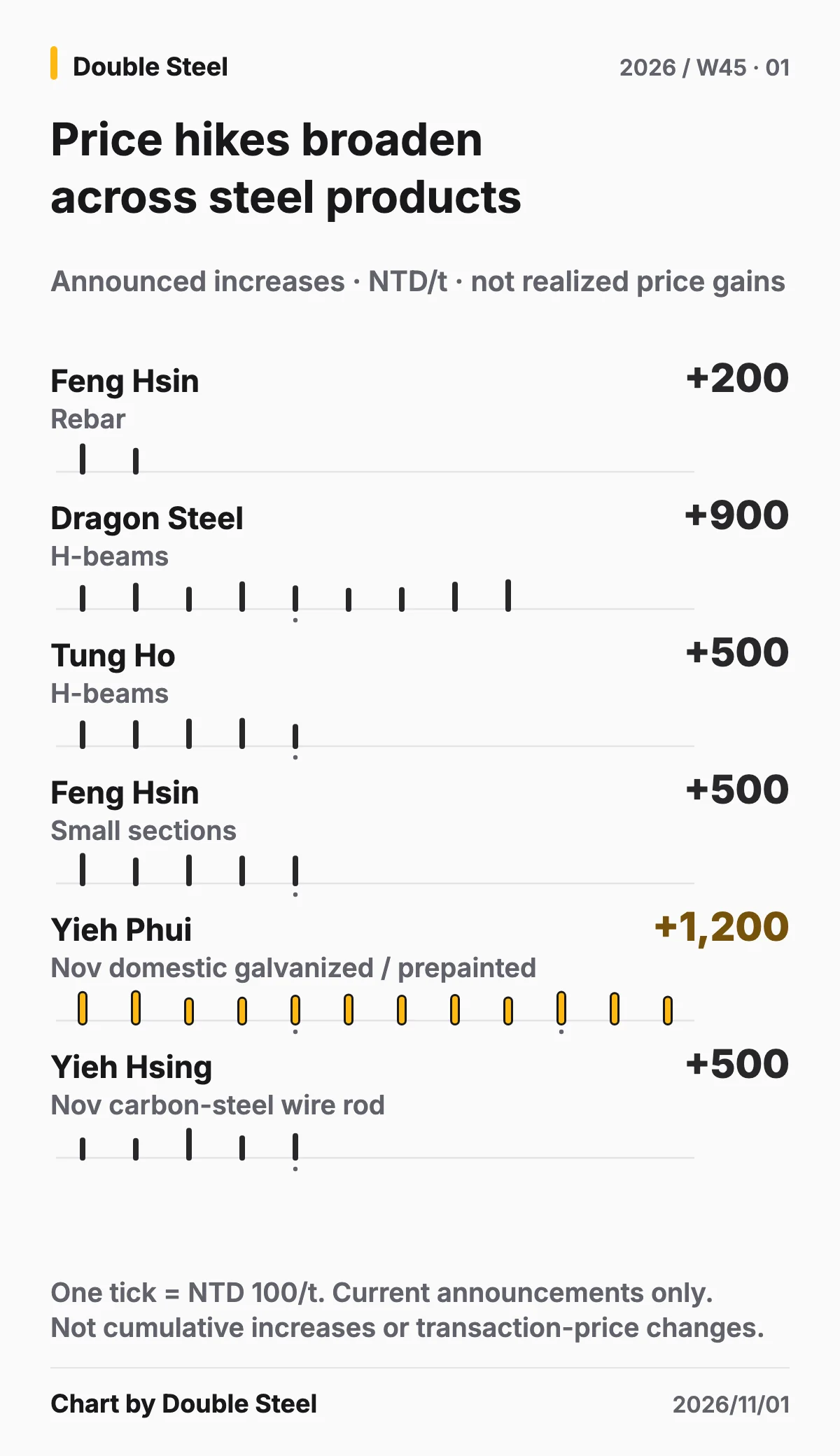
Mill price increases are spreading across more products, but the market's dividing line has shifted from whether prices have been raised to who can actually sell at the new levels. Taiwan's rebar mills booked bulk orders at low prices last week, while scrap procurement prices rose first. This week, Feng Hsin's rebar catch-up increase took effect, alongside new increases for Dragon Steel's and Tung Ho's H-beams and Yieh Phui's coated products. Suppliers are seeking to recover costs, but distributors still hold cheaper inventory. The gap between mill pricing and distribution selling prices continues to shape bookings and margins.
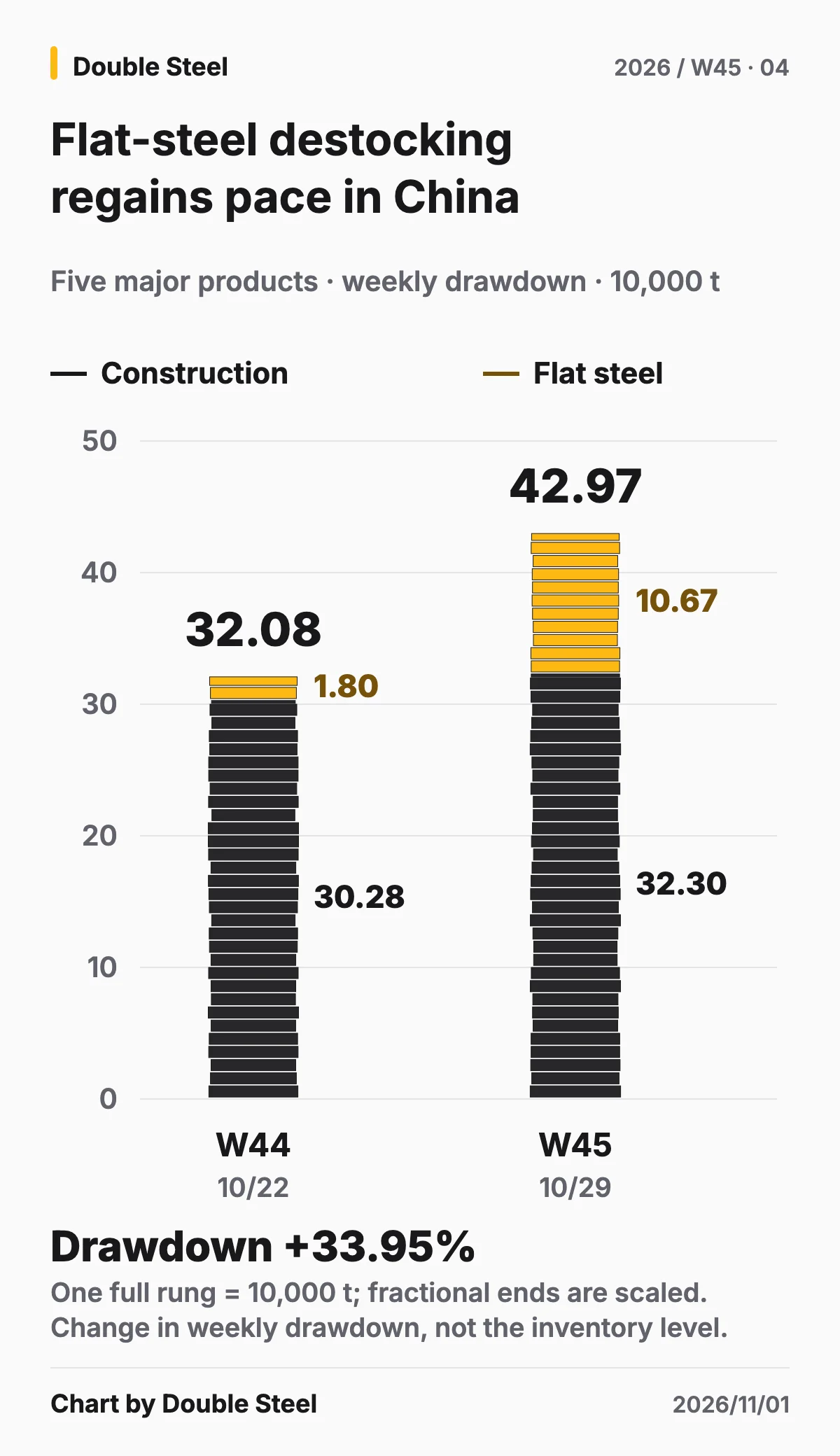
China's supply-demand balance improved from last week. Mysteel's combined inventories of the five major steel products fell to 14.0478 million tonnes, with the weekly drawdown expanding from 320,800 to 429,700 tonnes. Apparent consumption also recovered, and flat-product destocking accelerated again. Following W42's holiday inventory build, W43's concentrated replenishment and W44's slower destocking, this week brought firmer support from low-priced transactions and inventory clearance. However, HRC mill inventories still edged higher, and some lower flat-steel import offers to Taiwan failed to attract deals. Material is clearing, but buyers' capacity to accept higher prices varies by product and market.
The same divergence extends to round bars and specialty steel. Taiwan's ordinary-grade round bars and Japanese specialty steel saw price increases, while China's general carbon structural round steel remained weak. Japanese grades for high-end applications have order support, whereas Korean producers face growing sales but margins squeezed by import competition. This issue separates cost-led increases, low-priced replenishment and demand from high-end applications to identify where improvement is actually occurring.
Key figures and comparison with the previous four weeks
| Indicator | W41 | W42 | W43 | W44 | W45 latest | Change vs W44 cutoff |
|---|---|---|---|---|---|---|
| Iron ore (USD/t) | 91.35 | 90.68 | 90.90 | 90.83 | 90.71 | -0.13% |
| Iron ore (CNY/t) | 702.50 | 682.50 | 672.50 | 675.00 | 672.00 | -0.44% |
| Coking coal benchmark (USD/t) | 262.50 | 270.00 | 266.00 | 266.00 | 268.04 | +0.77% |
| International HRC benchmark (USD/t) | 1,310.00 | 1,316.08 | 1,356.00 | 1,381.00 | 1,429.00 | +3.48% |
| International scrap benchmark (USD/t) | 400.00 | 394.50 | 395.00 | 391.50 | 403.00 | +2.94% |
| Rebar/steel benchmark (CNY/t) | 3,109.00 | 3,099.00 | 3,089.00 | 3,051.00 | 3,035.00 | -0.52% |
| Tangshan common billet, ex-works (CNY/t) | 2,980 | 2,950 | 2,950 | 2,920 | 2,890 | -1.03% |
| USD/TWD spot selling rate | 31.91 | 31.94 | 32.42 | 32.62 | 32.63 | +0.01 |
| USD/CNY | 6.70627 | 6.69259 | 6.68630 | 6.66948 | 6.65231 | -0.26% |
The international scrap benchmark uses October 29 data; the other listed commodity benchmarks and USD/CNY use October 30 data. Tangshan common billet is the October 31 mainstream Qian'an ex-works price. The E.SUN exchange rate was queried on November 1 and does not represent a new Sunday transaction. Changes are calculated between each report's cutoff observations; USD/TWD is an absolute difference. International reference benchmarks are separate from the grade- and region-specific physical quotations below.
Rebar | Catch-up pricing takes effect, but cheaper distributor stock constrains new prices
Feng Hsin raised rebar by NTD 200/t on October 27, taking its list price to NTD 18,500/t; the mill price cited in market reports was NTD 17,900/t. Scrap prices were unchanged this week after procurement prices had already risen by NTD 300–400/t in the previous week. Following W44's low-priced bulk bookings, finished-steel prices have now increased, shifting mills' focus from securing orders toward easing the spread pressure associated with replenishing raw materials.
The increases have not established a uniform new market price. Yih Sheng and Ching Hsin Hsin kept rebar mill prices unchanged at NTD 17,500/t and NTD 17,700/t, respectively. Southern distributors, holding inventory bought at around NTD 17,200/t last week, tested offers of NTD 17,400–17,600/t. For mills, new prices reflect replacement costs; for distributors with cheaper stocks, lower selling prices can still leave a margin. Mill increases, unchanged competing mill prices and cheaper distributor resales therefore coexist.
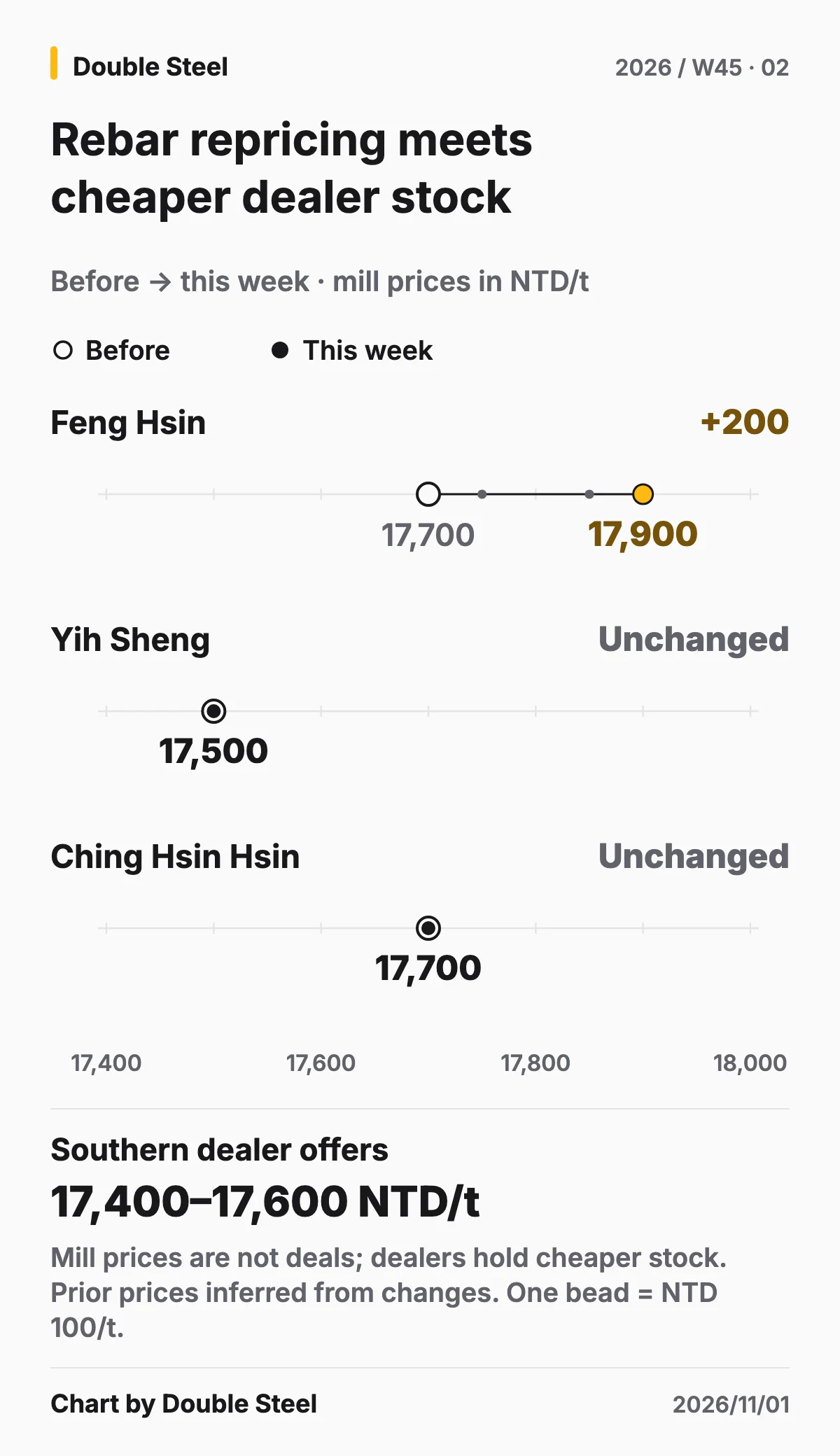
Over the previous four weeks, older stocks continued to undercut ordinary distribution in W41, individual large orders appeared in W42, broad-based willingness to pay higher prices had yet to emerge in W43, and low-priced bulk bookings expanded across several mills in W44. This week's new development is the announced catch-up increase, rather than another confirmed increment in total market bookings. Whether subsequent orders improve mill margins depends on the clearance of low-priced inventory, distribution selling prices moving closer to new mill prices, and when distributors need to replenish at higher costs.
China's long products also have support from inventory clearance. In Mysteel's October 29 five-major-product survey, combined inventories of the construction-steel group fell by 323,000 tonnes, slightly faster than the previous period's 302,800 tonnes, while apparent consumption rose approximately 3% week on week. These figures cover rebar and wire rod together. Low-priced demand continues to absorb regional long-product supply, but pricing power has not strengthened at the same pace as destocking.
Japan's Kyoei Steel announced a JPY 5,000/t increase in domestic rebar selling prices for November this period, while noting weak new inquiries and shipments. The increase primarily responds to energy, logistics and labor costs, as well as higher unit costs following production cuts. Mills in both Taiwan and Japan are pushing for higher prices, with the shared challenge of recovering costs from price-sensitive buyers.
Flat steel | Lower import offers still struggle to attract deals, while coated products rise
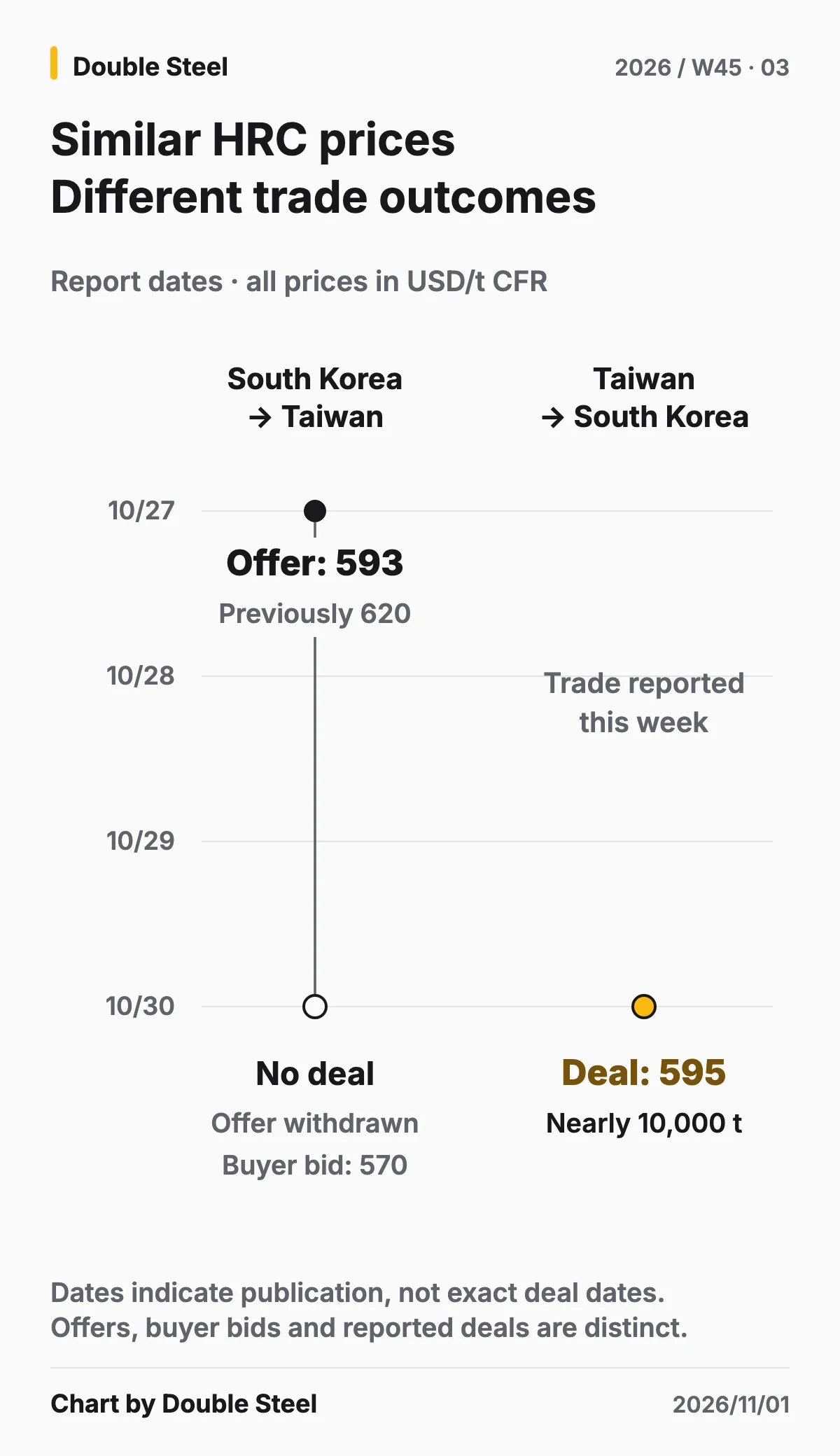
POSCO lowered its HRC offer to Taiwan from USD 620/t CFR to USD 593/t CFR, but buyers still did not accept it; subsequent market reports indicated that the offer was withdrawn. Buyer interest was around USD 570/t CFR, leaving a gap with the seller. Compared with W41's import transactions for specific specifications, CSC's confirmed new prices in W42 and Chung Hung's increases in W43, higher domestic replenishment costs now coexist with lower import offers. Distributors face constrained selling prices and resale margins, rather than simply a shortage of cheaper quotations.
During the same week, market reports indicated a Taiwanese HRC sale to South Korea at USD 595/t CFR for close to 10,000 tonnes. An unsuccessful offer to Taiwan alongside a completed sale to South Korea shows that similar dollar prices receive different responses across destinations. Local selling prices, demand, specifications and exchange rates all affect buyers' ability to enter the market. A relatively weak Taiwan dollar continues to constrain import purchasing, but this week's exchange-rate movement was very small and cannot account for every difference in transaction outcomes.
Regional price references remain low. Indonesian HRC offers to Vietnam were around USD 532–534/t CFR, with the reported USD 530/t CFR transaction terms requiring a 30,000-tonne batch.
Coated products, meanwhile, continued to see higher mill prices. On October 30, Yieh Phui announced November domestic increases of NTD 1,200/t for both galvanized and prepainted products, and NTD 1,000/t for 304 prepainted stainless steel. December export prices for galvanized and prepainted products rose by USD 10/t. The new domestic increases exceed the NTD 1,000/t increases for October galvanized and prepainted products announced in W41. Higher coated-product prices alongside weaker import HRC negotiations show different pricing cycles within flat steel.
China's flat-product clearance recovered noticeably from last week. In Mysteel's five-major-product survey, the weekly drawdown in combined flat-product inventories expanded from 18,000 to 106,700 tonnes, while apparent consumption rose about 1.5% week on week. Following rising flat-product social stocks in W41, the holiday build in W42, resumed destocking in W43 and another slowdown in W44, this period improved on last week's near-stall in clearance. However, HRC output still increased by 19,400 tonnes, mill stocks edged higher and downstream orders remained weak. Better inventory clearance has yet to establish consistent regional support for higher prices.
Japanese plate pricing offers a different comparison. On October 27, Chubu Steel Plate announced a JPY 5,000/t increase for November plate contracts. Reports described relatively firm demand from data centers, factories, logistics warehouses and semiconductor equipment. This contrasts with bargaining pressure on ordinary Asian HRC: price acceptance increasingly depends on end use and supply conditions. Taiwan's next focus is CSC's formal December pricing. At this report's cutoff, talk of another NTD 300–500/t increase and downstream calls for a freeze remained pre-announcement expectations and requests.
Sections | More mills raise prices, but distribution acceptance lags
More than one Taiwanese section producer raised prices this week. Dragon Steel increased its H-beam base price by NTD 900/t after a previous NTD 500/t increase. Tung Ho raised its H-beam order base price by another NTD 500/t on October 30, bringing three consecutive increases to a cumulative NTD 1,500/t. Feng Hsin also raised small sections by NTD 500/t, covering products including angles, channels and flat bars.
Compared with Tung Ho's W41 increase and its second increase in W43, this week's change is broader repricing and a larger cumulative adjustment, without a matching advance in downstream selling prices. A midweek market report reviewing the first two Tung Ho increases described domestic H-beam distribution prices meeting resistance near NTD 25,000/t, while imports continued competing at around NTD 24,000–24,200/t. This reflects distribution pressure before the third increase, not newly achieved transaction prices following the October 30 adjustment.
Fixed intake allocations and import competition make it difficult for dealers to absorb upstream increases merely by holding offers firm. Small sections face a similar situation: ordinary volume discounts coexist with engineering-project and large-customer contract terms, leaving actual price differences dependent on customer and quantity after a list-price increase. For distributors, repricing raises replenishment costs, while actual sales terms remain driven by orders and competing supply.
Japan is also seeking cost pass-through. On October 27, Oji Steel announced a JPY 3,000/t increase across flat- and square-bar products for November contracts. In earlier announcements, Tokyo Steel had raised all November contract products by JPY 3,000/t, while Nippon Steel announced H-beam increases of JPY 3,000/t for distributor contracts and JPY 5,000/t for new project contracts. These adjustments, announced on different dates, form Japan's supply-side pricing backdrop. Pass-through in Taiwan remains primarily dependent on local import competition, project deliveries and distributor inventories.
Round bars and specialty steel | Japanese increases, Korean competition and firmer high-end applications
Taiwan's round-bar market needs to be distinguished by product. Feng Hsin increased small sections by NTD 500/t, with ordinary-grade round bars up to and including 60 mm in diameter, including grades such as SS400 or A36, also seeing higher mill prices.
In China, general carbon structural round steel remained weak. Mysteel's October 30 national average for 45# round steel in 29–85 mm diameters was CNY 3,542/t, against CNY 3,599/t, CNY 3,590/t and CNY 3,580/t in the same series in W41, W42 and W43, respectively. The price trend has continued lower over recent issues. Separate data put the October 26–30 weekly average for medium-size 45# bars at CNY 3,650/t and medium-size 40Cr alloy structural bars at CNY 3,840/t, both down CNY 10/t from the previous week. Local business remained dominated by small and scattered orders, with some sellers discounting to improve turnover. The national daily price and Lecong weekly averages cover different samples, but both point to limited pricing power in ordinary products.
Japanese specialty-steel mills have new cost-led increases. On October 28, Aichi Steel announced November contract increases of at least JPY 5,000/t each for structural, spring and bearing steels, and 5%–7% for tool steel, following its earlier July adjustment. Elevated scrap prices and other cost pressures are prompting higher contract prices, contrasting with weak Chinese ordinary round-steel spot prices.
More tangible demand support is found in high-performance materials. Daido Steel raised its full-year forecast for the fiscal year ending March 2027 on October 29, with reports citing healthy orders for semiconductor-manufacturing-equipment stainless steel and open-die forgings. Alongside company-level order signals in Taiwan's high-end aerospace and energy steels, this period adds support from Japanese semiconductor equipment and high-performance forgings. Demand improvement is concentrated in specific applications.
South Korea presents another situation: sales are growing, but profits are squeezed. SeAH Besteel Holdings reported third-quarter consolidated revenue growth of 14.1% year on year on October 29, while operating profit fell 46.4%. Major subsidiaries increased product sales volumes and prices, but low-priced import competition prevented full pass-through of higher raw-material costs. According to SeAH, Chinese specialty-steel bar inflows into South Korea were approximately 276,400 tonnes in the third quarter, up around 70.8% year on year.
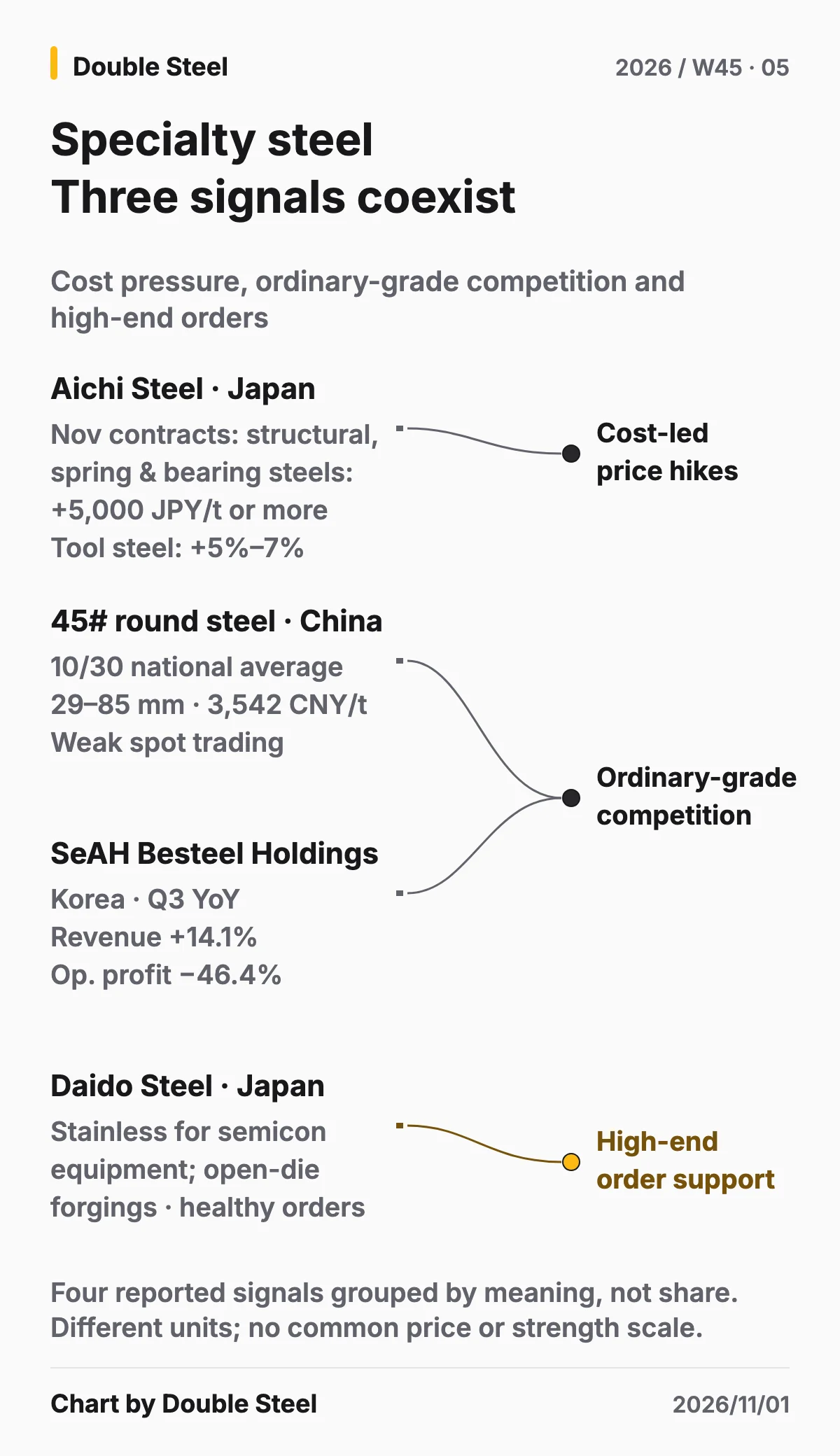
Taiwanese wire rod also varies by product. Yieh Hsing raised November carbon-steel wire rod by NTD 500/t and 300-series stainless wire rod by NTD 1,000/t, while keeping 200- and 400-series prices unchanged. Overall, ordinary-grade round bars, carbon-steel wire rod and some Japanese specialty steels are seeking higher selling prices; general carbon structural round steel remains constrained by spot-market turnover pressure, while high-performance materials have more specific end-use demand support. The dividing line for round bars and specialty steel lies in actual customer mix and recoverable costs, rather than simply whether upstream mills raise prices.
Steelmaking raw materials | Iron ore fluctuates at low levels; scrap and billet buying is constrained by finished steel
Iron ore first fell, rebounded and then eased again this week. The price of 62% Australian fines delivered to China was USD 91.05/t CFR on October 27, rose to USD 92.95/t on October 29 and fell to USD 92.25/t on October 30. It ended slightly below the previous week's USD 92.35/t. The midweek rebound improved sentiment, but ample supply and cautious mill purchasing continued to limit buying at higher prices, preventing a sustained increase in replenishment costs.
Metallurgical coal did not strengthen uniformly either. On October 27–28, Australian low-volatile hard coking coal, LVHCC, was around USD 230.1/t FOB, and premium low-volatile hard coking coal, PLV, around USD 265/t FOB, slightly below W44's available observations of approximately USD 230.8/t and USD 265.4/t. Chinese buyers preferred port stocks and prompt cargoes, while Indian spot purchasing remained cautious. Declining port stocks in India supported expectations of later replenishment. These physical quotations and the increase in the table's coking-coal benchmark reflect different qualities and pricing bases.
Chinese coke has yet to turn higher after the two rounds of reductions in previous weeks. Mysteel's publicly available October 30 analysis noted that leading coke producers' proposed increases had failed, while more producing-region coking-coal auction prices fell than rose. Corresponding daily hot-metal output was 2.3187 million tonnes, down 4,300 tonnes from the previous period. Upward cost pressure from blast-furnace raw materials therefore remains weak, and low mill profitability also limits fresh restocking.
For electric-arc-furnace inputs, the greater constraint comes from finished-steel selling prices. US containerized 80:20 scrap offers to Taiwan remain around USD 350–355/t CFR. Although market reports mentioned small low-priced trades near USD 345/t CFR, available volumes were limited. Diverging new rebar mill prices and distributor resale prices make it difficult for mills to establish an affordable ceiling for additional raw materials, prompting slower buying and lower bids this week. This coexists with a recovery in the international scrap benchmark; Taiwan has not obtained abundant cheap supply that would allow mills to reduce costs broadly.
Billet faces the same finished-steel constraint. Qian'an common billet ex-works prices in Tangshan moved lower than the previous period, while market offers for chemistry-adjusted billet to Taiwan were around USD 488–490/t CFR, against Taiwanese bids of approximately USD 480–483/t CFR. The gap remains. Some mills delayed buying while awaiting renewed Russian billet offers. The timing of that return remains market information; for now, buyers are waiting for additional supply options rather than receiving additional cargoes.
Incremental currency pressure has diminished considerably. The USD/TWD spot selling rate rose only 0.01 from the previous issue, but remains 0.72 above W41's 31.91; the accumulated currency cost of recent weeks has not disappeared. For Taiwan, low iron-ore and coal/coke prices offer a blast-furnace cost buffer, while electric-arc-furnace mills must still find affordable replenishment terms among scrap supply, billet substitution and actual rebar selling prices.
This week's advances are the implemented rebar catch-up increase, renewed flat-product destocking in China, and new pricing and order signals from Japanese specialty steel and high-performance applications. Constraints remain concentrated in low-priced inventory, import competition in ordinary products and incomplete pass-through of new costs into selling prices.
Next week, Taiwan's focus will be transactions at new rebar prices and clearance of cheaper stocks, CSC's formal December pricing, and distributor shipments following new section prices. Regional watchpoints are whether China's flat-product destocking continues, ordinary round-steel prices stabilize, and Japanese specialty-steel contract increases reach actual quotations. For raw materials, import scrap and billet transactions and the implementation of coke pricing remain central. These changes will determine how much margin the current round of increases can retain.
Sources: TradingEconomics (data through October 29–30, 2026); E.SUN Bank (USD/TWD spot exchange rate, queried November 1, 2026); Mysteel (through October 30, 2026; Tangshan billet through October 31, 2026); Lange Steel (through October 31, 2026); SteelWorld / Taiwan Steel News (mill pricing, transactions and raw-material reports through October 31, 2026); Tokyo Steel (November contract selling-price announcement, October 19, 2026); Japan Metal Daily (Japanese mill pricing and specialty-steel orders, reports through October 30, 2026); Newsis and ChosunBiz (SeAH third-quarter results and market commentary, October 29, 2026).
Published by the Market Research Department of Double Steel Co., Ltd. This report is provided for market research and procurement assessment only and does not constitute investment advice or the final basis for direct purchasing decisions.