Publication date: September 7, 2026
Market and news cutoff: September 6, 2026
Exchange-rate benchmark: USD/TWD spot selling rate: 31.71
The main development in the steel market this week was the further pass-through of higher raw material costs into new price announcements by Taiwanese mills. On September 4, China Steel Corporation (CSC) announced its October monthly prices and fourth-quarter quarterly prices. All monthly-priced products were raised by NTD 500–600/T, while quarterly-priced products were set on a flat-to-higher basis depending on the product. Wire rod and bar, automotive steel, and certain specialty coil products remained unchanged. This indicates that catch-up gains in flat products now have support from mill prices, although downstream industries still differ in their ability to absorb higher costs.
Compared with recent weeks, the market has moved from the raw material rebound in W34 and the mismatch between import costs and Taiwan selling prices in W35, to a recovery in distribution prices in W36 and the implementation of mill price increases in W37. Domestic HRC ex-yard distribution prices rose further to NTD 18,500–18,700/T, while pickled coil reached NTD 19,800/T and above. Mainstream rebar transactions in Taiwan were approximately NTD 16,900–17,200/T, and Russian billet was traded at CFR USD 487–489/T.
Demand showed only partial improvement. China's social inventories of five major steel products resumed their decline, falling to 11.7685 million tonnes on September 4, down 65,800 tonnes on the week. Rebar returned to destocking, but wire rod inventories increased for a second consecutive week and HRC inventories were almost unchanged. Prices and restocking sentiment have improved since mid-August, but whether end-user shipments can sustain the trend still needs to be monitored.
Key Data This Week and Four-Week Comparison
| Indicator | W34 | W35 | W36 | Latest W37 Value | Change from W36 Cutoff |
|---|---|---|---|---|---|
| Iron ore (USD/T) | 95.17 | 95.21 | 95.84 | 99.57 | +3.89% |
| Iron ore (CNY/T) | 710.50 | 707.50 | 723.00 | 727.00 | +0.55% |
| Coking coal benchmark (USD/T) | 225.00 | 249.00 | 270.00 | 275.00 | +1.85% |
| HRC benchmark (USD/T) | 1,220.00 | 1,185.00 | 1,191.07 | 1,238.00 | +3.94% |
| International scrap benchmark (USD/T) | 397.50 | 393.50 | 375.25 | 394.00 | +5.00% |
| Rebar/steel benchmark (CNY/T) | 3,018.00 | 3,061.00 | 3,130.00 | 3,131.00 | +0.03% |
| Tangshan Q235 billet (CNY/T) | 2,940 | 2,970 | 3,030 | 3,040 | +0.33% |
| USD/TWD spot selling rate | 32.07 | 31.92 | 31.72 | 31.71 | -0.01 |
| USD/CNY | 6.74342 | 6.72019 | 6.72980 | 6.70783 | -0.33% |
| China's social inventories of five major steel products (10,000 tonnes) | 1,190.91 | 1,180.37 | 1,183.43 | 1,176.85 | -0.56% |
Chapter 1: CSC Pricing Focus and Trend Assessment
October Monthly Prices: General Flat Products and Construction-Grade Galvanized Steel Raised
CSC announced its new prices on September 4, covering October 2026 monthly-priced products and fourth-quarter quarterly-priced products. The monthly price adjustments are listed below, all in NTD/T.
| October Monthly-Priced Product | Price Adjustment |
|---|---|
| HRC for rerolling | +600 |
| General-grade hot-rolled plate and coil | +600 |
| General-grade CRC | +600 |
| Electrogalvanized coil for construction | +500 |
| Hot-dip galvanized coil for construction and pre-painted applications | +500 |
Fourth-Quarter Prices: Wire Rod and Bar Unchanged; Plate and Selected Galvanized Products Raised
| Fourth-Quarter Quarterly-Priced Product | Price Adjustment (NTD/T) |
|---|---|
| Wire rod and bar (low carbon, medium/high carbon, cold heading, and low alloy) | Unchanged |
| Plate (shipbuilding, A36/SS400, and SM570 series) | +500 |
| Other plate | +500 |
| Hot-rolled plate and coil (medium/high carbon and tool steel) | Unchanged |
| Cold-rolled coil (medium/high carbon, tool steel, and drum applications) | Unchanged |
| Anti-fingerprint electrogalvanized coil | +600 |
| Hot-dip galvanized coil for home appliances, computers, and other applications | +600 |
| Medium- and low-grade electrical steel coil | +500 |
| High-grade electrical steel coil | Unchanged |
| Automotive steel | Unchanged |
Beginning in the fourth quarter, anti-fingerprint electrogalvanized coil, hot-dip galvanized coil for home appliances, computers, and other applications, and both medium/low-grade and high-grade electrical steel coil will move from monthly to quarterly pricing. Customers will need to plan order intake, procurement costs, and lead times according to the new applicable pricing cycle.
For wire rod and bar, CSC kept its fourth-quarter prices unchanged, while Dragon Steel Corporation likewise held its electric-arc-furnace A-grade wire rod price flat. After CSC raised wire rod and bar prices by NTD 1,000/T in both the second and third quarters, it halted further increases for the fourth quarter. This reflects the constraints posed by export order intake in downstream industries such as fasteners and hand tools, as well as competition from Asian peers. Stronger raw material costs do not necessarily mean wire rod and bar prices can be raised at the same pace.
HRC Price Structure: Announced Adjustments and Customers' Average Costs Must Be Assessed Separately
Post-announcement market reports showed that CSC's October price for first-grade HRC increased from NTD 20,200/T to NTD 20,500/T, a rise of NTD 300/T, while project-priced material increased from NTD 17,600/T to NTD 18,200/T, a rise of NTD 600/T. Assuming an equal split between first-grade and project-priced material, the average would increase from NTD 18,900/T to NTD 19,350/T, a gain of NTD 450/T.
This calculation illustrates differences in procurement structure and is not a transaction price that applies to every customer. Actual costs still depend on the grade mix, specifications, surcharges, and lifting conditions. The September equalization rebate mentioned in market reports applies to the earlier period and is subject to volume requirements, so it should not be deducted directly from the new October price.
Looking back to W33, CSC's September headline prices were unchanged, but the price of first-grade HRC was reduced, creating a structural concession. Taiwan's distribution market remained caught in low-price competition during W34 and W35, and restocking did not drive a recovery until W36. This week's new CSC prices have raised the cost of subsequent replenishment further. The flat-products market has therefore moved from clearing low-cost inventory to assessing whether the cost of the next replenishment cycle can be passed through.
Four-Week Trend: Costs Remain Firm While Finished Products and Demand Diverge
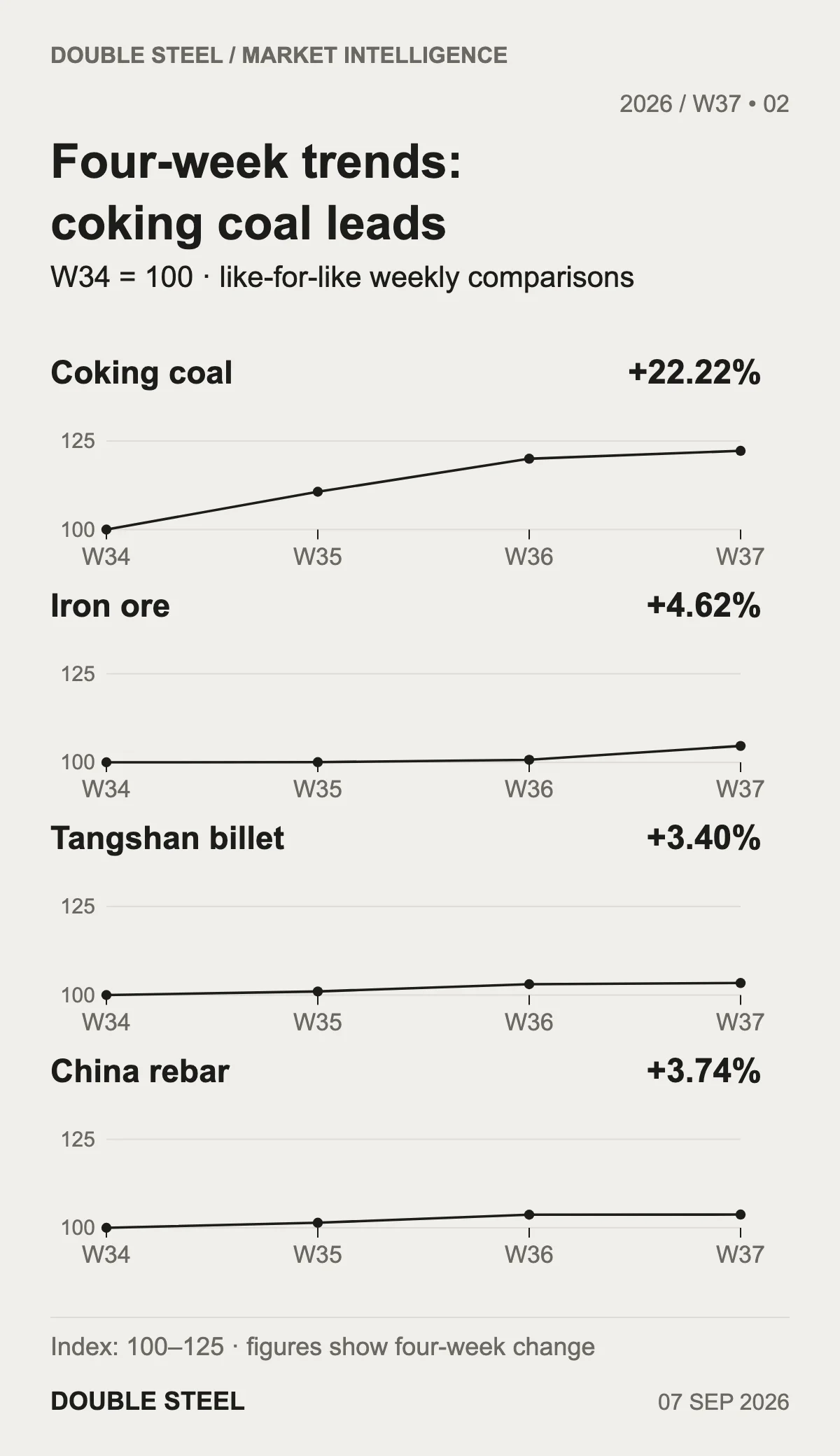
From W34 to W37, the coking coal benchmark rose by approximately 22.22% and Tangshan billet by approximately 3.40%, while the Chinese rebar benchmark was almost unchanged from W36 this week. This indicates that raw material costs are still rising faster than selling prices for some finished products can recover. Price differences among coking coal grades are also substantial, so premium hard coking coal, standard low-volatility hard coking coal, and the composite benchmark should be compared separately.
Taiwan's domestic HRC ex-yard distribution prices rose from NTD 18,100–18,300/T in W36 to NTD 18,500–18,700/T this week, lifting both ends of the range by approximately NTD 400/T. Pickled coil rose from NTD 19,400–19,600/T to NTD 19,800/T and above. These prices were drawn mainly from market reports before CSC's announcement. Whether actual transactions move higher after the announcement will be an important test next week.
The USD/TWD spot selling rate continued to decline, from 32.07 in W34 to 31.71 this week. The stronger New Taiwan dollar is favorable for imports, but the rate improved by only 0.01 from W36. For billet priced at CFR USD 490/T, this week's exchange-rate movement reduces the cargo value by only about NTD 4.9/T, which is insufficient to offset raw material increases of several US dollars per tonne.
Chapter 2: Analysis of Costs, Inventories, and Key Products
2.1 Raw Materials and Inventories: Destocking Resumes, but HRC Inventory Reduction Nearly Stalls
Spot iron ore prices remained supported by costs and supply expectations. The September 4 price of 62% Australian fines shipped to China was CFR USD 101.25/T, up USD 1.25/T from the previous week. In coking coal, standard low-volatility hard coking coal was quoted on September 2 at FOB USD 237.5/T and CFR China USD 258/T, while premium low-volatility hard coking coal reached FOB USD 275.5/T and CFR USD 296/T. Market reports indicated partial acceptance of the fourth round of coke price increases. Cost pressure therefore remains, although actual implementation across regions still needs to be tracked.
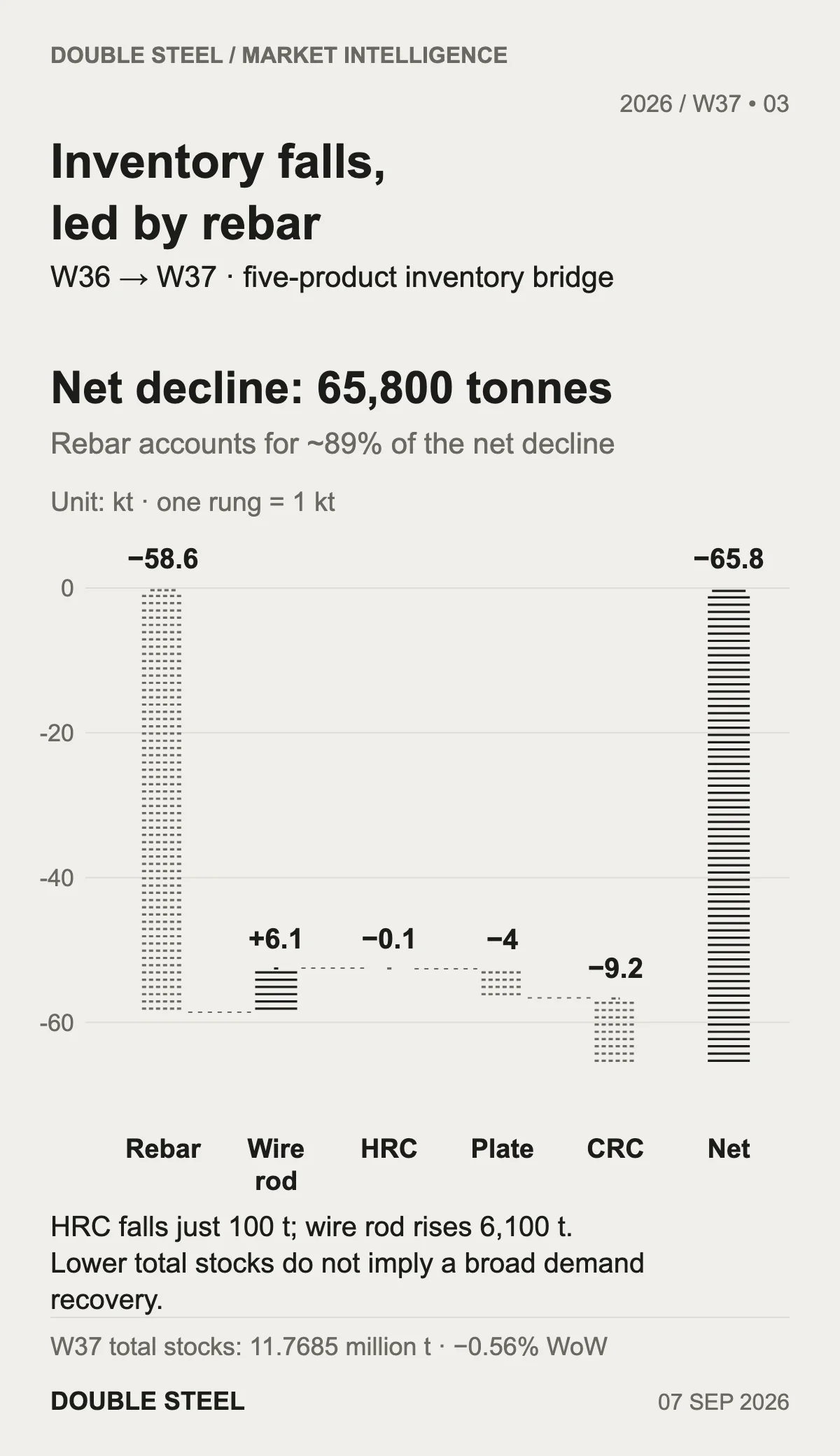
China's social inventories returned to a decline this week, improving from the simultaneous inventory increases in rebar and wire rod in the previous week. However, the reduction was concentrated mainly in rebar, which accounted for approximately 89% of the net weekly decline. The product breakdown is shown below.
| Product | W36 Social Inventory (10,000 tonnes) | W37 Social Inventory (10,000 tonnes) | Change (10,000 tonnes) | Weekly Change |
|---|---|---|---|---|
| Rebar | 511.32 | 505.46 | -5.86 | -1.15% |
| Wire rod | 65.76 | 66.37 | +0.61 | +0.93% |
| HRC | 365.15 | 365.14 | -0.01 | Approximately unchanged |
| Plate | 119.19 | 118.79 | -0.40 | -0.34% |
| CRC | 122.01 | 121.09 | -0.92 | -0.75% |
Over the past four weeks, total inventory followed a pattern of decline, decline, rebound, and renewed decline. The W37 total was 140,600 tonnes, or approximately 1.18%, lower than in W34. Although rebar destocked this week, its inventory remained slightly above the W35 level of 5.0470 million tonnes. Wire rod inventories increased for a second consecutive week, while HRC inventories fell by only 100 tonnes. The decline in total inventory therefore should not be interpreted as a broad-based recovery in demand across all products.
2.2 Steel Billet and Rebar: Russian Billet Trading Resumes, but Finished-Product Margins Have Yet to Recover
Mainstream offers for Asian 3SP 150 mm billet were approximately CFR USD 497–500/T, with a tradable range of about CFR USD 490–495/T, above the CFR USD 485–490/T level in W36. Chinese export offers were approximately FOB USD 465–470/T, with raw material and freight costs continuing to support landed prices.
Approximately 20,000 tonnes of Russian billet were traded into Taiwan this week at CFR USD 487–489/T, slightly below the mainstream Asian tradable range and also below the previous Russian billet transaction at CFR USD 492/T cited in W36. The resumption of Russian supply provided some opportunity to replenish inventory, but whether the same price will remain available depends on the next offers.
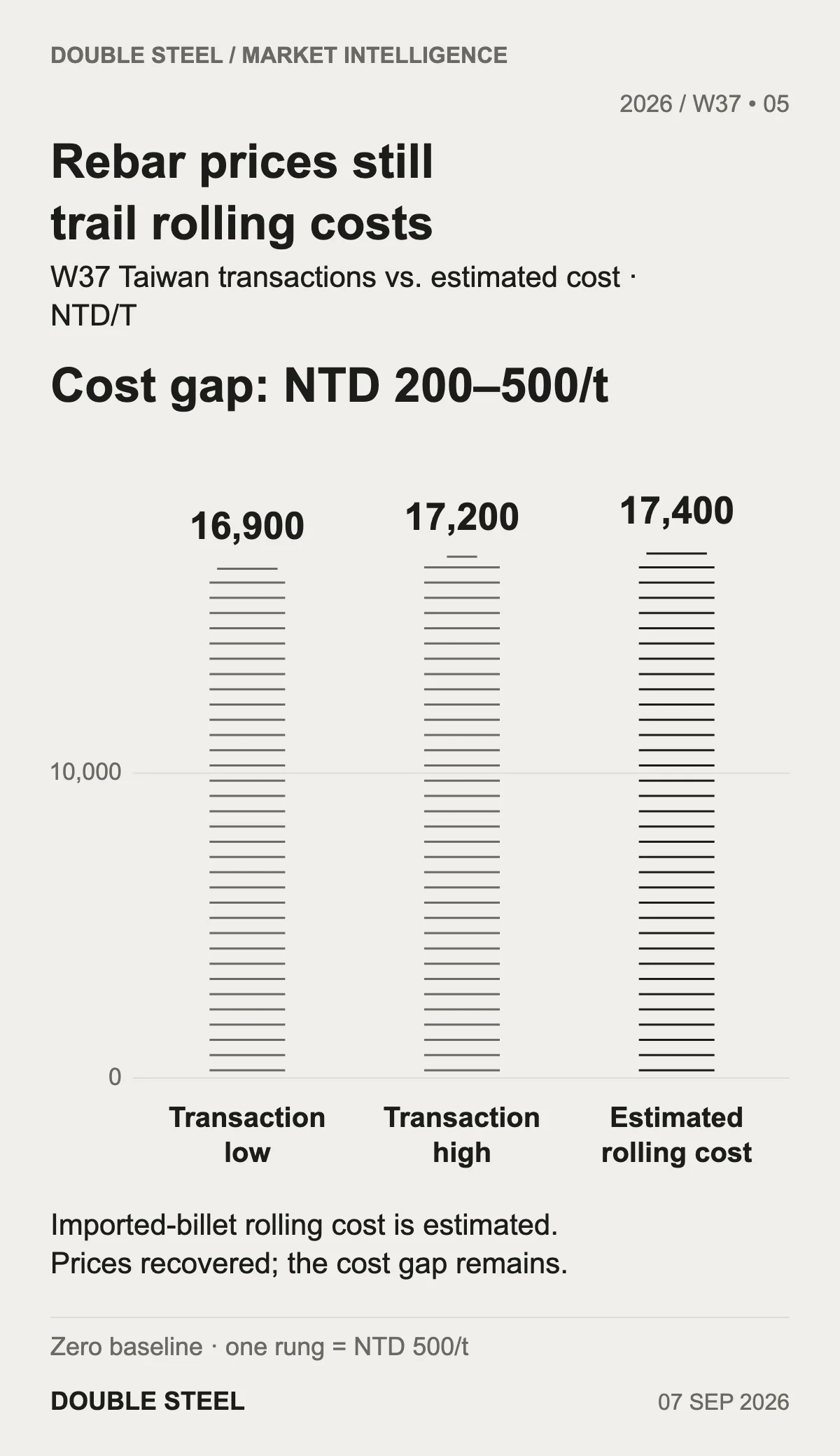
Mainstream rebar transactions in Taiwan were approximately NTD 16,900–17,200/T: around NTD 16,900–17,000/T in southern Taiwan and NTD 17,100–17,200/T in central and northern Taiwan. Compared with the W35 low of NTD 16,550–16,600/T in southern Taiwan, low-price competition has eased considerably, although prices still vary by region and order volume.
The market estimates the cost of rolling imported billet into rebar at approximately NTD 17,400/T, or about NTD 200–500/T above current mainstream transaction prices. This is a market estimate of processing costs, not a simple conversion of the CFR price at the prevailing exchange rate. Individual mills must still account for yield, energy, processing, freight, and handling costs. The new transactions have improved access to raw materials, but whether finished-product prices can rise in step remains the key issue.
2.3 Special Steel, Wire Rod and Bar, and Round Bar: CSC's Unchanged Prices Preserve Order Competitiveness
The 45# special-steel round bar benchmark was CNY 3,530/T this week, CNY 70/T or approximately 2.02% above the latest available W35 level of CNY 3,460/T. This is a comparison between data points two reporting periods apart. Mysteel's market updates this week indicated modest price increases in some regions and stable prices in others, with trading activity remaining average.
Ordinary wire rod prices in Asia were also driven by costs. On September 2, the assessed price of Chinese SAE1008 6.5 mm mesh-quality wire rod was approximately FOB USD 504/T, up USD 3/T from the previous week. Mill offers were around FOB USD 510–515/T, while buyer bids remained near FOB USD 490/T. The continued increase in China's wire rod social inventory also indicates that stronger offers have yet to receive broad support from demand.
For Taiwan's downstream wire rod and bar users, CSC's unchanged fourth-quarter prices help preserve cost visibility when accepting orders. Specifications and lead times for ordinary wire rod, cold-heading grades, alloy steel, and heat-treatment round bar must still be confirmed separately. Prices for ordinary export wire rod should not be used directly as substitutes for quotations on specialty grades.
2.4 HRC, Pickled Coil, and CRC: Hoa Phat and CSC Raise New Prices in Succession
Vietnam's Hoa Phat announced October-delivery HRC prices on September 3, raising them by USD 16/T from the previous month to CIF USD 530–540/T. The CIF USD 530/T level applies to large orders of approximately 20,000 tonnes. At the exchange rate used in this report, USD 16/T equals about NTD 507/T, broadly in line with the direction of CSC's announced increase for general flat products, although delivery terms and customer structures differ.
Tradable Chinese SS400/Q235 HRC prices were approximately FOB USD 500–510/T. Indonesian offers to Vietnam were around CFR USD 535–540/T, while Indian offers were approximately CFR USD 550/T. Compared with W36, the center of gravity for Asian offers moved higher, although some buyers became more cautious after the recent price increases.
Pickled coil showed more pronounced catch-up gains because distribution inventories were low. General-grade CRC also received support from higher costs and declining inventories. The average Chinese spot price for 1.0 mm CRC rose from CNY 3,690/T in the previous week to CNY 3,720/T, while the tradable export level increased from approximately FOB USD 545/T to FOB USD 560/T. Subsequent assessment should focus on shipment volumes after the increase, rather than mill offers alone.
2.5 Scrap: International Benchmark Recovers While Competition for Taiwan's Imports Remains Strong
The international scrap benchmark recovered this period, but Taiwan's actual procurement conditions require separate monitoring of containerized and bulk scrap markets. High-end offers for US containerized scrap to Taiwan were approximately CFR USD 335/T this week, with the tradable threshold around CFR USD 330/T. Japanese H2 offers to Vietnam were approximately CFR USD 355–358/T.
On August 31, Feng Hsin Steel raised its domestic scrap purchase price and rebar base price by NTD 200/T each, while leaving section steel unchanged. This extended the catch-up pressure in costs seen in W36. However, Vietnam's advantages in bid levels and purchasing volume continue to make it difficult for Taiwan to secure lower-priced imports. Whether prices rise again next week should be assessed based on mills' formal announcements.
2.6 Plate and Stainless Steel: Ability to Absorb Increases Continues to Vary by Application
Chinese SS400/A36 plate offers were approximately FOB USD 540–565/T, up another USD 3–5/T from the previous week, while most buyer indications were around FOB USD 530–535/T. Shipbuilding and selected engineering applications provided stronger support, but transactions in general-grade plate remained slow. CSC's fourth-quarter plate increase provides a basis for subsequent Taiwan quotations, although actual pass-through still depends on the underlying orders.
In stainless steel, China's most-active stainless steel futures contract closed at CNY 13,845/T on September 4, still below CNY 14,000/T. Following the September increases announced by Taiwanese stainless producers in W36, attention this week shifted to whether downstream buyers would accept the new prices. Stronger restocking in carbon steel flat products should not be taken as direct evidence of improved stainless steel demand.
Chapter 3: Regional Market Intelligence
Taiwan | CSC Group Shipments Decline; New Prices Still Reflect Cost and Industry Differences
Combined August shipments by CSC and Dragon Steel, including billet, were 831,000 tonnes, down 170,000 tonnes or approximately 16.98% from 1.001 million tonnes in July. The company said heavy rainfall affected shipment arrangements, indicating that monthly deliveries were also influenced by weather and shipment deferrals.
Impact assessment: The increases in October and fourth-quarter prices do not mean shipment demand has expanded sharply at the same pace. September lifting progress and actual order intake should be monitored to determine whether the price increases can be sustained.
Taiwan | Coated Products Follow Higher Costs, but Domestic and Export Pricing Diverge
On August 31, Yieh Phui raised September domestic prices for galvanized and pre-painted steel by NTD 500/T each and increased 304 stainless pre-painted steel by NTD 1,500/T. Its October export prices for galvanized and pre-painted steel were unchanged.
Impact assessment: Domestic catch-up gains are spreading to processed steel products, but export competition continues to constrain pricing. Domestic and export quotations should be assessed separately.
Vietnam | Formosa Ha Tinh Hot-Blast System Failure Requires Monitoring of Delivery Impact
On September 4, a failure occurred in the hot-blast system of No. 1 blast furnace at Formosa Ha Tinh Steel, and the unit was temporarily shut down for inspection and repair. A company representative said at the time that repairs were expected to take approximately 48 hours, and no casualties were reported.
Impact assessment: The incident increases near-term uncertainty over production scheduling and delivery. As of this report's cutoff, actual restart announcements should continue to be monitored. The estimated repair time should not be treated as confirmation that production has resumed or as evidence of a substantial long-term reduction in supply.
China and Asia | Inventory Improvement Remains Uneven
China's social inventories resumed their decline this week, and rebar destocking improved. However, rising wire rod inventories and nearly unchanged HRC inventories indicate that the handoff to peak-season demand remains incomplete. Asian mill offers have cost support, while buyers' acceptance of higher prices varies by market and application.
Impact assessment: Restocking can support prices in the near term, but a sustained uptrend still requires consecutive inventory declines and confirmation from end-user consumption.
Key Monitoring Indicators
-
Whether the actual mix, surcharges, and lifting conditions for first-grade and project-priced HRC alter customers' average costs after CSC's October price announcement.
-
Whether domestic HRC distribution prices of NTD 18,500–18,700/T and pickled coil prices starting at NTD 19,800/T are supported by actual shipments.
-
Whether downstream order intake in fasteners, hand tools, and other sectors improves after CSC and Dragon Steel kept wire rod and electric-arc-furnace A-grade material prices unchanged.
-
Whether China can sustain rebar destocking, whether wire rod inventories stop increasing, and whether HRC destocking accelerates again.
-
Whether quotations for different coking coal grades and implementation of the fourth round of coke price increases continue to compress finished-steel margins.
-
Whether subsequent Russian billet offers, supply volume, and lead times can preserve this week's replenishment terms of CFR USD 487–489/T.
-
Whether Taiwan rebar transactions move closer to the market-estimated imported-billet rolling cost of NTD 17,400/T.
-
The actual restart progress of Formosa Ha Tinh's blast furnace, and transactions and delivery arrangements following Hoa Phat's new price announcement.
Conclusion
The key change in W37 was that catch-up gains in Taiwan's flat-product market extended from distribution prices to new mill prices. CSC's higher October monthly prices and unchanged fourth-quarter wire rod and bar prices clearly reflect the tension between cost pressure and downstream competitiveness. Compared with recent weeks, the price floor and willingness to restock have both improved. However, China's inventory decline was concentrated in rebar, HRC inventories were almost unchanged, and Taiwan's rebar processing margins have yet to recover fully. Whether the trend continues will depend on transactions, lifting volumes, and end-user orders after the price increases.
Sources: TradingEconomics (iron ore, coking coal, HRC, rebar, international scrap, and USD/CNY, as of Sep 06, 2026); E.SUN Bank (USD/TWD spot exchange rate, as of Sep 06, 2026); Mysteel (Tangshan billet, as of Sep 06, 2026); domestic and international steel industry news (cross-verified through Sep 06, 2026); and publicly available information from industry associations (as of Sep 06, 2026).
This report is published by the Market Research Department of Double Steel Co., Ltd. Its contents are provided solely for market research and procurement assessment and do not constitute a final basis for investment or direct purchasing decisions.