
Publication date: October 12, 2026
Market and news cutoff: October 11, 2026
Exchange-rate reference: USD/TWD spot selling rate 31.94
W42 centers on “CSC price increases and a large rebar order in Taiwan; pressure on Chinese flat steel and diverging raw-material trends.” Taiwan has seen two concrete developments since W41: China Steel Corporation (CSC) has formally announced its November prices, with different increases for regular-grade and project-priced hot- and cold-rolled material; meanwhile, a central Taiwan rebar mill reportedly secured an order of 6,000 tonnes, providing localized buying support for mills holding their prices. However, HRC distribution prices still do not fully reflect the new mill-price costs, and ordinary rebar distribution channels have not seen a broad-based increase in volumes.
In China, the five major steel products have shifted from pre-holiday destocking to a holiday inventory build, with HRC stocks particularly notable. This is not entirely a holiday effect: flat-steel stocks were already rising in W41, and the pre-holiday supply–demand gap has carried into this period. Daily construction-steel trading has recovered after the holiday, but that does not establish a simultaneous recovery in flat steel. Baosteel's unchanged November prices and modest Vietnamese HRC increases contrast with Taiwan's price catch-up.
Raw materials likewise cannot be characterized simply as rising or falling. Iron ore remains at low levels, standard seaborne hard coking coal is weak, and China's coke market has seen notices for a second round of price cuts. Japanese scrap buying and auction prices, however, continue to rise, with some US grades and Indian imported shredded scrap also supported. The different cost directions facing blast-furnace and electric-arc-furnace steelmakers are an important dividing line this week.
Key figures and comparison with the previous four weeks
| Indicator | W38 | W39 | W40 | W41 | W42 latest | Change vs W41 cutoff |
|---|---|---|---|---|---|---|
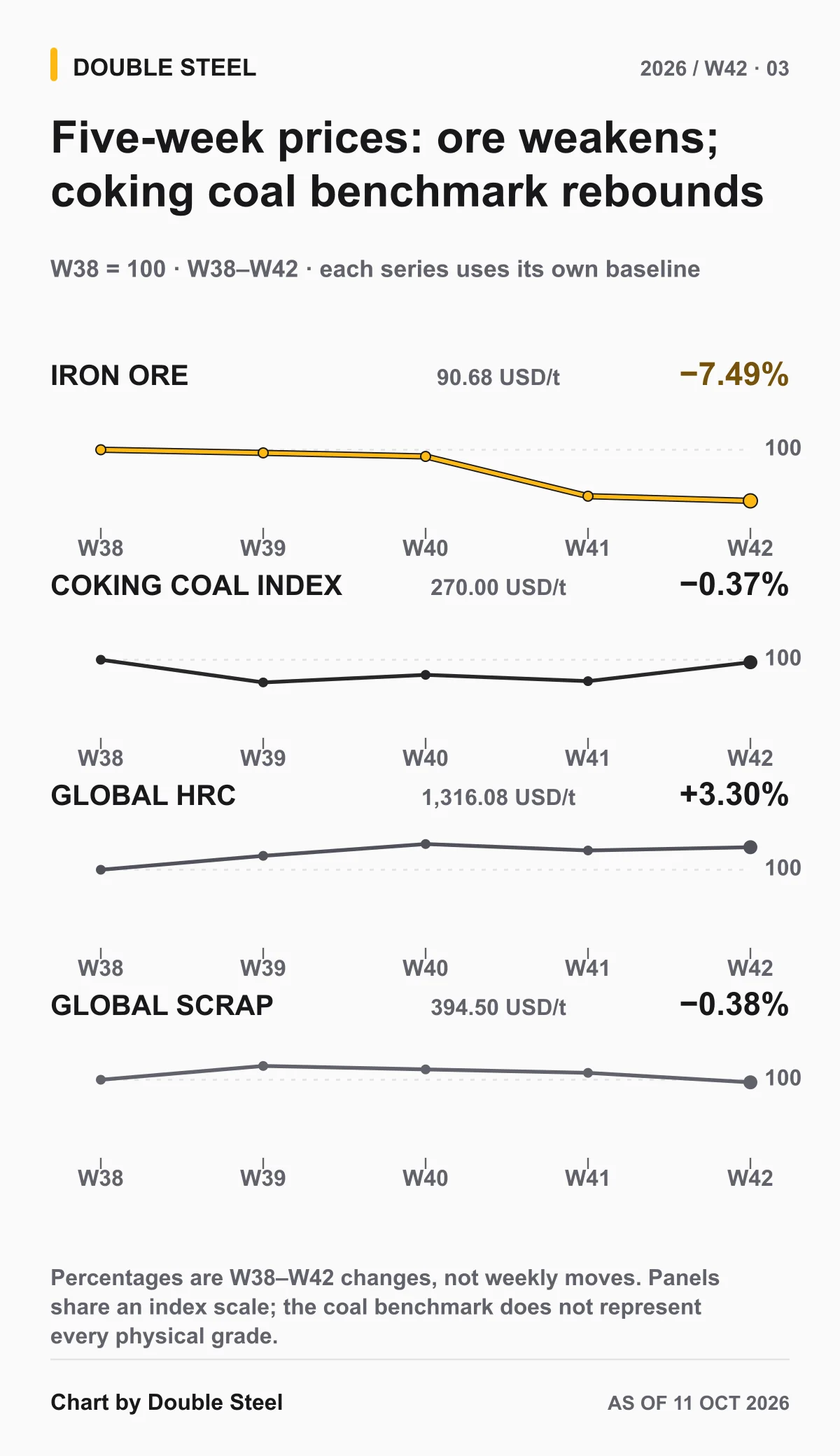
| Iron ore (USD/t) | 98.02 | 97.57 | 97.06 | 91.35 | 90.68 | -0.73% |
| Iron ore (CNY/t) | 718.00 | 715.50 | 713.50 | 702.50 | 682.50 | -2.85% |
| Coking coal benchmark (USD/t) | 271.00 | 262.00 | 265.00 | 262.50 | 270.00 | +2.86% |
| International HRC benchmark (USD/t) | 1,274.00 | 1,300.00 | 1,322.00 | 1,310.00 | 1,316.08 | +0.46% |
| International scrap benchmark (USD/t) | 396.00 | 404.00 | 402.00 | 400.00 | 394.50 | -1.38% |
| Rebar/steel benchmark (CNY/t) | 3,071.00 | 3,099.00 | 3,107.00 | 3,109.00 | 3,099.00 | -0.32% |
| Tangshan Q235 billet (CNY/t) | 3,000 | 3,000 | 3,010 | 2,980 | 2,950 | -1.01% |
| USD/TWD spot selling rate | 31.70 | 31.87 | 31.85 | 31.91 | 31.94 | +0.03 |
| USD/CNY | 6.70793 | 6.69531 | 6.72040 | 6.70627 | 6.69259 | -0.20% |
The international scrap benchmark uses October 8 data. Most other listed commodities and USD/CNY use October 9 data. Tangshan billet uses the latest available ex-works prices from October 8–9; the E.SUN exchange rate was queried on October 11.
Chapter 1: CSC's November prices are set, but Taiwan's flat-steel price pass-through still lags
Larger announced increases, different costs for regular-grade and project-priced material
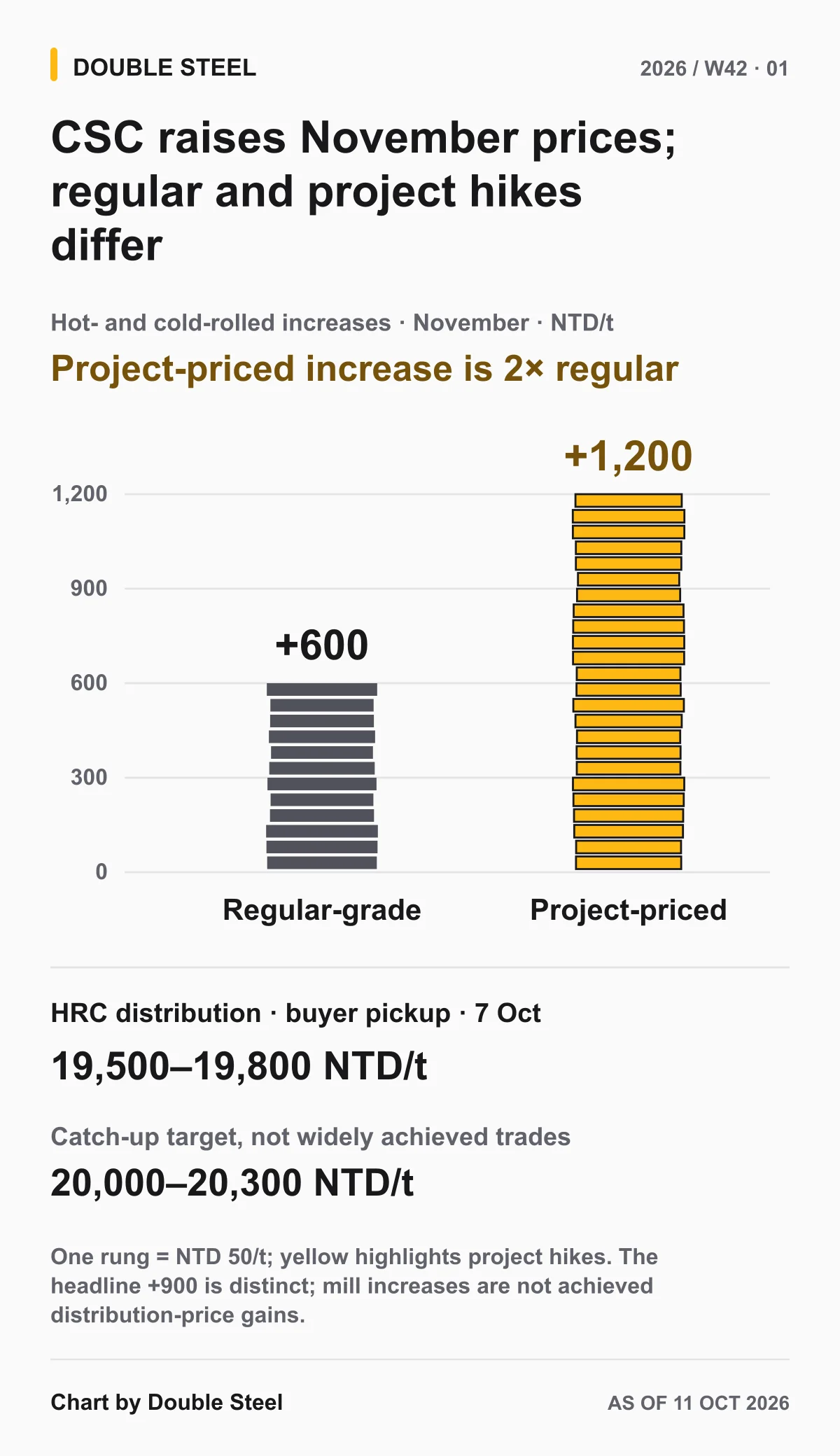
On October 5, CSC announced a November monthly price increase of NTD 900/t for five product categories. Compared with October's NTD 600/t increase, the supply-side push for higher prices has strengthened, and the expectations discussed in W41 have become a formal announcement.
The detailed terms for hot- and cold-rolled products need to be distinguished. Market reports indicate increases of NTD 600/t for regular-grade material and NTD 1,200/t for project-priced material. New HRC prices are NTD 21,100/t for regular-grade material and NTD 19,400/t for project-priced material. A 50:50 purchasing mix would imply an average increase of NTD 900/t, but individual customers' actual costs depend on their purchasing mix and contract terms; the same increase cannot be applied to everyone.
Taiwanese coated-steel mills taking redirected US orders, and consequently requiring more HRC substrate, are one industry factor behind this price increase. This supports orders in particular supply chains, but differs from demand conditions among general domestic processors.
Distribution prices have yet to catch up with new costs; POSCO's higher offer provides support
Market reports on October 7 put HRC distribution prices for buyer pickup at around NTD 19,500–19,800/t. Sellers hoped to lift prices to NTD 20,000–20,300/t after the mill announcement, but demand constraints meant these remained catch-up targets, not widely achieved transaction prices.
Compared with the import transactions and pickled-coil price increases already seen in W41, the more direct change this week is the higher cost of future domestic replenishment. Spot sales can draw on previously purchased low-cost inventory, while new purchases face the new mill prices. That timing gap squeezes margins at processors and distributors. The larger increase for project-priced material also means that sellers with different supply mixes face different pass-through pressures.
POSCO's latest HRC offer to Taiwan is around USD 640/t CFR for December–January shipment, higher than its previous offer, supporting the market through higher import replacement costs.
Chapter 2: Taiwan rebar sees a large order, with improvement still concentrated in individual transactions
Feng Hsin holds prices; transaction terms vary by region
On October 5, Feng Hsin kept its rebar base price at NTD 18,300/t, scrap buying base price at NTD 9,800/t, and section-steel price at NTD 25,000/t. All three were unchanged. Base prices, buying prices for different scrap grades, and negotiated rebar terms are distinct; list prices should not be treated as market-wide transaction prices.
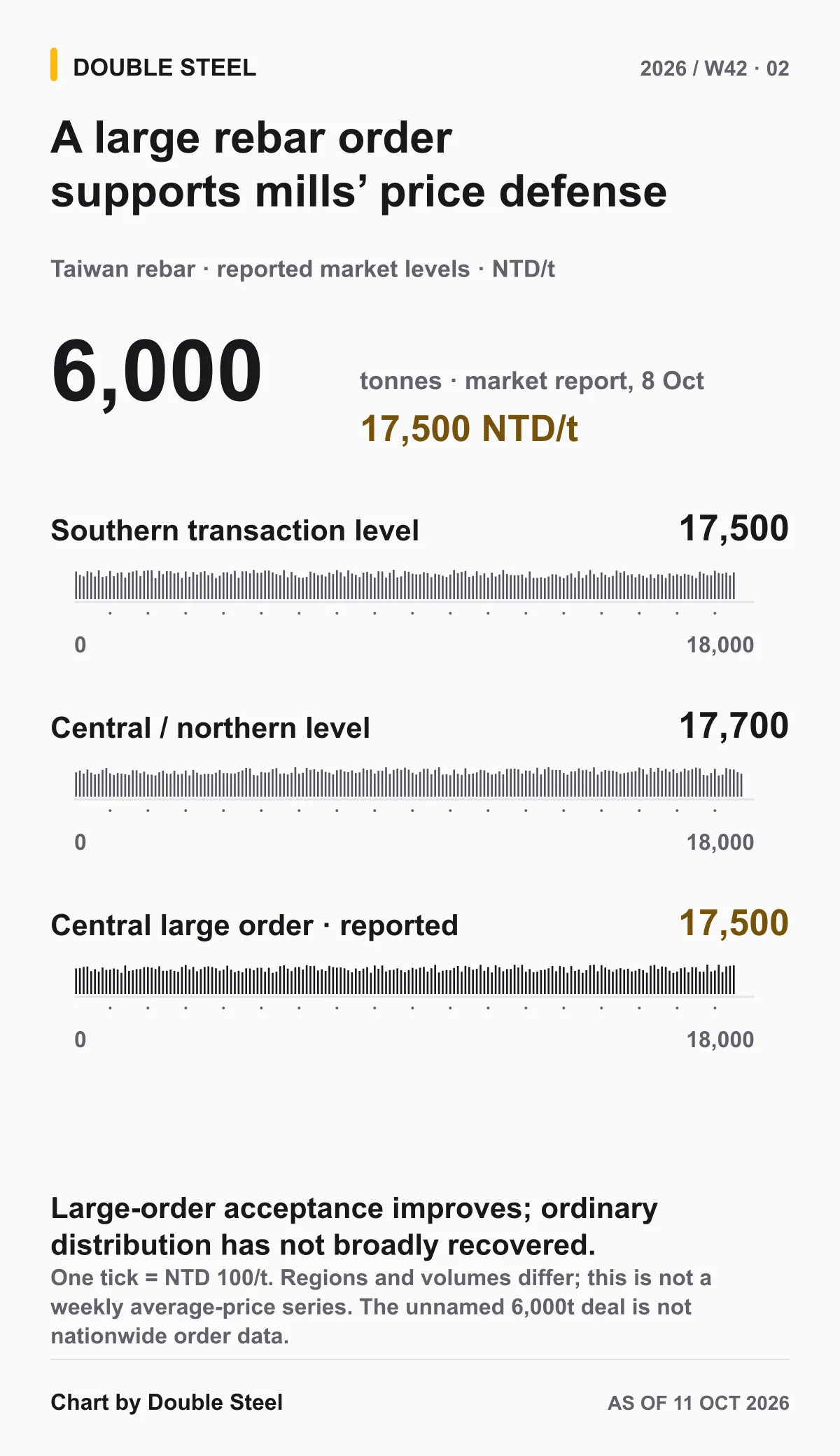
Reported rebar transaction levels this week were approximately NTD 17,500/t in southern Taiwan and NTD 17,700/t in central and northern Taiwan. Quantity, payment, and delivery terms still affect individual negotiations. Buyers seek lower prices, while mills hold their price positions because of imported raw-material costs.
A 6,000-tonne order is a new signal, not a nationwide order statistic
On October 8, market reports suggested that a large distributor had purchased approximately 6,000 tonnes of rebar from a leading central Taiwan mill at NTD 17,500/t.
The significance is that even a large-volume purchase did not materially undercut the mills' defended price range, and a buyer was willing to take material. Compared with earlier weeks' discussion of mills withholding offers or a buyer–seller standoff, this period adds a buying signal with a specific quantity and price, suggesting improving rebar order intake.
However, the split between improved project and large-order demand in W40 and continued distribution of cheaper old stock through general channels in W41 has not disappeared because of one transaction. The central Taiwan large order and earlier southern resale prices differ in region, quantity, and trading level. Subtracting one from the other would not establish a rise in Taiwan's average rebar price.
The more appropriate reading is “greater acceptance of localized large orders, with distribution destocking yet to broaden.” Wider price pass-through would require ordinary distributors to replenish repeatedly near mills' new price levels and the gap between old-stock resale and new mill prices to narrow.
Scrap is another key factor. Continuing Japanese buying-price increases and higher US monthly prices for some grades mean electric-arc-furnace mills may not share the cost benefits of lower iron ore. Taiwan's subsequent rebar pricing still depends on actual imported scrap transactions, finished-steel shipments, and whether order intake continues.
Chapter 3: China shifts from destocking to a holiday inventory build; flat-steel pressure predates this week
Total stocks of the five major products rise, with deeper HRC accumulation
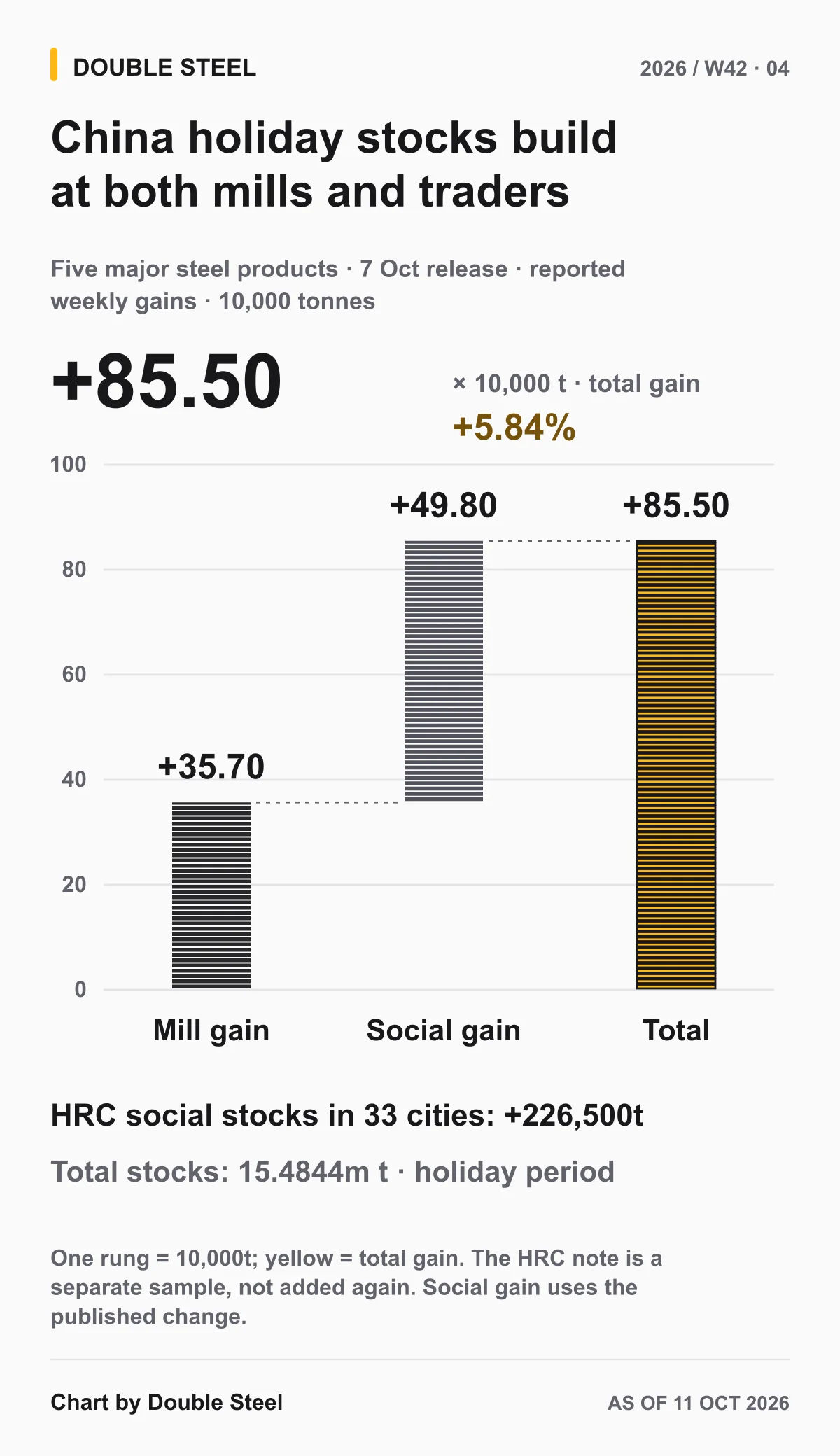
Mysteel's five-product data published on October 7 show weekly production of 7.9493 million tonnes, up 17,500 tonnes; mill stocks of 4.2024 million tonnes, up 357,000 tonnes; and social stocks of 11.2820 million tonnes, with a reported weekly increase of 498,000 tonnes. Combined mill and social stocks reached 15.4844 million tonnes, up 855,000 tonnes, or approximately 5.84%.
This reporting period includes the National Day holiday. Interrupted pickups and construction activity, alongside continuing mill production, are important reasons for the inventory increase. The holiday build should therefore not be read as a full post-holiday working week's demand result.
Flat-steel pressure, however, cannot be attributed entirely to the holiday. HRC, plate, and CRC social stocks had already risen together in W41. China's September HRC market review also described increasing supply and downstream purchases mainly for immediate needs. By October 8, HRC social stocks across 33 cities had risen to 3.8075 million tonnes from 3.5810 million tonnes, an increase of 226,500 tonnes, or approximately 6.33%. The pre-holiday supply–demand gap thus persisted through the break.
Post-holiday construction-steel trading rebounds, but flat-steel volumes have not necessarily followed
On October 9, Mysteel's nationwide construction-steel trading volume reached 113,976 tonnes, up 26.1% from the previous day. This is a positive sign of trading resuming after the holiday and shows why holiday stocks alone should not be used to characterize all demand as continuing to weaken.
However, the figure measures a single day's construction-steel trading, not manufacturing demand for HRC and CRC. Concentrated post-holiday replenishment may also not sustain the same growth rate. For long products, the question is whether trading continues through the next full working week. For flats, it is whether stocks of products such as HRC stop rising and processors' orders improve.
Baosteel holds prices while Shagang raises them: Chinese mills are not moving together
On October 10, Baosteel announced unchanged November prices for major products including HRC, CRC, plate, pickled material, and coated steel, ending three consecutive months of increases. This is a clear change toward slower supply-side price increases.
Meanwhile, Shagang raised early-October ex-works construction-steel and HRC prices by CNY 100/t from the previous pricing period. Mills, products, and pricing cycles differ, reflecting a market where price defense and adjustments coexist rather than one in which all prices are uniformly unchanged.
Vietnam makes only modest increases, constrained by demand and processors' selling prices
Vietnam's Hoa Phat and Formosa Ha Tinh Steel raised November HRC prices by approximately USD 8/t and USD 10/t, respectively. Reported new levels are around USD 555–556/t CIF for Hoa Phat and USD 555–570/t CIF for Formosa Ha Tinh. Preferential terms for large buyers taking around 20,000 tonnes are approximately USD 543–548/t CIF.
The increases were smaller than earlier market expectations. Although local trading has been relatively stable, demand, financing costs, and processors' selling prices limit the scope for increases.
CSC's catch-up increases in Taiwan, Baosteel's unchanged prices, and modest Vietnamese increases coexist, showing how Asian pricing increasingly reflects local supply, product mix, and buyers' ability to absorb costs.
Chapter 4: Raw-material divergence brings blast-furnace cost relief but continued pressure on EAF mills to defend prices
Iron ore remains weak after the holiday; a low-level rebound has not changed the cost direction
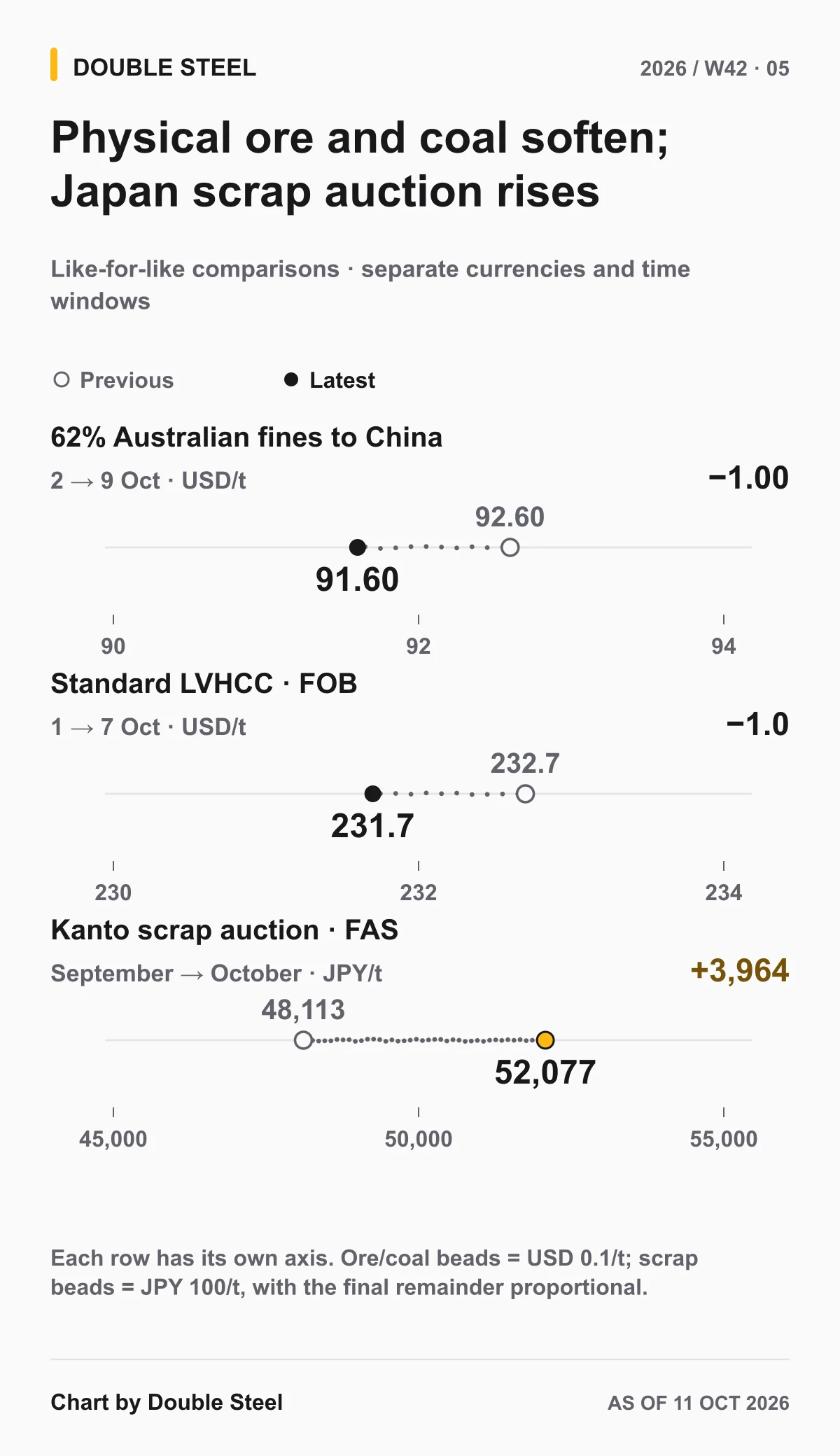
Iron ore briefly rebounded during the week but remained under pressure after the holiday. The reported price of 62% Australian fines shipped to China fell to around USD 91.60/t on October 9, approximately 1.08% below USD 92.60/t on October 2 in the same series.
Higher Chinese port inventories and low mill margins limit price-chasing, keeping purchases tied to immediate needs. Lower ore prices provide room for blast-furnace mills to repair costs, but if finished-steel prices and shipments are also under pressure, not all of that cost reduction translates into better margins.
Compared with W38, the listed USD iron ore benchmark is down approximately 7.49%, while the international HRC benchmark remains approximately 3.30% higher.
Coking coal and coke: the benchmark rebounds, while physical grades remain differentiated
The listed coking coal benchmark rebounded this week, but standard seaborne low-volatile hard coking coal did not show the same trend. A market report for October 7 put standard LVHCC at around USD 231.7/t FOB, below the previous approximately USD 232.7/t. Premium coking coal and standard hard coking coal differ in quality, trading terms, and price spreads; an increase in one benchmark does not imply strength across all metallurgical coal.
China's coke market has moved from implementation of the first-round cuts in W41 to notices for a second round. On October 9, some mills proposed reductions of CNY 100/t for wet-quenched coke and CNY 110/t for dry-quenched coke, requesting implementation from October 12. Indian coking coal supply also offers a relevant international development: BCCL reported provisional September raw coking coal production of 2.49 million tonnes, up 21.5% year on year, although cumulative April–September production remained down 12.0%.
Scrap: Japan rises again, while the US, India, and Turkey follow different rhythms
Japan's Kanto scrap export auction on October 9 achieved JPY 52,077/t FAS for approximately 20,000 tonnes, up JPY 3,964/t from September.
Tokyo Steel raised domestic scrap buying prices from the same date. Its original price tables show increases of JPY 500–1,000/t depending on location and grade, with H2 prices around JPY 49,000–51,500/t. Following W41's adjustment, Japanese mills have raised buying prices again, extending supply-side price support.
Other regions are not moving uniformly. US October monthly settlements reportedly increased for shredded scrap and PNS, with more limited changes in prime new scrap. Indian imported containerized shredded scrap was around USD 405/t CFR on October 7, slightly above the previous level. In Turkey, buyers were resisting higher offers and transactions were encountering obstacles.
Tangshan billet's latest available ex-works price fell from the previous period, providing a reference for alternative feedstock costs. Imported billet, however, also involves shipment timing, ocean freight, rolling losses, and finished-product shipments.
Chapter 5: Round bar and special steel — faster inventory accumulation and limited momentum for spot increases
Mill and social stocks rise together, with more inventory pressure than before the holiday
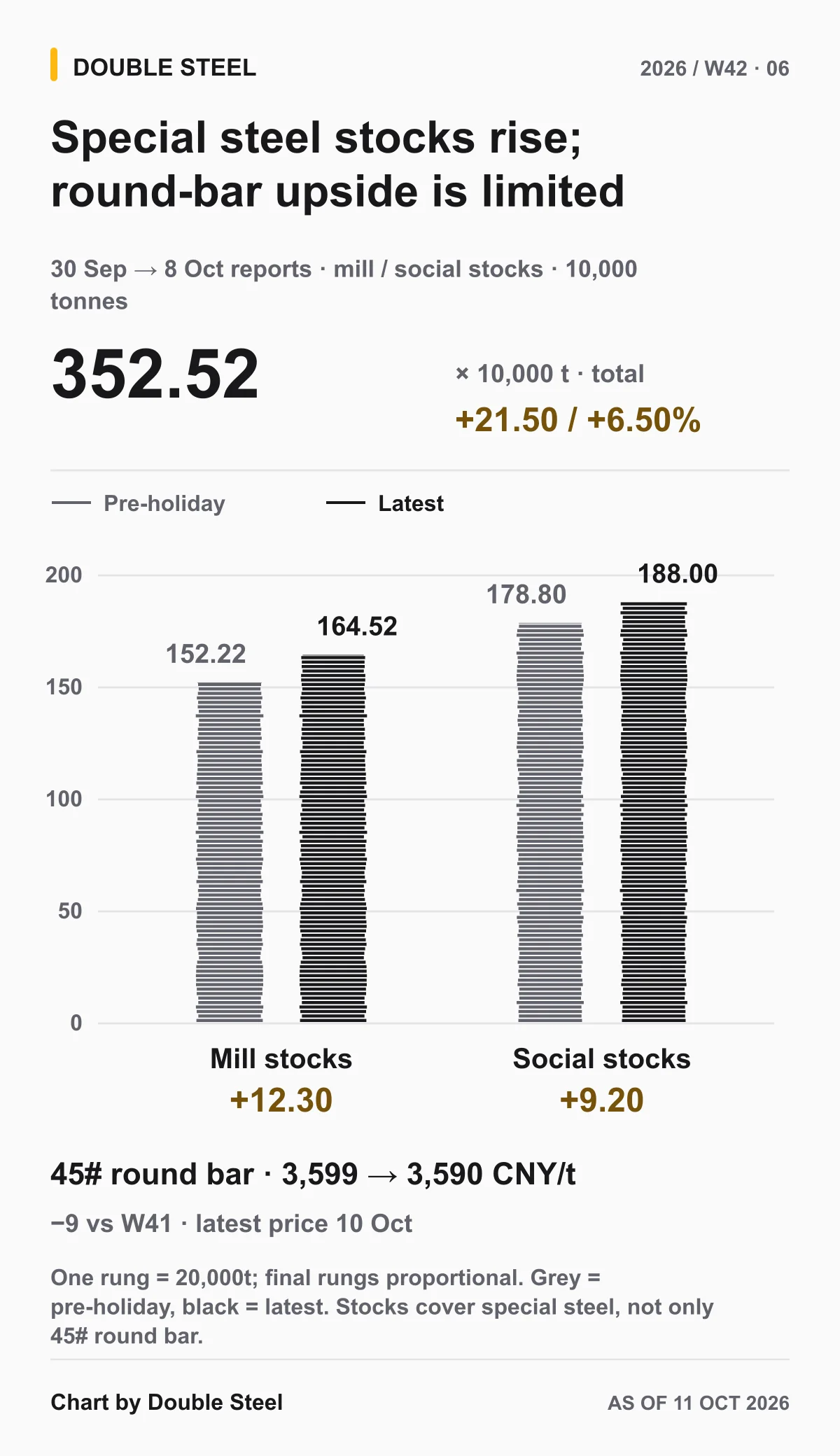
Mysteel's nationwide special-steel inventory weekly report dated October 8 shows stocks at 46 sampled mills of 1.6452 million tonnes, up 123,000 tonnes from before the holiday; social stocks were 1.8800 million tonnes, up 92,000 tonnes. Combined stocks rose from 3.3102 million tonnes in W41 to 3.5252 million tonnes, an increase of 215,000 tonnes, or approximately 6.50%.
Compared with W41's increase of 30,100 tonnes, accumulation accelerated markedly. Slower holiday pickups are an important factor, but simultaneous increases at mills and distribution channels mean there is more material to absorb after the holiday, rather than merely a transfer from mills to traders.
45# round steel edges lower; firmer futures have not lifted spot prices
As of October 10, the national average price of 45# carbon structural round steel, diameter 29–85 mm, was CNY 3,590/t, CNY 9/t below W41's CNY 3,599/t. Warehouse-pickup prices were around CNY 3,530/t in Hangzhou and CNY 3,500/t in Wuxi, both approximately CNY 10/t below pre-holiday levels. Post-holiday prices remain mainly stable to slightly lower, without a catch-up increase.
Mysteel's daily market report on the same date said that the previous trading day's futures gains improved sentiment but did not effectively pass through to special-steel spot prices. Stocks are growing faster while spot prices have slipped only slightly, indicating that the main pressure is a constrained rebound rather than a sharp price fall: traders have more material on hand, less urgency to replenish at higher prices, and trading remains driven by end users' immediate needs.
September's market review also showed ordinary carbon structural and alloy structural steel constrained by traditional machinery orders and working capital, while some long-term contracts supported bearing and gear steel. In W42, faster special-steel stock accumulation coincides with stagnant ordinary round-bar spot prices. Unlike Taiwan's flat-steel catch-up driven by new mill costs, China's ordinary round-bar market currently lacks the conditions to turn higher offers into sustained transactions. The benefits of post-holiday reopening remain concentrated in resumed purchasing, rather than expanded buying at higher prices.
Chapter 6: Four-week trends and next-week watchpoints
From W38 to W42, where has improvement been concentrated?
W38 featured limited acceptance of prices after mill increases, with Chinese destocking concentrated in rebar. In W39, destocking broadened to some flat products and price pass-through became more evident in Taiwan's flat steel. W40 saw localized improvement in project and large-order demand, while pre-holiday pickups helped Chinese destocking. By W41, Taiwan's flat-steel market had new import transactions, but cheaper inventories still constrained rebar distribution prices, and Chinese flat-steel stocks were rising again.
W42 adds CSC's formal new prices and an individual large rebar order in Taiwan, alongside holiday stock accumulation and a one-day post-holiday construction-steel trading rebound in China. Flat-steel supply–demand pressure did not emerge suddenly, and rebar improvement has not spread to all channels. Over the past month, support for particular products and transactions has become more concrete, but general distribution inventory and price pass-through problems remain unresolved.
Exchange rates add modestly to import costs. The USD/TWD spot selling rate rose by 0.03 from W41. For material valued at USD 550/t, that change alone adds approximately NTD 16.5/t to the purchase cost. Although small, it should be considered alongside USD offers, freight, and payment timing.
Key watchpoints for next week
- Whether Taiwan's HRC distribution prices approach sellers' catch-up targets and generate continuing shipments, rather than just higher offers.
- Whether large rebar orders broaden into ordinary distributors' buying, whether the gap between old-stock resale and new mill prices narrows, and the outcome of next week's formal mill pricing.
- Whether construction-steel trading continues through China's first full working week after reopening and whether HRC and other flat-steel stocks stop rising; holiday replenishment and sustained demand should be distinguished.
- The actual implementation scope of second-round coke cuts, transactions across different seaborne coking coal grades, and iron ore purchasing for immediate needs.
- Whether high Japanese scrap prices pass through to actual Taiwanese import transactions, and whether other origins or billet offer viable alternative costs.
- Whether repairs to damaged Japanese production lines, Vietnamese preferential terms, and import shipment schedules affect the flat-steel specifications available to Taiwan.
Conclusion
W42 is neither a uniformly stronger nor a uniformly weaker week. Higher Taiwanese flat-steel mill prices and buying through an individual large rebar order give suppliers more concrete support for holding prices. However, HRC distribution prices have not fully caught up with costs, and ordinary rebar channels still face inventory-clearance pressure.
Chinese flat-steel pressure coexists with a post-holiday rebound in construction-steel trading, while pricing rhythms differ across Asia. In raw materials, weaker iron ore and some physical coal and coke markets contrast with firmer scrap in Japan and certain other regions, leaving blast-furnace and electric-arc-furnace steelmakers in different cost environments.
Data sources: TradingEconomics (market data through October 8–9, 2026), E.SUN Bank (USD/TWD spot exchange rate, queried October 11, 2026), Mysteel (data through October 7–10, 2026), domestic and international steel news (through October 10, 2026), Tokyo Steel (domestic scrap buying-price tables effective October 9, 2026), and BCCL / India's NSE filings (provisional September and April–September 2026 production; announcement dated October 1, 2026).
This report is issued by the Market Research Department of Double Steel Co., Ltd. for market research and procurement assessment only. It does not constitute the final basis for investment or direct procurement decisions.