
Publication date: October 19, 2026
Market and news cutoff: October 18, 2026
Exchange-rate reference: USD/TWD spot selling rate 32.42
W43 centers on “mill prices keep rising, spot prices struggle to follow; China resumes destocking, while a weaker Taiwan dollar raises replenishment pressure.” Chung Hung has followed with higher November domestic prices, but Taiwan's HRC distribution prices remain within last week's range. In rebar, mills continue defending prices while distributors resell cheaper material, and earlier large orders have not prompted ordinary buyers to pay more. Compared with the previous four weeks, the central issue has shifted from whether mills can announce increases to how those higher costs can be passed through.
China's first full post-holiday working week brought tangible improvement: total stocks of the five major steel products fell by 686,100 tonnes, offsetting about 80% of the previous period's holiday build, with HRC also returning to destocking. However, rebar still accounted for most of the net decline in social stocks; cold-rolled stocks were nearly unchanged, plate stocks rose, and flat-steel prices did not strengthen in parallel. Demand has recovered, but the rebound remains concentrated in certain products and post-holiday pickups.
Among raw materials, China's second round of coke price cuts took effect, iron ore rebounded late in the week, and seaborne coking coal diverged by quality. Scrap remained firm in Japan, while some import markets in India and Turkey softened. For Taiwan, depreciation of the local currency has offset much of the benefit from lower US-dollar offers. Blast-furnace cost relief and electric-arc-furnace cost pressure remain two different stories.
Key figures and comparison with the previous four weeks
| Indicator | W39 | W40 | W41 | W42 | W43 latest | Change vs W42 cutoff |
|---|---|---|---|---|---|---|
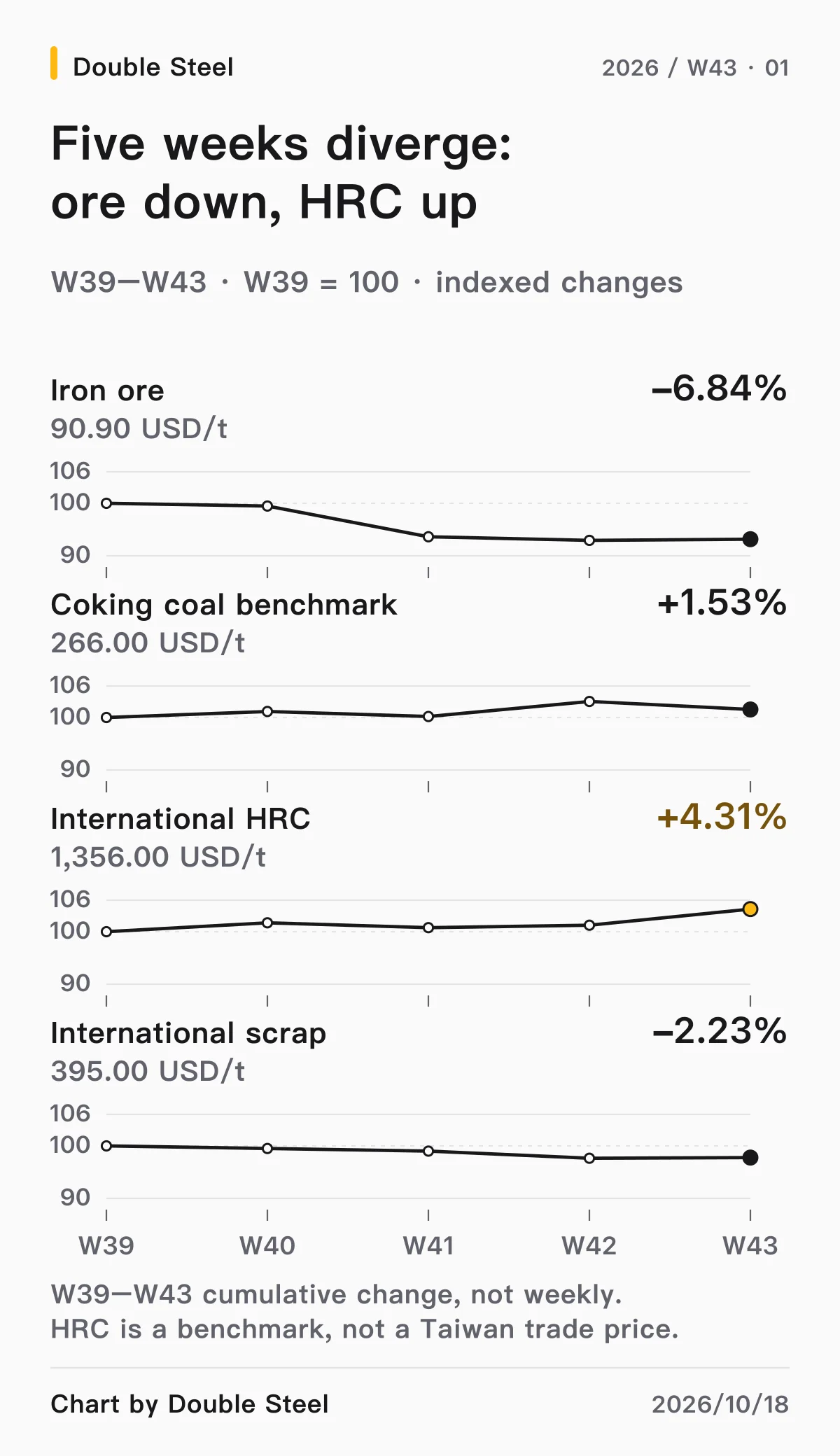
| Iron ore (USD/t) | 97.57 | 97.06 | 91.35 | 90.68 | 90.90 | +0.24% |
| Iron ore (CNY/t) | 715.50 | 713.50 | 702.50 | 682.50 | 672.50 | -1.47% |
| Coking coal benchmark (USD/t) | 262.00 | 265.00 | 262.50 | 270.00 | 266.00 | -1.48% |
| International HRC benchmark (USD/t) | 1,300.00 | 1,322.00 | 1,310.00 | 1,316.08 | 1,356.00 | +3.03% |
| International scrap benchmark (USD/t) | 404.00 | 402.00 | 400.00 | 394.50 | 395.00 | +0.13% |
| Rebar/steel benchmark (CNY/t) | 3,099.00 | 3,107.00 | 3,109.00 | 3,099.00 | 3,089.00 | -0.32% |
| Tangshan common billet, ex-works (CNY/t) | 3,000 | 3,010 | 2,980 | 2,950 | 2,950 | Unchanged |
| USD/TWD spot selling rate | 31.87 | 31.85 | 31.91 | 31.94 | 32.42 | +0.48 |
| USD/CNY | 6.69531 | 6.72040 | 6.70627 | 6.69259 | 6.68630 | -0.09% |
The coking coal and international scrap benchmarks use October 15 data; the other listed commodity benchmarks and USD/CNY use October 16 data. Tangshan common billet is the October 18 mainstream Qian'an ex-works price. The E.SUN exchange rate was queried on October 18. Changes are calculated between each weekly report's cutoff observations; the USD/TWD change is an absolute difference. The international benchmarks are separate from the grade-specific physical quotations discussed below.
Chapter 1: Chung Hung follows with an increase, but flat-steel distribution prices stall
Domestic replenishment costs rise before spot prices catch up
On October 14, Chung Hung announced November domestic increases of NTD 900/t for hot-rolled, cold-rolled and galvanized products, following CSC's price increase the previous week. Higher replacement costs are becoming more definite for processors and distributors using domestic substrate.
However, market reports on October 14 still put HRC distribution prices for buyer pickup at around NTD 19,500–19,800/t, unchanged from W42. Sellers' catch-up target of NTD 20,000–20,300/t has not become the prevailing transaction range. Distribution prices rose gradually in W39–W40 but have now stalled, with the lag between new mill prices and spot sales squeezing margins on subsequent replenishment.
The pressure in flat steel this week is not a lack of mill-price increases, but processors' inability to raise selling prices in step. Sellers with older, cheaper inventory can still make deliveries, while new buyers must take the higher mill prices. Participants may be defending prices, but their ability to absorb costs differs.
Indonesian HRC trades at a lower dollar price, but currency depreciation absorbs most of the saving
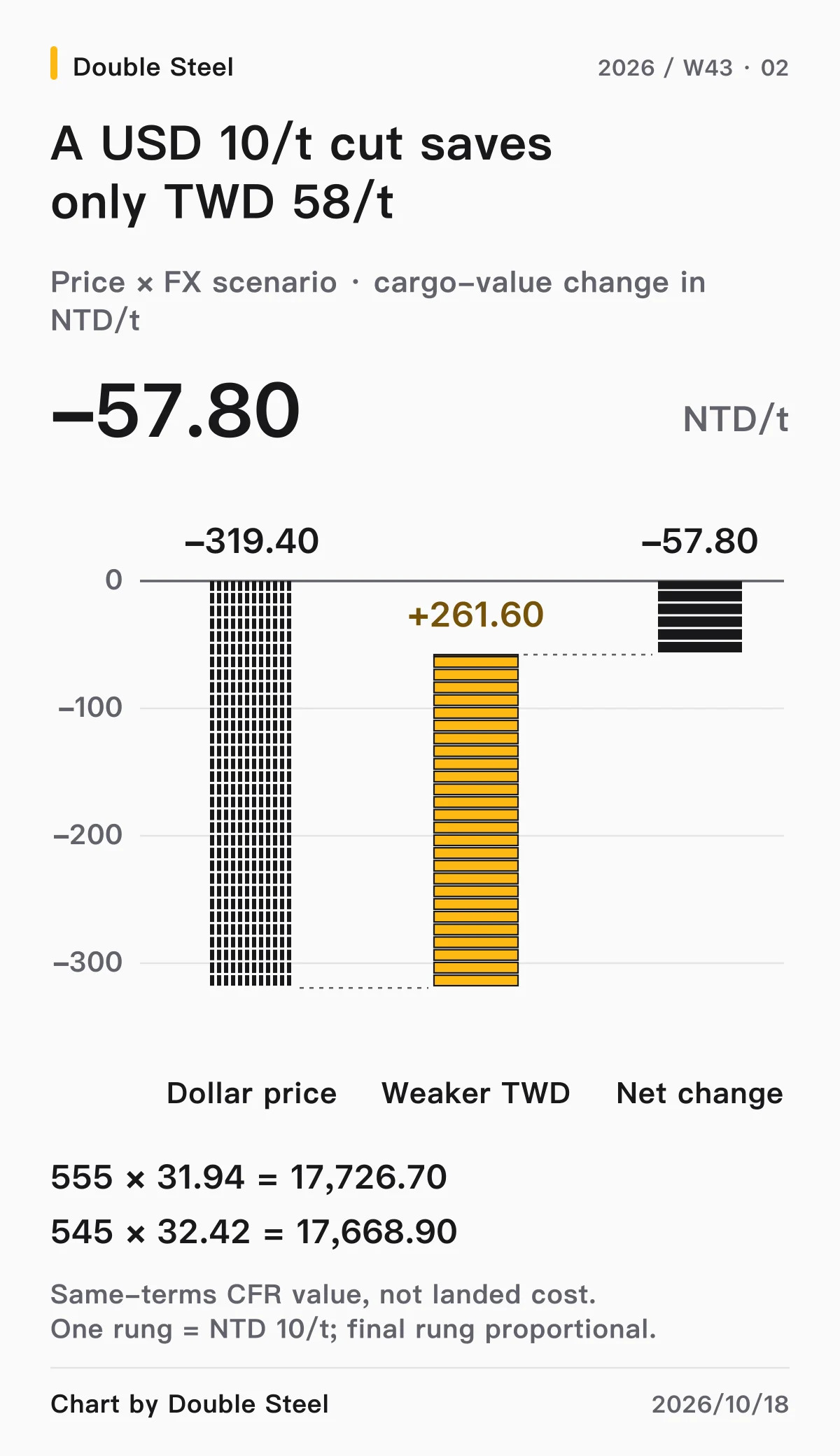
A new import transaction has provided a lower price reference. A report published on October 16 indicated that approximately 5,000 tonnes of Indonesian HRC had traded to Taiwan at USD 545/t CFR, below the USD 554–556/t CFR reported for earlier batches. This gives buyers a fresh bargaining reference, although specifications, shipment timing and payment terms affect comparisons between batches.
The Taiwan dollar has significantly changed the cost conversion. E.SUN's spot selling rate rose from 31.94 in W42 to 32.42. Using USD 555/t, the midpoint of the earlier reported range, with the W42 exchange rate and holding other conditions constant, the cargo value converts to NTD 17,726.70/t. USD 545/t at this week's exchange rate converts to NTD 17,668.90/t—a reduction of only about NTD 58/t.
Lower dollar prices have therefore created room for negotiation, but Taiwan-dollar replenishment costs have not fallen by the same magnitude. At a fixed cargo value of USD 545/t, this week's exchange-rate movement alone adds approximately NTD 262/t to the currency-conversion outlay.
POSCO presents a different set of price levels: its HRC offer to Taiwan is around USD 620/t CFR, while the reported USD 600/t remains a possible negotiated level. Pickled coil has separately been reported traded at USD 625/t CFR. High offers, negotiation assessments and transactions in different products coexist; the import market is not moving uniformly lower at one price.
Chapter 2: Large rebar orders have not prompted higher bids; finished steel and raw materials pull in different directions
Feng Hsin holds for a third week, while cheaper material remains in distribution
On October 12, Feng Hsin left rebar, scrap and section-steel prices unchanged for a third consecutive week. Its rebar base price remained NTD 18,300/t, scrap buying base price NTD 9,800/t, and section-steel price NTD 25,000/t. Negotiated rebar market levels were still approximately NTD 17,500/t in southern Taiwan and NTD 17,700/t in central and northern Taiwan, while buyer indications leaned toward NTD 17,300–17,500/t.
Southern distributors still had resale material at around NTD 17,300/t, extending the gap between new and older material seen since W41. Although mills are defending prices, buyers can still find cheaper material in distribution; ordinary replenishment has not turned into buying at higher prices.
Compared with the improvement in project and large-order intake, support remains concentrated in specific transactions rather than a broad increase in ordinary distribution volumes. Large orders improve order visibility, but cheaper old stock and volume discounts restrain finished-steel price increases. That is the more immediate contradiction in this week's rebar market.
Imported scrap is not cheap, limiting EAF margin relief from lower raw-material prices
US containerized scrap offers to Taiwan are around USD 350–355/t CFR, with the lowest tradable level assessed at approximately USD 347–348/t and limited tonnage available at the low end. Japanese 50:50 scrap offers of around USD 385–390/t CFR remain well above Taiwanese bids of approximately USD 355–360/t.
Finished-steel price increases are meeting resistance, while sufficient cheaper raw material has yet to emerge. Together with the weaker Taiwan dollar, this concentrates pressure on mill margins, not just order volumes. Lower iron ore and Chinese coke prices help blast-furnace producers, but do not provide equivalent cost relief to Taiwan's scrap-based EAF mills.
Long products are also diverging internally. Tung Ho raised H-beam prices by another NTD 500/t this week, bringing the combined increase across two adjustments to NTD 1,000/t. Sections have progressed further in price adjustment than ordinary rebar; one long-product trend does not describe both.
Chapter 3: China resumes destocking, led by long products; flat-steel improvement is uneven
About 80% of the holiday inventory build has been offset
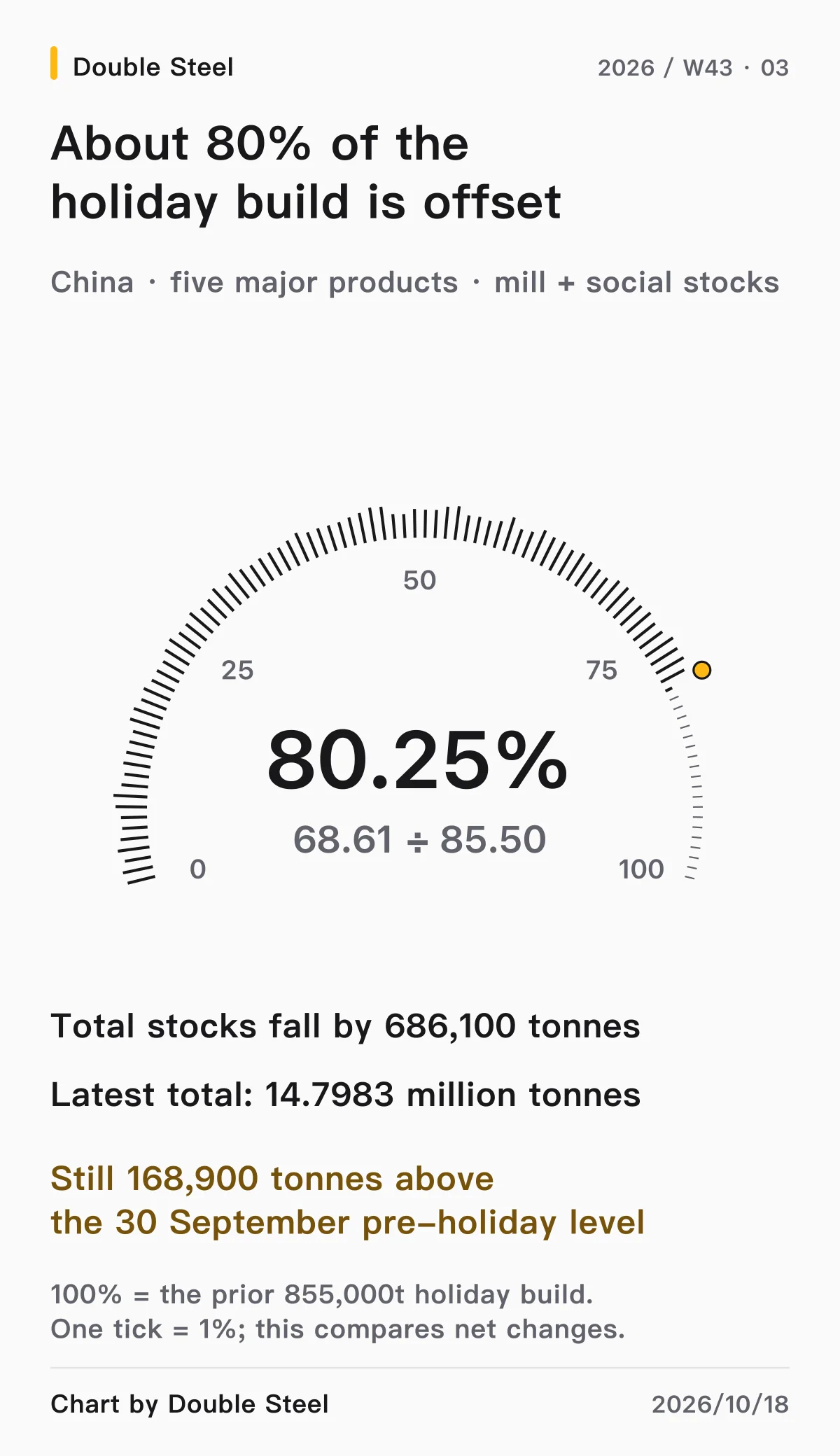
Mysteel data published on October 16 put weekly production of the five major steel products at 7.9452 million tonnes, down only 4,100 tonnes. Total stocks fell from 15.4844 million to 14.7983 million tonnes, a reduction of 686,100 tonnes, or about 4.43%. With production nearly unchanged, the inventory decline mainly reflects resumed post-holiday pickups rather than substantial production cuts.
Apparent consumption recovered to 8.6313 million tonnes, approximately 21.7% above the low holiday base. This period's stock drawdown is equivalent to about 80% of the previous period's 855,000-tonne holiday build. Total stocks are now only 168,900 tonnes above the September 30 pre-holiday level. W42's inventory pressure has genuinely eased; describing post-holiday demand as still absent no longer fits the evidence.
Trading volumes did not expand continuously, however. Mysteel's weekly construction-steel review described concentrated trading on the first day after the holiday, followed by lower volumes, with buying still driven mainly by immediate needs at low prices. This week's sharp recovery primarily reflects a return to normal trading and construction activity. Further price gains depend on continued pickups.
HRC also destocks, but plate rises and cold-rolled stocks are almost flat
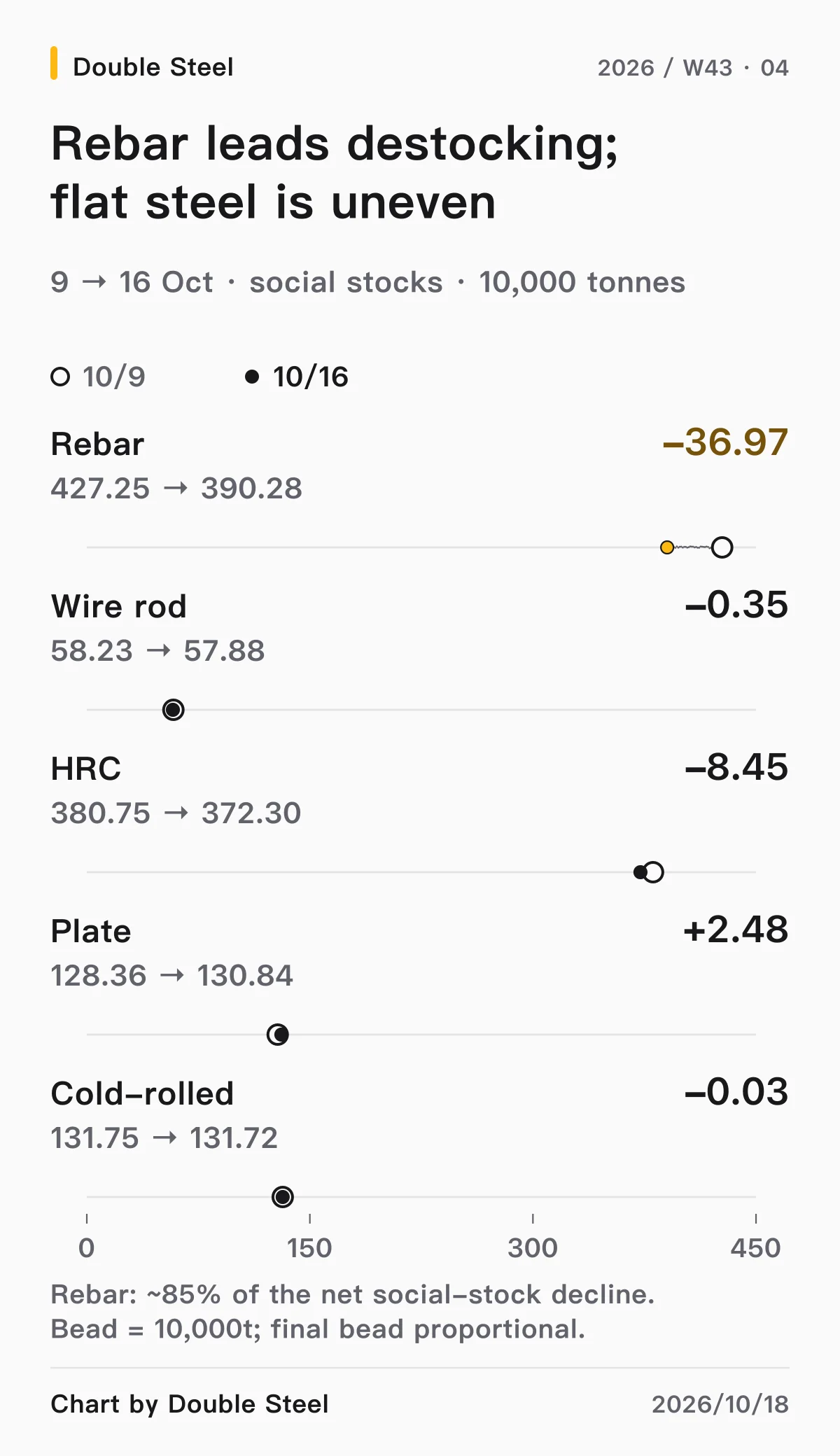
Within the same October 9–16 social-stock series, inventories of the five major steel products fell from 11.2634 million to 10.8302 million tonnes, down 433,200 tonnes. Rebar fell by 369,700 tonnes, accounting for approximately 85% of the net decline; HRC fell by 84,500 tonnes and wire rod by 3,500 tonnes. Cold-rolled stocks edged down by only 300 tonnes, while plate increased by 24,800 tonnes.
Improvement is therefore no longer confined to construction steel: HRC has also returned to destocking. Differences within flat steel remain substantial, however. HRC social stocks in 33 cities fell to 3.7230 million tonnes, still 142,000 tonnes above the pre-holiday 3.5810 million. Supply accumulated during and before the holiday has not been fully absorbed.
Prices also show resistance to a rebound. Mysteel's HRC weekly report lists an average of CNY 3,276/t for 4.75 mm HRC across 24 cities, CNY 22/t below October 10. Resumed destocking eases supply pressure but has not yet turned HRC spot prices upward. Stalled cold-rolled stock clearance and further plate accumulation also leave flat-steel recovery behind long products.
Chapter 4: Coke cuts take effect, iron ore rebounds, and regional scrap trends diverge further
Blast-furnace cost relief becomes more tangible; seaborne coal still varies by quality
China's second round of coke price cuts took effect from October 12, reducing wet-quenched coke by CNY 100/t and dry-quenched coke by CNY 110/t. Compared with W42's notices, implementation now makes blast-furnace raw-material cost relief more tangible. A third round remains a market expectation, not an implemented cost benefit.
Iron ore did not move steadily lower. Physical 62% Australian fines shipped to China fell to USD 91.15/t CFR on October 15, then recovered to USD 92.40/t the following day. The late-week rebound contrasts with the previous week's continued decline. Nevertheless, the listed dollar iron ore benchmark remains approximately 6.84% below W39, leaving medium-term cost levels lower than a month earlier.
Seaborne metallurgical coal is also diverging. On October 15, standard low-volatile hard coking coal, or LVHCC, was around USD 233.3/t FOB, holding after the previous day's recovery. Premium low-volatile coal, or PLV, was around USD 268/t FOB, slightly lower on the day. Standard hard coking coal, premium coal and the listed coking coal benchmark differ in quality and pricing basis; this week shows mixed performance rather than a uniform decline across coking coal.
Japan rises again, while import buyers in India and Turkey turn more cautious
Tokyo Steel broadly raised buying prices for standard scrap grades by JPY 1,000/t on October 14, followed by further increases at selected sites and for selected grades on October 17. Relevant grades at Utsunomiya and Tokyo Bay received another JPY 1,000/t, with larger increases for some new-production scrap grades. Repeated increases in Japanese domestic buying prices continue to support export supply prices.
US domestic October monthly settlements also increased by around USD 10–30 depending on region and grade, but import markets have not followed uniformly. Indian containerized shredded scrap was referenced at around USD 395/t CFR, with offers still at USD 400–405/t but buyer indications at only approximately USD 375–385/t. In Turkey, US-origin material was around USD 395/t CFR and European material around USD 385–390/t, with buyers resisting higher prices.
Compared with W42's strength in Japan and some other regions, scrap divergence has become more pronounced. Firm Japanese prices have not automatically lifted every import market, and Taiwan has not secured sufficient cheaper material. Finished-steel price tolerance and the exchange rate continue to constrain purchasing.
In Tangshan, the mainstream Qian'an common-billet ex-works price was CNY 2,950/t on October 18, unchanged from W42. Low, stable billet prices provide a reference for alternative raw materials, but Taiwan's workable import terms still depend on rebar selling prices and dollar-conversion costs.
Chapter 5: Round-bar mill prices stay flat; inventory improvement is concentrated in parts of the chain
Feng Hsin and Wei Chih kept bar and wire-rod prices unchanged for their 510 pricing round, marking a sixth consecutive unchanged round, with corresponding base prices of NTD 25,700/t and NTD 25,200/t. While flat-steel mill prices have risen repeatedly, ordinary round bar and wire rod have not shown the same pricing momentum.
Chinese prices also remain soft. Mysteel's October 16 national average for 45# carbon structural round steel, diameter 29–85 mm, was CNY 3,580/t, CNY 10/t below the same specification in W42. Hangzhou warehouse-pickup prices were around CNY 3,520/t, down CNY 10/t over the week, while Wuxi remained at approximately CNY 3,500/t.
There is additional evidence of destocking this period. Lange's special-steel weekly report published on October 16 shows stock reductions in its mill survey, with declines in Shandong but further accumulation at some Jiangsu mills. Social stocks in its 25-city survey edged lower as of October 16. Post-holiday pickups have absorbed some material, but clearance rates differ by region and between mills and distribution channels.
China's special-steel market now shows more noticeable mill destocking and slower clearance in distribution, with little upward price momentum and pressure concentrated in particular regions and parts of the chain. For ordinary round bar in Taiwan, softer Chinese spot prices alongside repeated local bar and wire-rod price holds suggest weak pricing momentum for general grades. These products have not joined flat steel's cost-driven price increases.
Chapter 6: The previous four weeks—trading recovers, but price pass-through remains difficult
Global recovery forecasts are lowered, while regional prices diverge further
In its latest Short Range Outlook released on October 12, worldsteel cut its 2026 global steel demand forecast from 0.3% growth to approximately 1.722 billion tonnes, unchanged from the previous year. Chinese demand is projected to fall by 2%. Global demand growth in 2027 is forecast at 1.7%, below the earlier 2.2%; projected growth of 4% outside China concerns next year's recovery prospects.
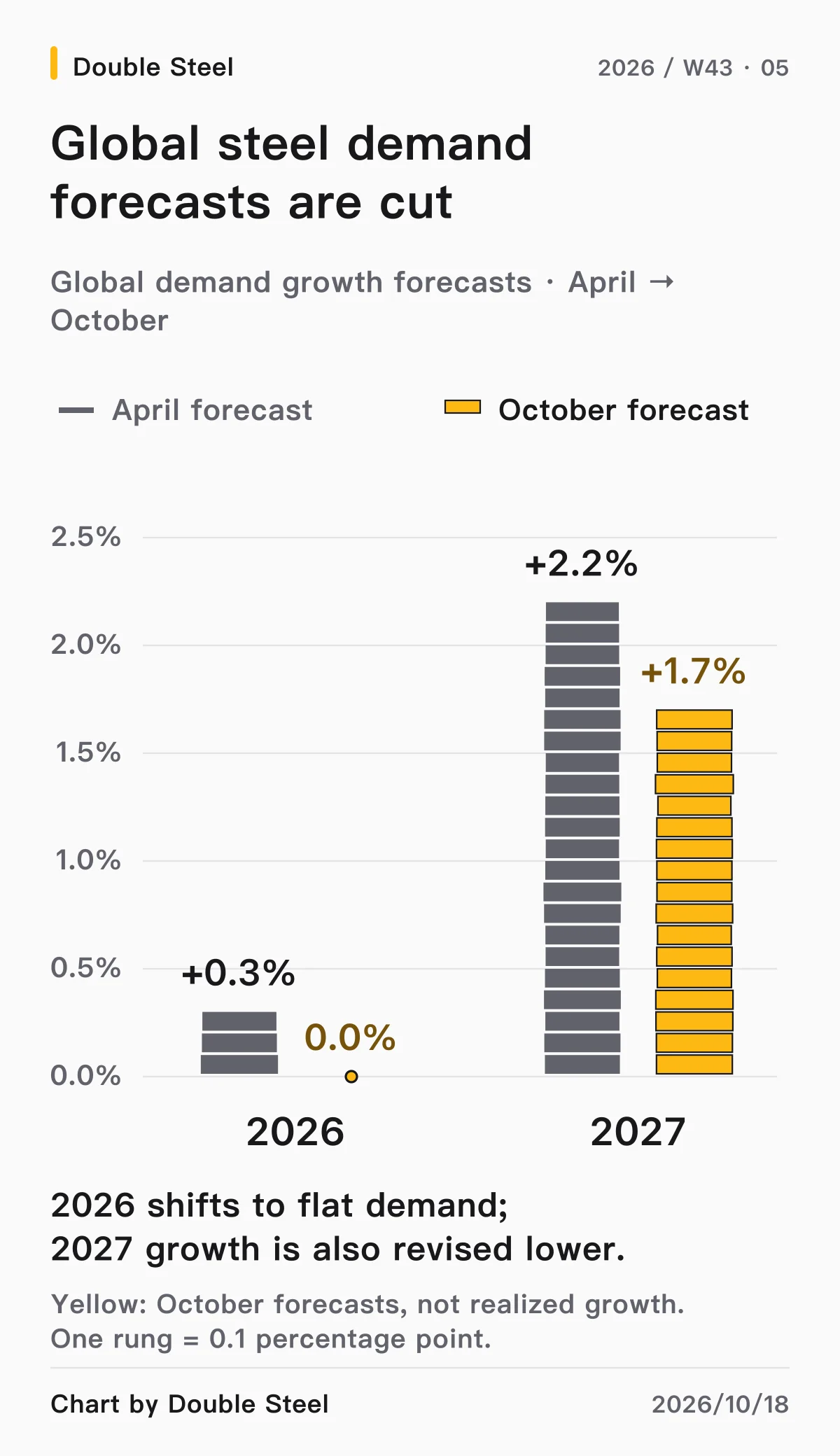
The outlook indicates that supply-side price increases this year still face a modest demand backdrop, leaving regional supply–demand conditions and product terms more influential. Reported US physical HRC spot prices rose further to around USD 1,300/short ton this week, contrasting with lower offers for some Asian HRC imports. Similarly, the increase in the listed international HRC benchmark cannot be applied directly as an equivalent rise in ordinary HRC transaction prices in Taiwan or Asia.
Recent four-week observations: the locations of support and resistance have shifted
In W39, Taiwan's flat-steel price catch-up progressed more smoothly, while Chinese destocking spread from long products to some flat products. W40 brought improved Taiwanese project and large-order demand, alongside Chinese pre-holiday pickups that helped reduce stocks. In W41, new flat-steel import transactions emerged, but ordinary rebar distribution remained constrained by cheaper inventory, and Chinese flat-steel stocks began rising again.
W42 added CSC's formal price increase and individual large rebar orders, while China accumulated inventory over the holiday. By W43, Chinese destocking has resumed and Chung Hung has followed with higher prices, but Taiwan's HRC distribution prices have not advanced further and ordinary rebar bids have not moved materially higher. Improvement has progressed from isolated transactions to lower Chinese stocks, while Taiwanese price pass-through remains stuck in distribution.
The exchange rate is another new pressure. Since W39, the dollar iron ore benchmark has fallen and the international scrap benchmark is also lower, but the USD/TWD spot selling rate has risen from 31.87 to 32.42. Different production routes are affected differently, and the weaker Taiwan dollar means local businesses' cost experience does not move in step with international dollar prices.
Key developments to watch next week
- Whether Taiwan HRC can sustain transactions above NTD 20,000/t, narrowing the gap between new mill-price costs and distribution selling prices.
- Whether ordinary rebar bids move closer to the levels mills are defending, and whether southern resale material at around NTD 17,300/t becomes less available.
- Whether new imported HRC and scrap transactions actually reduce Taiwan-dollar costs when converted at payment exchange rates.
- Whether China's five major steel products continue destocking, particularly whether HRC absorbs more of the stocks accumulated before the holiday and plate stops building.
- Whether further coke cuts are formally implemented, and whether the gap between firm Japanese scrap prices and Taiwanese import bids narrows.
- Whether round-bar distribution stocks clear faster alongside mill destocking, spot prices stabilize, and Taiwan's next bar and wire-rod pricing round breaks the run of unchanged prices.
Conclusion
W43 adds actual Chinese destocking and Chung Hung's formal price increase to the previous week's developments, without a matching rise in Taiwan's spot selling prices. Flat-steel costs are arriving before catch-up increases; large rebar orders provide order support but also leave a discount reference; and improving Chinese special-steel inventories have yet to generate upward price momentum.
Our assessment is that the market has moved beyond the question of whether post-holiday trading can resume to whether renewed pickups can improve prices and margins. Chinese long-product destocking provides support, while stocks and selling prices continue to constrain flat steel and ordinary round bar. Taiwan-dollar depreciation further erodes the benefit of lower import prices. The next stage depends on stock clearance connecting with price pass-through, not simply on mills continuing to raise list prices.
Sources: TradingEconomics (through October 15–16, 2026); E.SUN Bank (USD/TWD spot exchange rates, queried through October 18, 2026); Mysteel (through October 18, 2026); Lange Steel (published October 16, 2026); SteelWorld and domestic and international steel news (reports through October 17, 2026); Tokyo Steel (October 14 and October 17, 2026); worldsteel (October 12, 2026).
This report is published by the Market Research Department of Double Steel Co., Ltd. It is intended solely for market research and procurement assessment and does not constitute a final basis for investment or direct purchasing decisions.