Publication date: September 28, 2026
Market and news cutoff: September 27, 2026
Exchange-rate benchmark: USD/TWD spot selling rate: 31.85
The central shift in W40 is that the market has moved from “waiting for demand confirmation” to seeing demand materialize in selected products. China's social inventories of five major steel products fell to 10.9757 million tonnes, their fourth consecutive weekly decline. The reduction accelerated to 470,900 tonnes, or 4.11%, this week. Rebar and wire rod inventories fell by 7.70% and 7.11%, respectively, while apparent rebar demand recovered. These figures point to actual deliveries and restocking in long products ahead of the National Day holiday.
This week's destocking cannot, however, be attributed entirely to demand. Combined weekly output of the five products fell to 7.7968 million tonnes, down 144,600 tonnes, as mill losses and production cuts reduced supply. Cold-rolled coil (CRC) social inventories rose by 1.42%, while plate stocks barely declined and flat-steel prices failed to strengthen alongside long products. What W40 confirms is a short-term improvement in Chinese long products, not the start of a broad peak season across all steel products.
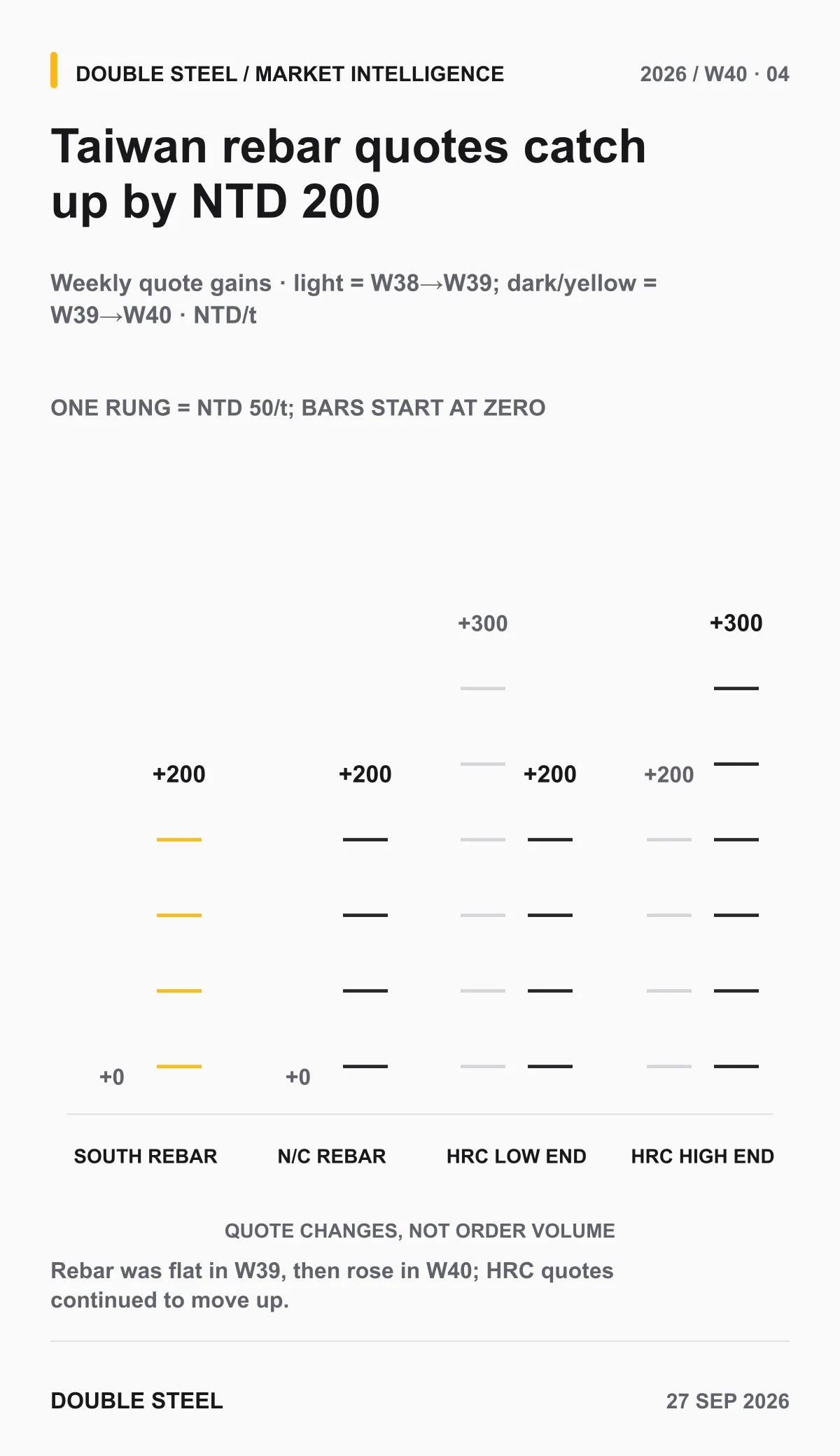
Taiwanese rebar orders also improved selectively from W39. Feng Hsin raised its rebar price by NTD 200/T, and the center of market transactions moved higher. A supply requirement of approximately 29,000 tonnes of rebar for TSMC's Central Taiwan Science Park fab was the clearest project order reported this week. Yet ordinary distribution channels are still working through earlier low-priced inventories, and spot trading at NTD 17,500–17,700/T softened later in the week. The evidence points to stronger project demand and greater acceptance of higher prices, not broad-based distributor restocking.
Key Data This Week and Five-Week Comparison
| Indicator | W36 | W37 | W38 | W39 | Latest W40 Value | Change from W39 Cutoff |
|---|---|---|---|---|---|---|
| Iron ore (USD/T) | 95.84 | 99.57 | 98.02 | 97.57 | 97.06 | -0.52% |
| Iron ore (CNY/T) | 723.00 | 727.00 | 718.00 | 715.50 | 713.50 | -0.28% |
| Coking coal benchmark (USD/T) | 270.00 | 275.00 | 271.00 | 262.00 | 265.00 | +1.15% |
| International HRC benchmark (USD/T) | 1,191.07 | 1,238.00 | 1,274.00 | 1,300.00 | 1,322.00 | +1.69% |
| International scrap benchmark (USD/T) | 375.25 | 394.00 | 396.00 | 404.00 | 402.00 | -0.50% |
| Rebar/steel benchmark (CNY/T) | 3,130.00 | 3,131.00 | 3,071.00 | 3,099.00 | 3,107.00 | +0.26% |
| Tangshan Q235 billet (CNY/T) | 3,030 | 3,040 | 3,000 | 3,000 | 3,010 | +0.33% |
| USD/TWD spot selling rate | 31.72 | 31.71 | 31.70 | 31.87 | 31.85 | -0.02 |
| USD/CNY | 6.72980 | 6.70783 | 6.70793 | 6.69531 | 6.72040 | +0.37% |
| China's social inventories of five major steel products (10,000 tonnes) | 1,183.43 | 1,176.85 | 1,160.55 | 1,144.66 | 1,097.57 | -4.11% |
Chapter 1: Taiwanese Rebar Improves Selectively as Supply Continues to Lift Flat-Steel Prices
A TSMC Project Order Emerges, and Rebar Orders Improve from the Previous Week
Feng Hsin raised its rebar base price by NTD 200/T this week, bringing its list price to NTD 18,300/T. Its domestic scrap purchase price remained at NTD 9,800/T, while section steel stayed at NTD 25,000/T. Southern mills also raised their offers, bringing mainstream market prices to approximately NTD 17,500/T in the south and NTD 17,700/T in central and northern Taiwan.
Small transactions took place early in the week at NTD 17,300–17,500/T, above the W39 transaction center of roughly NTD 17,150–17,300/T in the south. For large orders of around 2,000 tonnes, a major southern mill tended to accept approximately NTD 17,400–17,450/T. Across Taiwan, the tradable range for large-volume purchases was approximately NTD 17,400–17,600/T. The increase was therefore not confined to nominal offers: some downstream buyers accepted higher prices.
For project demand, a rebar supply package of approximately 29,000 tonnes for TSMC's Central Taiwan Science Park fab reportedly carried an awarded price of about NTD 18,300/T. Approximately 10,000 tonnes of the package was SD490W rebar.
Project orders and ordinary distribution demand must nevertheless be assessed separately. Taiwan Steel raised its rebar offer to NTD 17,500/T, and Ching Hsin Hsin also launched a time-limited, 5,000-tonne offer. By late week, however, distribution trading at NTD 17,500–17,700/T had turned quieter, while dealers continued to consume older inventory purchased at around NTD 17,000/T. The most accurate reading is that project orders and price acceptance improved, but distributor restocking has not expanded across the market.
Two Rebar Production Routes Set a Cost Floor, Leaving Mills Under Pass-Through Pressure
Asian small billets were offered at approximately CFR USD 495–500/T, with tradable levels near CFR USD 492–495/T and most buyers indicating interest around CFR USD 490/T. As Taiwanese rebar prices rose, some mills' acceptable price for imported billet recovered to CFR USD 490–495/T, improving their position after regional sellers had largely passed them over in preceding weeks.
Market estimates put the cost of rolling imported billet directly into rebar at approximately NTD 17,600/T, close to this week's NTD 17,400–17,600/T large-order transaction range. Under a separate imported-scrap electric-arc-furnace route, US containerized scrap offers rose to around CFR USD 350/T, and the estimated rebar cost approached NTD 18,700/T. These routes use different processes and raw-material combinations and are not interchangeable, but both suggest that current rebar transactions leave little room for a comfortable margin.
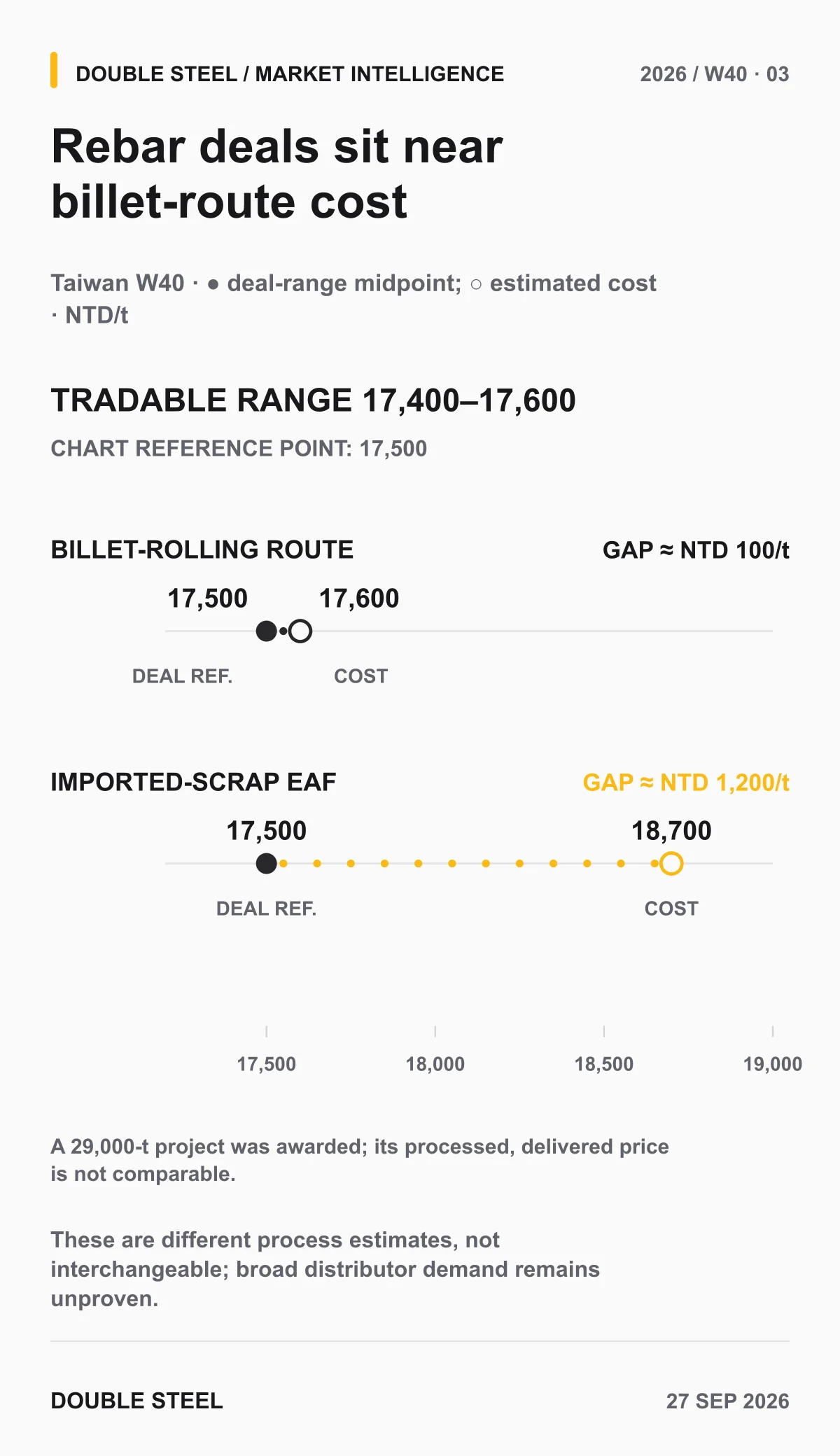
Whether rebar rises further after the holiday depends not only on raw-material costs, but also on whether NTD 17,500–17,700/T becomes a range for sustained transactions. If project demand continues and distributors' lower-priced inventories decline, mills may be able to narrow the gap between costs and selling prices. If buying remains concentrated in discounted large orders, the market is more likely to hold steady while absorbing the latest increase.
HRC and Pickled Coil Rise Again, but General HRC Demand Has Yet to Follow Broadly
Domestic and imported HRC in Taiwan's distribution market was approximately NTD 19,000–19,300/T on a self-collection basis, with some offers moving toward NTD 19,300–19,500/T. Domestic and imported pickled coil was around NTD 20,300–20,600/T. Both price centers rose from W39. Pickled coil has a relatively firmer demand base because low-priced inventories are smaller and processing applications continue to support consumption.
Supply and cost remain the main drivers of this round of flat-steel increases. Korean import offers are elevated, import transaction volumes have contracted, and Indonesian HRC was offered to Taiwan at about CFR USD 554/T, with tradable levels near CFR USD 550/T. As lower-priced inventories diminish and the market expects a further increase in China Steel Corporation's subsequent prices, distributors have become more reluctant to sell.
Some market participants expect October HRC distribution prices to challenge NTD 20,000/T, but this is a forecast, not a price at which transactions are already widespread. A possible NTD 500–600/T increase in China Steel Corporation's November HRC price is also not an official announcement. General HRC prices are currently being pushed up more by a shortage of imports and sellers' reluctance to sell. The next test is whether sales can continue above NTD 19,300/T; higher offers alone do not prove a broad increase in end-user demand.
Five-Week Trend: HRC and Scrap Strengthen as Iron Ore and Coal Lose Momentum
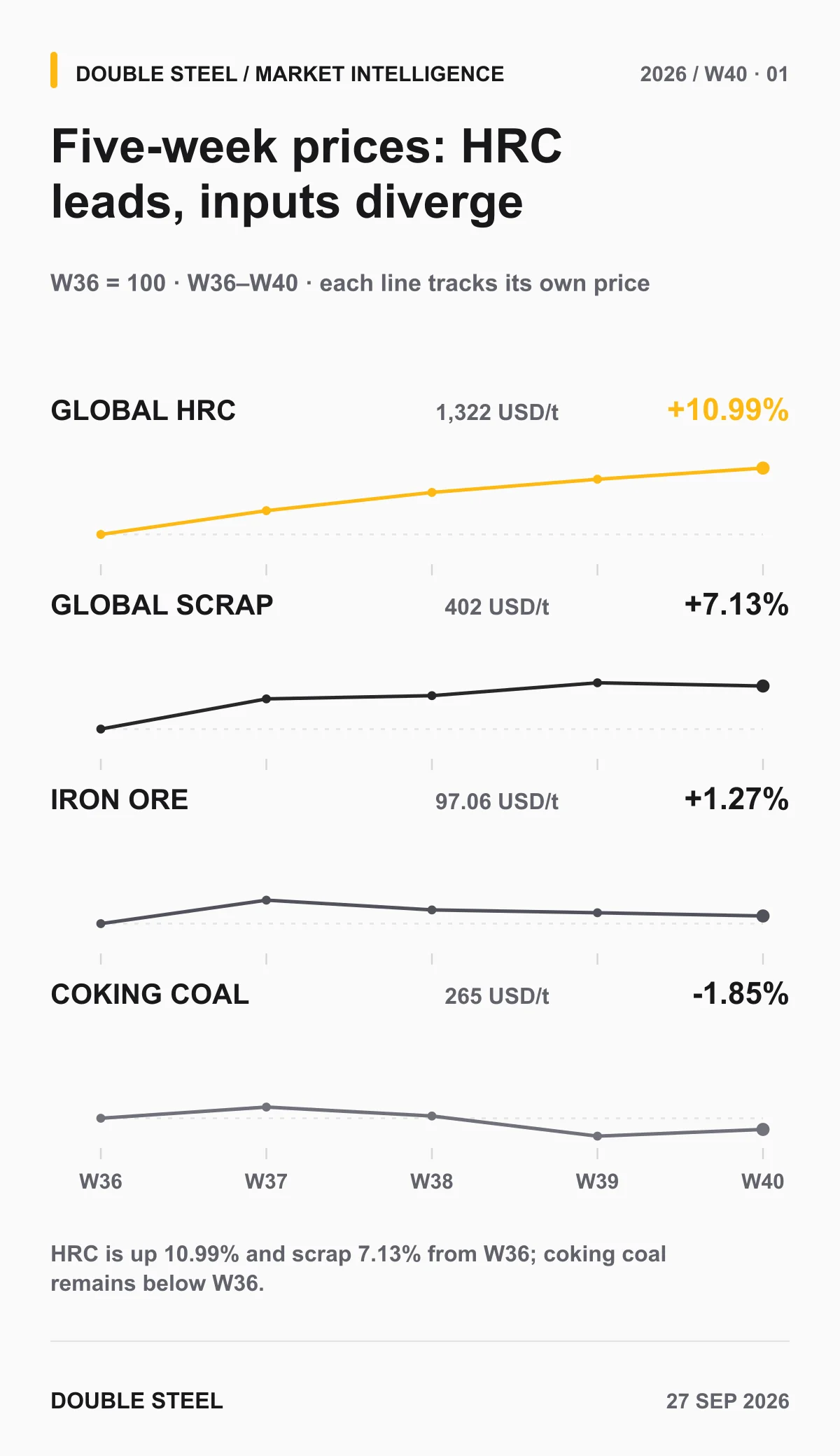
From W36 to W40, the international HRC benchmark rose from USD 1,191.07/T to USD 1,322/T, a cumulative gain of approximately 10.99%. The international scrap benchmark climbed from USD 375.25/T to USD 402/T, up about 7.13%. Both clearly outperformed iron ore, coking coal, and the Chinese rebar benchmark. Recent cost and price support has gradually shifted from the earlier coal-led rise toward flat-steel prices and scrap costs.
Over the same period, the US-dollar iron ore benchmark rose only about 1.27%, from USD 95.84/T to USD 97.06/T, and declined in each of the last three weeks. The composite coking coal benchmark fell from USD 270/T to USD 265/T, leaving it approximately 1.85% below W36. The Chinese rebar/steel benchmark fell about 0.73% over five weeks, while Tangshan billet eased roughly 0.66%. Chinese finished products and blast-furnace inputs have therefore not risen in step with the international HRC benchmark.
The USD/TWD spot selling rate rose from 31.72 in W36 to 31.85 in W40, an increase of about 0.41% over five weeks, although it edged down from 31.87 this week. The Taiwan dollar's limited appreciation this week provided only a small cushion against import costs and could not offset higher landed offers for US containerized scrap and some Asian steel products.
Chapter 2: Demand for Chinese Long Products Materializes in Part, While Flats and Raw Materials Diverge
2.1 Social Inventories: Destocking Accelerates, Led by Long Products
As of September 25, China's social inventories of five major steel products fell to 10.9757 million tonnes, down 470,900 tonnes or 4.11% from W39 and declining for a fourth consecutive week. The pace of destocking accelerated markedly from W39's 158,900-tonne weekly reduction. Relative to W36, inventories fell by 858,600 tonnes, or approximately 7.26%, over four weeks.
| Product | W39 Social Inventory (10,000 tonnes) | W40 Social Inventory (10,000 tonnes) | Change (10,000 tonnes) | Weekly Change |
|---|---|---|---|---|
| Rebar | 476.27 | 439.59 | -36.68 | -7.70% |
| Wire rod | 62.49 | 58.05 | -4.44 | -7.11% |
| HRC | 362.15 | 354.70 | -7.45 | -2.06% |
| Plate | 120.30 | 120.03 | -0.27 | -0.22% |
| CRC | 123.45 | 125.20 | +1.75 | +1.42% |
Rebar alone accounted for approximately 78% of this week's net destocking, and wire rod inventories fell by more than 7%. This indicates a round of concentrated deliveries in construction steel before the holiday. Apparent rebar demand recovered to approximately 2.0885 million tonnes. Together with falling social and mill inventories, that supports upgrading the assessment of Chinese long products from “awaiting confirmation” to “partly confirmed in the short term.”
Supply contracted at the same time. Combined weekly output of the five products fell to 7.7968 million tonnes, down 144,600 tonnes, as widening mill losses, maintenance, and production cuts reduced inventory pressure. The 470,900-tonne decline in social stocks therefore reflects a combination of better demand, lower output, and stocking ahead of the National Day holiday. It cannot all be treated as an increase in end-user consumption.
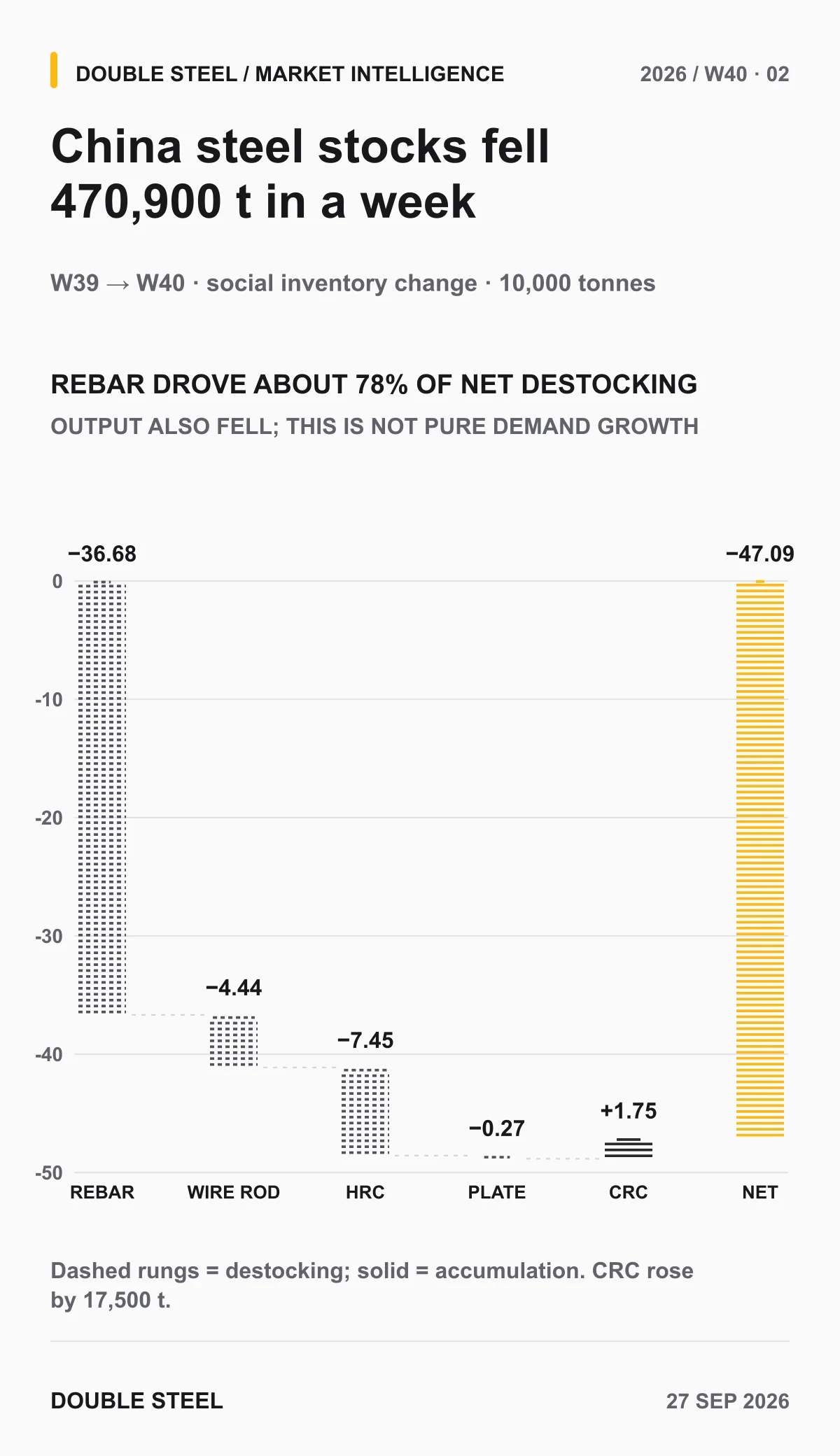
Flat products have not broadly taken over. HRC social inventories fell by 74,500 tonnes, but its prices remained weak and its inventory level was still high. Plate inventories declined by just 2,700 tonnes, while CRC inventories rose by 17,500 tonnes. If long products return to accumulation after the holiday, or if CRC and plate remain weak, W40's improvement will look more like a pre-holiday effect than the start of a sustained, broad peak season.
2.2 Iron Ore: Restocking Ends as Supply and Mill Losses Weigh on Prices
The US-dollar iron ore benchmark fell from USD 97.57/T to USD 97.06/T, down 0.52% for the week. Its renminbi counterpart declined from CNY 715.50/T to CNY 713.50/T, down 0.28%. A separate 62% Australian fines spot assessment reached approximately USD 96.65/T on September 25, returning close to its mid-September lows.
With pre-holiday restocking largely complete, purchases at Chinese ports slowed. Rising global shipments and arrivals, relatively high port inventories, and mills' reluctance to pay more while operating at a loss all weighed on iron ore. Blast-furnace hot-metal output remained relatively high, providing a floor of essential demand, but ore could face further pressure if post-holiday steel production cuts deepen.
2.3 Coking Coal and Coke: International Spot Prices Soften as China's Fifth Coke Increase Gives Way to a Standoff
The composite coking coal benchmark recovered from USD 262/T to USD 265/T, up 1.15% for the week, but the physical Asian metallurgical coal market moved differently. Australian low-volatile hard coking coal was around FOB USD 235.9/T and material delivered to China around CFR USD 258/T, with both recently weakening as Chinese and Indian mills slowed purchases.
These observations are not necessarily contradictory. The composite benchmark may cover different grades, regions, and cutoff times, whereas Asian spot assessments reflect a particular Australian coal grade under FOB or CFR trading terms. This week's conclusion is therefore “a modest rebound in the composite benchmark, while Asian hard coking coal spot prices remain weak,” rather than a blanket call that all coking coal is rising or falling.
Internationally, Indian mills increased purchases somewhat in early September, but restocking remained gradual and highly price-sensitive. Expected increases in Australian and Canadian supply, combined with losses at Chinese mills and the possibility of further output cuts, provide no clear evidence of a broad strengthening in seaborne coking coal demand in the fourth quarter.
In China, the fifth round of coke price increases has taken effect, improving coking plants' margins and operating rates. Loss-making steel mills have begun to resist another increase, however, leaving little momentum for a sixth round. After the one-way gains of earlier weeks, the coal-and-coke market has shifted to a high-level standoff between coking plants defending prices and mills pressing for lower costs.
2.4 Scrap: The International Benchmark Edges Down, but Taiwan's Landed Costs Continue to Rise
The international scrap benchmark slipped from USD 404/T to USD 402/T, down 0.50% for the week, but Taiwan's actual import market did not weaken with it. Offers for US 80:20 containerized scrap to Taiwan rose to around CFR USD 350/T, while the reported tradable range was approximately CFR USD 342–345/T, still higher than earlier levels.
Vietnamese mills have been willing to pay more for US and Japanese scrap than Taiwanese buyers, leaving Taiwan to compete for regional supply. This explains why a small decline in an international composite index did not lower costs for Taiwan's electric-arc-furnace mills. Supply origin, freight, purchase volume, and competing buyers differ across markets, so movements in the index cannot be equated directly with Taiwan's landed costs.
With imported scrap supply relatively tight and billet prices holding high, Taiwanese mills have reason to defend rebar prices in the near term. If spot transactions fail to hold at the higher level, the pressure may show up in reduced output, limited order intake, or delayed raw-material purchases rather than an immediate cut in finished-steel prices.
2.5 HRC, CRC, and Plate: Long-Product Destocking Is Firmer, While Flat-Steel Prices Remain Weak
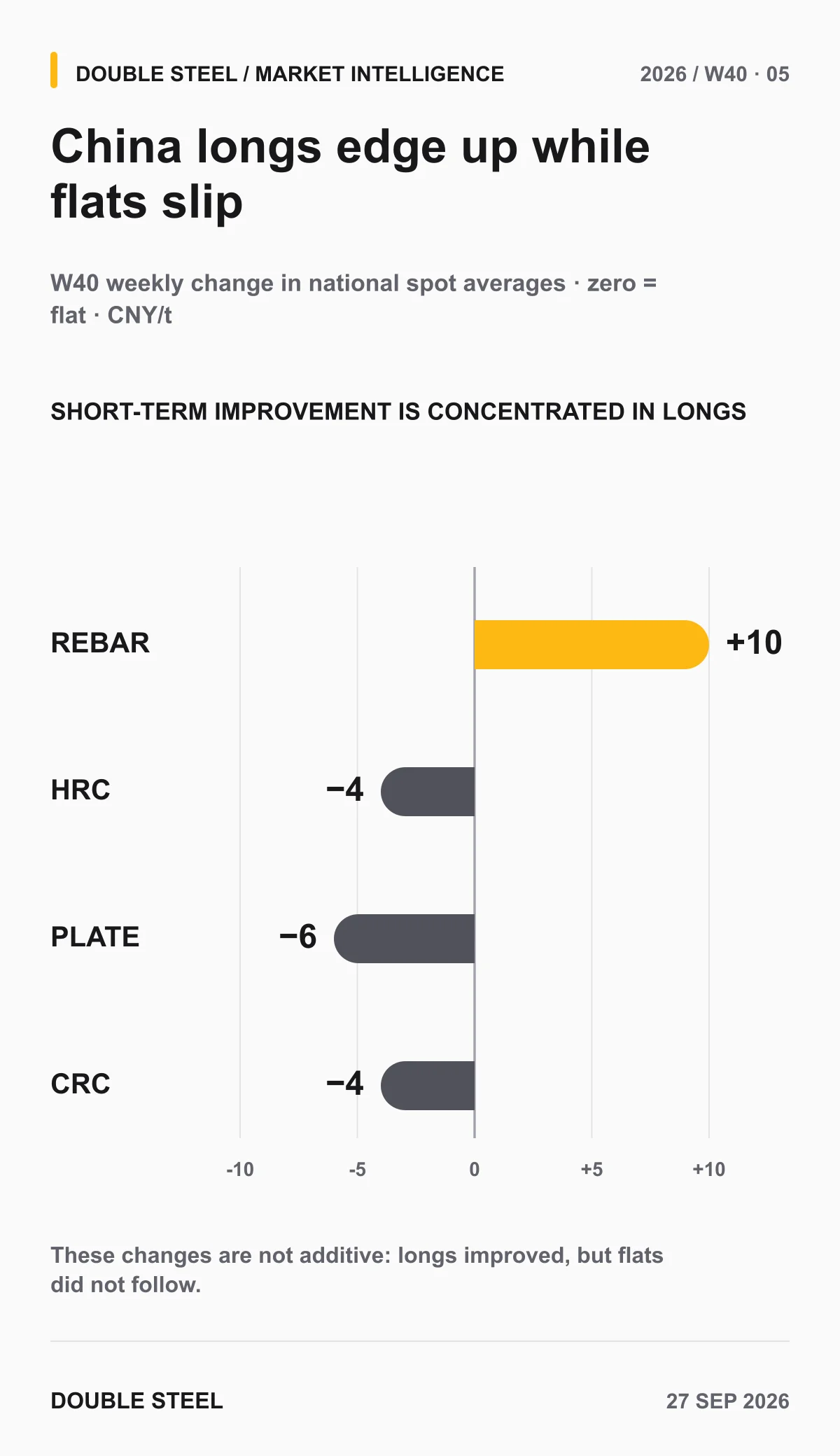
China's spot market still favors long products over flats. Around September 24, the national average rebar price was approximately CNY 3,323/T, up about CNY 10/T from the previous week. HRC was around CNY 3,317/T, down CNY 4/T; plate was near CNY 3,554/T, down CNY 6/T; and CRC was approximately CNY 3,793/T, down CNY 4/T.
In the export market, Chinese SS400/Q235 HRC was offered at approximately FOB USD 498–510/T, with tradable levels near FOB USD 495–505/T. Earlier renminbi appreciation and mill losses limit sellers' room to cut prices, but overseas buying interest remains modest. Indonesian HRC to Vietnam was around CFR USD 540–545/T, with tradable levels near CFR USD 536–538/T. Even with Indonesian supply affected by water shortages, buyers have not rushed to secure material.
Rising CRC stocks and falling spot prices point to continued weakness in thin-sheet demand, while plate destocking has almost stalled. Neither shows a broad improvement yet. Taiwan's stronger flat-steel prices, by contrast, are driven more by import shortages, landed costs, expectations for domestic mill prices, and sellers' reluctance to sell—not by a simultaneous recovery in Chinese flat-steel demand.
2.6 Stainless Steel and Nickel: Ample Supply Still Outweighs the Production-Cut Story
LME nickel futures closed at approximately USD 16,329/T on September 25. Although they rose about 0.91% for the week, they were still down roughly 3.16% for the month; the spot price was near USD 16,150/T. LME-monitored inventories increased by 6,048 tonnes in a day to 284,946 tonnes, up approximately 6.28% for the month.
Water shortages in Indonesia's Morowali Industrial Park reportedly reduced nickel pig iron and some steel production. Weak Chinese stainless-steel demand, lower mill production schedules, and cautious battery-sector nickel purchases have, for now, offset the supply disruption. Asian 304 CRC offers were around CFR USD 2,150/T, falling for a fifth consecutive week and down about USD 80/T over five weeks.
The short-term rebound in nickel therefore looks more like a response to supply headlines and a technical correction than a basis for broad strength in stainless-steel prices. Buyers should continue to track how much Indonesian production is actually cut, LME inventories, and real transactions for Chinese 304 material.
Chapter 3: Regional Markets and Trade Measures
Taiwan | Rebar Moves from Price Stabilization to Selective Orders, While Supply Lifts Flat Products
Taiwanese rebar offers rose this week, and project orders and some market transactions improved from W39. The improvement, however, was concentrated in the large TSMC supply package, lower-priced trades, and discounted large orders; ordinary distributors have not broadly chased higher prices. Flat-steel prices continued to rise. Pickled coil has a firmer demand base than general HRC, but both are also supported by fewer imports and sellers' reluctance to sell.
Implications: Taiwan has shifted from W39's “strong flats, weak longs” to “flat-steel prices remain firm, while rebar improves selectively.” After the holiday, the key questions are whether project-related rebar orders spread to ordinary distribution channels and whether HRC can sustain sales above NTD 19,300/T.
China | Long-Product Demand Improves in the Short Term; Persistence Will Be Tested After the Holiday
Rebar and wire rod destocking accelerated substantially, and apparent rebar demand recovered. Pre-holiday demand was therefore more than market sentiment alone. Output fell at the same time, however, CRC inventories rose, plate inventories barely moved, and spot prices did not increase across all five steel products.
Implications: W40 supports a short-term improvement in Chinese long products, but it does not confirm a fourth-quarter peak season in advance. A broader recovery would require rebar and wire rod to keep destocking after the holiday and HRC, CRC, and plate to improve as well.
Asia | Indonesian Output Cuts Support Supply, but Buyers Are Not Scrambling for Material
Drought-related water shortages in Indonesia's Morowali area reportedly caused some steel mills to reduce output by approximately 30%–40% and suspend or restrict offers for HRC and billet. Local coke suppliers were also reported to have cut production. Tighter supply lifted Vietnamese HRC transaction prices slightly, but buyers in Indonesia and elsewhere in Asia remained cautious about building inventories.
Implications: Indonesian supply disruption helps support a price floor for Asian HRC, billet, and coke, but it has not triggered panic buying. For Taiwan, the practical risks are delayed shipments and import gaps—not an automatic sharp rise in every Asian offer.
South Korea | H-Beam Measures Continue, While the Chinese Bar Case Remains Preliminary
The Korea Trade Commission issued a final affirmative determination in its second sunset review of Chinese H-beams, recommending a five-year extension of price undertakings and anti-dumping measures of 28.23%–32.72%. The Laiwu and Rizhao producers would remain under price undertakings, while other Chinese suppliers would face the recommended anti-dumping rates.
A separate Chinese steel-bar case is only at the preliminary affirmative determination stage. The commission recommended provisional anti-dumping duties of 25.08%–27.96%, with a final determination expected in February 2027. The bars in this case are mainly used for automotive, shipbuilding, and machinery components; they are not the same as construction rebar.
Implications: South Korea's import price floor is likely to remain, but Chinese H-beam and specialty-bar supply restricted there may be redirected to other Asian markets. This is a trade-policy-driven shift in supply flows, not evidence of stronger Asian end-user demand. Taiwan could face both substitute export opportunities and greater import competition.
Japan, the United States, and Europe | Supply Supports Prices, While Demand Varies by Region
Heavy rain and typhoon damage at JFE Steel's Chiba works in Japan are expected to reduce steel output by approximately 600,000 tonnes, affecting thin sheet, stainless steel, and iron powder. Deliveries of some products may be delayed. This near-term Japanese supply risk could further limit flat-steel material available to Taiwan and other Asian markets.
US HRC was around USD 1,240 per short ton, with mill offers at approximately USD 1,240–1,260 per short ton. Average lead times lengthened from 9.1 to 9.3 weeks, leaving spot supply relatively tight. European HRC rose in some markets—about EUR 730/T in northern Europe and EUR 725/T in southern Europe—but distributors were still working through lower-priced inventories, and end users showed limited acceptance of higher prices.
Implications: Supply tightness in Japan and the United States helps sustain flat-steel prices, but European and Asian demand have not strengthened in tandem. Global flat-steel pricing remains driven more by regional supply differences than by a broad rise in demand.
Key Indicators to Monitor
-
Beyond the reported 29,000-tonne TSMC Central Taiwan Science Park project, whether other Taiwanese rebar mills receive follow-on orders or see simultaneous growth in order volumes.
-
Whether NTD 17,500–17,700/T Taiwanese rebar becomes a range for stable transactions rather than offers alone, and whether discounts on large orders narrow.
-
How quickly distributors consume earlier low-priced rebar stocks, and whether ordinary distribution restocking begins after the holiday.
-
Whether domestic and imported HRC at NTD 19,000–19,300/T and pickled coil at NTD 20,300–20,600/T are supported by sustained deliveries.
-
China Steel Corporation's official November price announcement and the actual increase for each specification, rather than treating market expectations as a formal opening price.
-
Whether Chinese rebar and wire rod return to inventory accumulation after the holiday, and whether this week's improvement in apparent demand persists.
-
Whether combined output of China's five major steel products continues to fall, and how much destocking comes from production cuts rather than actual consumption.
-
Whether CRC social inventories turn from rising to falling and whether plate destocking accelerates.
-
Whether Australian hard coking coal spot prices, the pace of Indian restocking, and Chinese mill cuts pull the composite coking coal benchmark down again.
-
Actual transactions against US containerized scrap offers of CFR USD 350/T to Taiwan, and whether Vietnamese bidding further restricts Taiwanese access to supply.
-
Support for iron ore in the USD 96–100/T range, and whether post-holiday blast-furnace cuts reduce daily consumption.
-
Whether water-related production cuts in Indonesian HRC, billet, coke, and nickel pig iron actually affect shipping schedules and available tonnage.
Conclusion
W40's most important difference from earlier weeks is that demand can no longer be described simply as unconfirmed. Rebar and wire rod inventories in China declined much faster, and apparent rebar demand recovered, partly confirming short-term demand for long products. Taiwan also had a reported 29,000-tonne project order, while the center of rebar transactions moved above W39, so it would be inaccurate to say that order intake did not improve at all.
The improvement nevertheless has boundaries. Lower Chinese output and pre-holiday stocking amplified destocking, while CRC continued to accumulate and plate inventories barely declined. Taiwanese rebar trading slowed later in the week, and HRC prices rose mainly because of import gaps and sellers' reluctance to sell. The market is therefore closer to “long products and specific project demand improve first, while flats and general distribution channels still need to follow” than to the start of a broad peak season.
Raw materials are also diverging. Iron ore is weak as restocking ends, shipments rise, and mill losses constrain buying. Asian hard coking coal spot prices are still affected by slower Chinese and Indian purchases, while coke has entered a standoff after its fifth price increase. Taiwan's imported scrap and billet costs, by contrast, remain high; a small decline in an international composite benchmark has not yet translated into lower local input costs.
The most important post-holiday test is whether short-term restocking turns into sustained consumption. If Chinese long products keep destocking, orders in Taiwan's general rebar distribution channels expand, and CRC and plate improve as well, the market may move from a partial realization of demand toward a broader recovery. Until then, procurement decisions should continue to distinguish project orders from distribution transactions and evaluate each raw-material source and steel product separately.
Sources: Trading Economics (iron ore, coking coal, HRC, rebar, international scrap, and USD/CNY; through September 25, 2026); E.SUN Bank (USD/TWD spot exchange rate; through September 27, 2026); Mysteel (Tangshan billet and China's output and inventories of five major steel products; through September 25, 2026); domestic and international steel news (cross-checked through September 27, 2026); public information from South Korea's Ministry of Trade, Industry and Energy and the Korea Trade Commission (through September 17, 2026); and public information from industry research organizations (through September 25, 2026).
This report is published by the Market Research Department of Double Steel Corporation. It is intended solely as a reference for market research and procurement evaluation and does not constitute a final basis for investment or direct purchasing decisions.