Publication date: September 14, 2026
Publication date: September 14, 2026
Market and news cutoff: September 13, 2026
Exchange-rate benchmark: USD/TWD spot selling rate: 31.70
The central theme of the W38 steel market was the continued rollout of mill price increases, while the market moved into a stage of testing actual transactions and inventory changes. Feng Hsin Steel raised its domestic scrap purchase price by NTD 200/T and its rebar list price by NTD 300/T this week. Baosteel also increased its October prices for a third consecutive month, widening the adjustment for most flat products to CNY 200/T. However, Chinese ferrous futures, iron ore, and the rebar benchmark all retreated later in the week, indicating that cost support remains, but peak-season demand has yet to generate broad-based price chasing.
Taiwan's market showed a similar divergence. Mainstream rebar transactions rose from NTD 16,900–17,200/T in W37 to approximately NTD 17,300–17,500/T, bringing prices close to the previously estimated cost of rolling imported billet. Buying interest nevertheless weakened after the increase as downstream users continued to consume lower-cost inventories. In flat products, mainstream domestic and imported HRC transactions were approximately NTD 18,500–18,800/T, only slightly above pre-announcement levels. Pickled coil, supported by low distribution inventories and processing demand, was the first product to move above NTD 20,000/T.
Compared with recent weeks, the market has moved from the raw material rebound in W34, the mismatch between import costs and Taiwan selling prices in W35, the recovery in distribution prices in W36, and the implementation of mill price adjustments in W37, to a post-increase transaction test in W38. The decline in China's social inventories of five major steel products accelerated this week, but almost all of the reduction came from rebar, while HRC and CRC inventories increased. Subsequent assessments should therefore consider transaction volume, product-level inventories, and downstream orders together, rather than relying solely on higher mill prices or a decline in total inventories.
Key Data This Week and Five-Week Comparison
| Indicator | W34 | W35 | W36 | W37 | Latest W38 Value | Change from W37 Cutoff |
|---|---|---|---|---|---|---|
| Iron ore (USD/T) | 95.17 | 95.21 | 95.84 | 99.57 | 98.02 | -1.56% |
| Iron ore (CNY/T) | 710.50 | 707.50 | 723.00 | 727.00 | 718.00 | -1.24% |
| Coking coal benchmark (USD/T) | 225.00 | 249.00 | 270.00 | 275.00 | 271.00 | -1.45% |
| International HRC benchmark (USD/T) | 1,220.00 | 1,185.00 | 1,191.07 | 1,238.00 | 1,274.00 | +2.91% |
| International scrap benchmark (USD/T) | 397.50 | 393.50 | 375.25 | 394.00 | 396.00 | +0.51% |
| Rebar/steel benchmark (CNY/T) | 3,018.00 | 3,061.00 | 3,130.00 | 3,131.00 | 3,071.00 | -1.92% |
| Tangshan Q235 billet (CNY/T) | 2,940 | 2,970 | 3,030 | 3,040 | 3,000 | -1.32% |
| USD/TWD spot selling rate | 32.07 | 31.92 | 31.72 | 31.71 | 31.70 | -0.01 |
| USD/CNY | 6.74342 | 6.72019 | 6.72980 | 6.70783 | 6.70793 | Approximately unchanged |
| China's social inventories of five major steel products (10,000 tonnes) | 1,190.91 | 1,180.37 | 1,183.43 | 1,176.85 | 1,160.55 | -1.39% |
Chapter 1: Can Transactions Keep Pace After the Price Increases?
Feng Hsin Raises Rebar and Scrap Again, but the List Price Remains Above Market Transactions
In its September 7 announcement, Feng Hsin Steel raised its domestic scrap purchase base price by NTD 200/T to NTD 9,600/T and its rebar base price by NTD 300/T to NTD 18,100/T, while leaving section steel unchanged at NTD 25,000/T. Mills in southern Taiwan also followed with higher rebar offers, reflecting increases in international scrap, semi-finished products, and the cost of earlier restocking.
In the distribution market, mainstream Taiwan rebar transactions were approximately NTD 17,300–17,500/T this week, including around NTD 17,300/T in the south and NTD 17,500/T in central and northern Taiwan. Compared with W37's NTD 16,900–17,200/T range, both ends increased by approximately NTD 300–400/T, indicating partial pass-through of mill price increases. However, some downstream users still hold earlier inventories purchased at NTD 16,700–17,000/T and became more cautious after the increase. A higher list price should therefore not be interpreted as evidence that transaction volumes increased at the same pace.
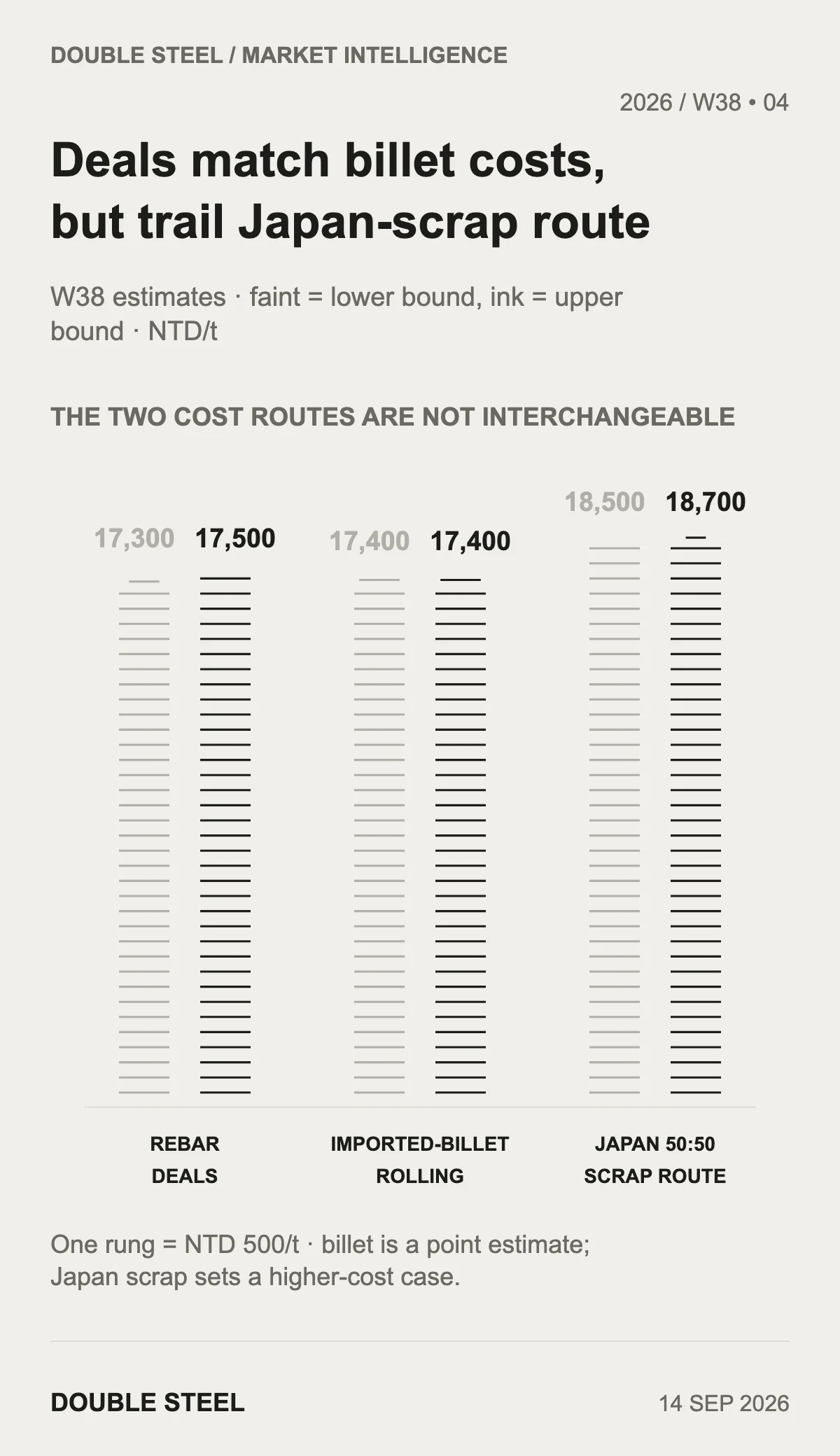
Using the W37 market estimate of approximately NTD 17,400/T for the cost of rolling imported billet into rebar, this week's transaction range improved from being entirely below the estimated cost to roughly NTD 100/T on either side of it. This only indicates that the inversion has narrowed under this particular reference scenario; it does not mean margins have recovered at every mill. Billet, scrap, energy, yield, freight, and handling costs differ substantially among producers and must still be calculated individually.
HRC Rises Only Slightly, While Pickled Coil Moves Above NTD 20,000/T First
After CSC's actual average October HRC increase of approximately NTD 450/T, ex-yard distribution prices for domestic and imported HRC moved from around NTD 18,300–18,600/T before the announcement to approximately NTD 18,500–18,800/T this week. Compared with W37's NTD 18,500–18,700/T range, the low end did not rise further and the high end increased by only about NTD 100/T. General HRC has therefore not yet fully reflected the new mill-price adjustment.
Pickled coil was stronger. The ex-yard distribution price of imported pickled coil rose from approximately NTD 19,600/T to NTD 20,000/T, while domestic pickled coil was quoted at around NTD 20,100–20,300/T. In addition to low inventories, some customers requiring subsequent coating or electroplating shifted to material that had already been pickled, reducing their own transportation, processing, and environmental-treatment burden. This also strengthened relative demand for pickled coil.
The W38 flat-products market should therefore not be assessed using a single HRC price. General HRC remains in a period of price transmission, while pickled coil has moved ahead because of inventory and end-use conditions. Whether CRC, galvanized, and pre-painted products can continue to rise will still depend on downstream processing orders and the cost of existing inventories.
Five-Week Trend: Coal Remains Elevated, While Iron Ore and Long Products Retreat This Week
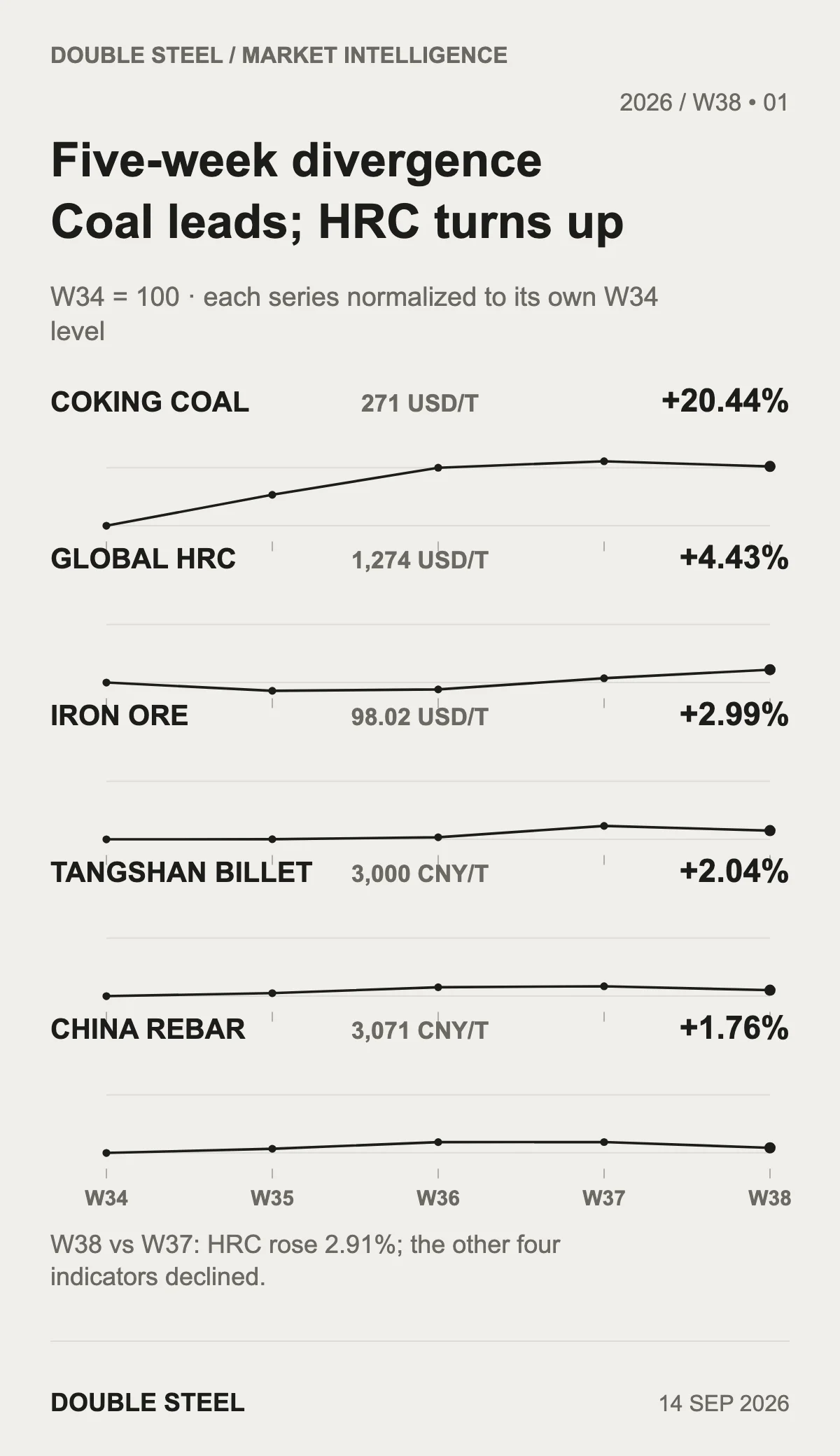
From W34 to W38, the composite coking coal benchmark rose from USD 225/T to USD 271/T, remaining approximately 20.44% higher over the period. During the same period, the US-dollar iron ore benchmark rose approximately 2.99%, Tangshan billet 2.04%, and the Chinese rebar benchmark 1.76%. Although the coking coal benchmark fell 1.45% from W37 this week, coal and coke prices remain high compared with mid-August, and cost pressure has not disappeared.
Iron ore briefly rose to USD 102.55/T on September 8 before declining for several consecutive sessions. The price of 62% Australian fines shipped to China fell to USD 97.85/T on September 11, while the benchmark at this report's cutoff was USD 98.02/T. Demand falling short of peak-season expectations, widening mill losses, and lower hot-metal production made mills more cautious about iron ore procurement.
Raw materials are no longer rising in unison. Tight coking coal supply and a fifth round of coke price increases continue to support steelmaking costs, while iron ore and billet have begun to correct and the Chinese rebar benchmark has also declined. The next issues to monitor are whether high coal and coke prices force more mills to schedule maintenance and reduce output, and whether lower iron ore prices can partially offset coke costs.
Chapter 2: Analysis of Costs, Inventories, and Key Products
2.1 Coal, Coke, and Iron Ore: Raw Materials Begin to Diverge
On September 10, Australian standard low-volatility hard coking coal was approximately FOB USD 245/T and CFR China USD 265.5/T. Premium low-volatility hard coking coal reached FOB USD 284.9/T and CFR China USD 305.8/T. Some coke producers in Hebei had secured acceptance of a fifth-round coke price increase of approximately CNY 100–110/T, indicating that tight coal and coke supply continued to flow through to mill costs.
Meanwhile, the composite coking coal benchmark used in this report fell from USD 275/T in W37 to USD 271/T. The composite benchmark, standard low-volatility hard coking coal, and premium hard coking coal represent different qualities and delivery terms and should not be used interchangeably. A more appropriate interpretation is that coking coal remains elevated overall, while price trends among grades have begun to diverge and buyers' acceptance of high prices has weakened.
Lower iron ore prices may partially offset coal and coke costs, but it is too early to conclude that total mill costs have broadly declined. A substantial proportion of Chinese mills remain loss-making. If coke prices rise again, mills may control costs by adjusting their raw material mix, reducing iron ore purchases, or scheduling maintenance, which could further affect hot-metal and steel supply.
2.2 Five-Product Social Inventories: Decline Accelerates, but HRC and CRC Accumulate
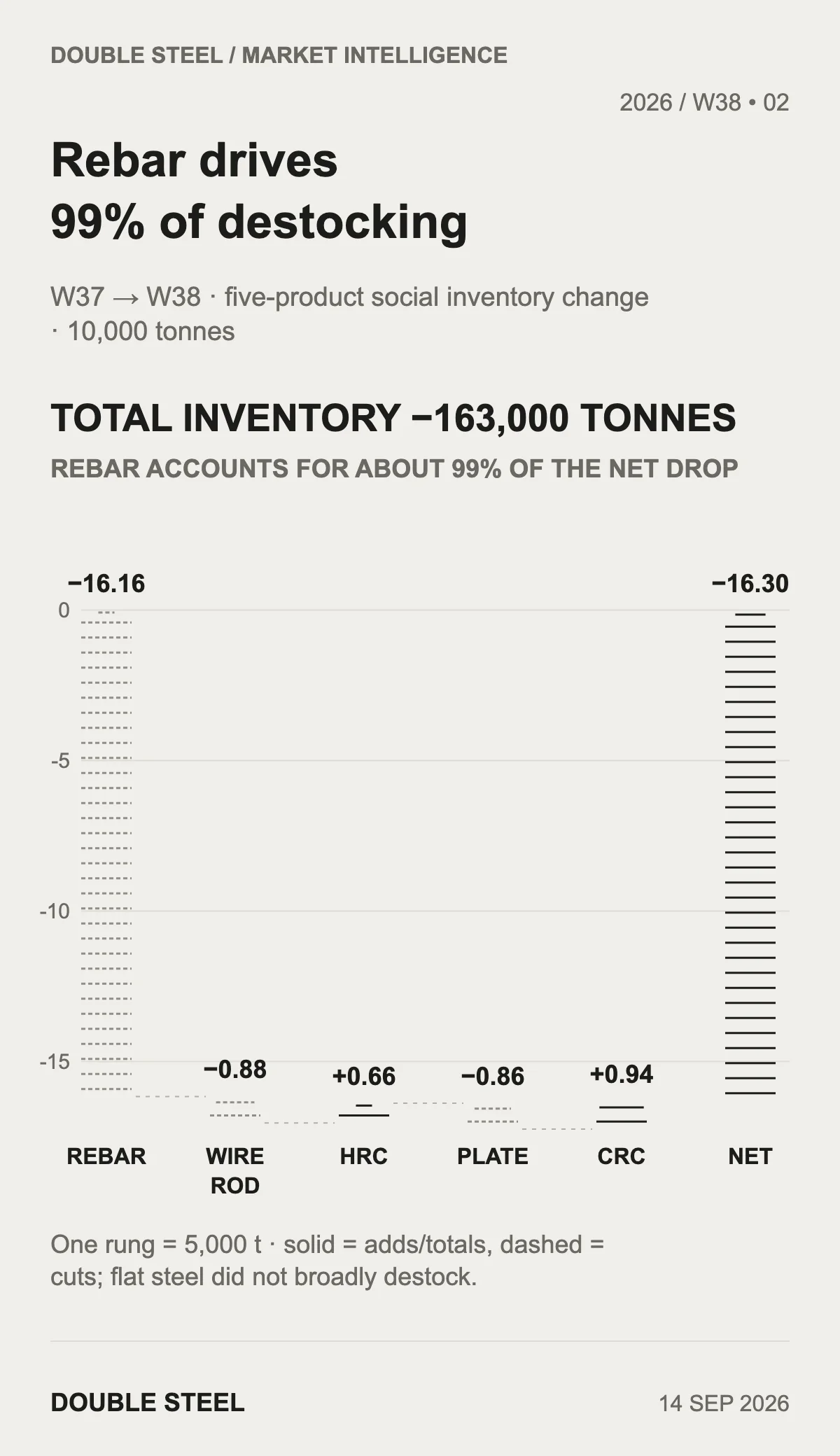
As of September 11, China's social inventories of five major steel products had fallen to 11.6055 million tonnes, down 163,000 tonnes or approximately 1.39% from W37. The reduction was substantially larger than W37's 65,800-tonne decline. Compared with W34, inventories were down 303,600 tonnes, or approximately 2.55%, over five weeks.
| Product | W37 Social Inventory (10,000 tonnes) | W38 Social Inventory (10,000 tonnes) | Change (10,000 tonnes) | Weekly Change |
|---|---|---|---|---|
| Rebar | 505.46 | 489.30 | -16.16 | -3.20% |
| Wire rod | 66.37 | 65.49 | -0.88 | -1.33% |
| HRC | 365.14 | 365.80 | +0.66 | +0.18% |
| Plate | 118.79 | 117.93 | -0.86 | -0.72% |
| CRC | 121.09 | 122.03 | +0.94 | +0.78% |
Rebar inventories fell by 161,600 tonnes, accounting for approximately 99% of the net decline in the five-product total and making rebar the principal driver of destocking. Wire rod inventories fell by 8,800 tonnes after increasing for two consecutive weeks, improving the inventory structure for construction steel compared with W37.
Flat products moved in the opposite direction. HRC inventories, which had been nearly unchanged in W37, increased by 6,600 tonnes, while CRC shifted from destocking in the previous week to an increase of 9,400 tonnes. This indicates that the improvement in China's peak-season demand remains concentrated in construction steel, while end-user procurement of flat products has yet to broaden. Higher Baosteel and Asian mill prices may support offers, but subsequent developments still need to be validated by flat-product inventories and actual shipments.
2.3 Billet and Rebar: The Cost Floor Remains, but Willingness to Chase Finished-Product Prices Is Limited
Southeast Asian billet offers were broadly stable at CFR USD 485–495/T this week. Chinese 150 mm 5SP billet was offered to Manila at approximately CFR USD 500/T, with tradable prices no lower than CFR USD 495/T. Russian Far East billet was recently traded at CFR USD 485/T.
Taiwan has recently completed several consecutive purchases of Russian billet at approximately CFR USD 488–492/T, totaling around 60,000–70,000 tonnes. These transactions improved raw material availability for some mills, but the price, origin conditions, and delivery schedule of subsequent cargoes still need to be confirmed individually. A single low-priced transaction should not be extended into a long-term market benchmark.
Tangshan Q235 billet fell from CNY 3,040/T in W37 to approximately CNY 3,000/T, while Chinese 3SP 150 mm billet export offers were around FOB USD 468–473/T. The renminbi was broadly unchanged between the two weekly cutoffs, and the USD/TWD spot selling rate moved only from 31.71 to 31.70. For billet priced at CFR USD 490/T, the weekly exchange-rate movement reduced cargo value by only approximately NTD 4.9/T, with limited impact on total cost.
Taiwan rebar prices have recovered significantly, but transactions weakened after this week's increase. The next key issue is not whether mills still have reasons to raise prices, but whether NTD 17,300–17,500/T can become a stable transaction range and whether downstream users will accept higher levels after lower-cost inventories are depleted.
2.4 Scrap: Lower US Supply and Higher Japanese Prices Create a More Expensive Cost Scenario
US containerized scrap offers to Taiwan were approximately CFR USD 335–340/T this week, higher than in the previous period, while available supply declined. Japan's Kanto scrap tender raised the export-price benchmark. A reasonable price for 50:50 Japanese scrap commonly used in Taiwan was approximately CFR USD 360–365/T. Mills sought to purchase at around CFR USD 355/T, but completing transactions remained difficult.
Based on 50:50 Japanese scrap at CFR USD 360/T, the market-estimated cost of producing rebar via the electric-arc-furnace route was approximately NTD 18,500–18,700/T, substantially above current rebar transaction prices. This estimate represents a different production route from direct rolling of imported billet and should not be used as a substitute for it. Instead, it reflects the upper cost scenario created by a change in scrap origin and the procurement pressure faced by Taiwanese mills when US scrap is scarce.
Feng Hsin raised both scrap and rebar prices for a second consecutive week, indicating that mills are gradually passing through costs. Near-term scrap prices remain influenced by US supply, the Japanese yen, freight, and competition from Vietnamese buyers. Taiwan mills are unlikely to secure sufficient supply simply by holding bids down.
2.5 HRC, CRC, and Plate: Mill Offers Remain Firm, but Buyer Acceptance Diverges
Chinese SS400/Q235 HRC export offers were approximately FOB USD 505–515/T, with tradable prices around FOB USD 500–510/T. Indonesian HRC was offered to Vietnam at about CFR USD 542–545/T, while most buyer indications were no higher than CFR USD 530/T. New Indonesian offers to Taiwan at one point reached CFR USD 550–555/T, but the specifications and prices had not gained broad market acceptance.
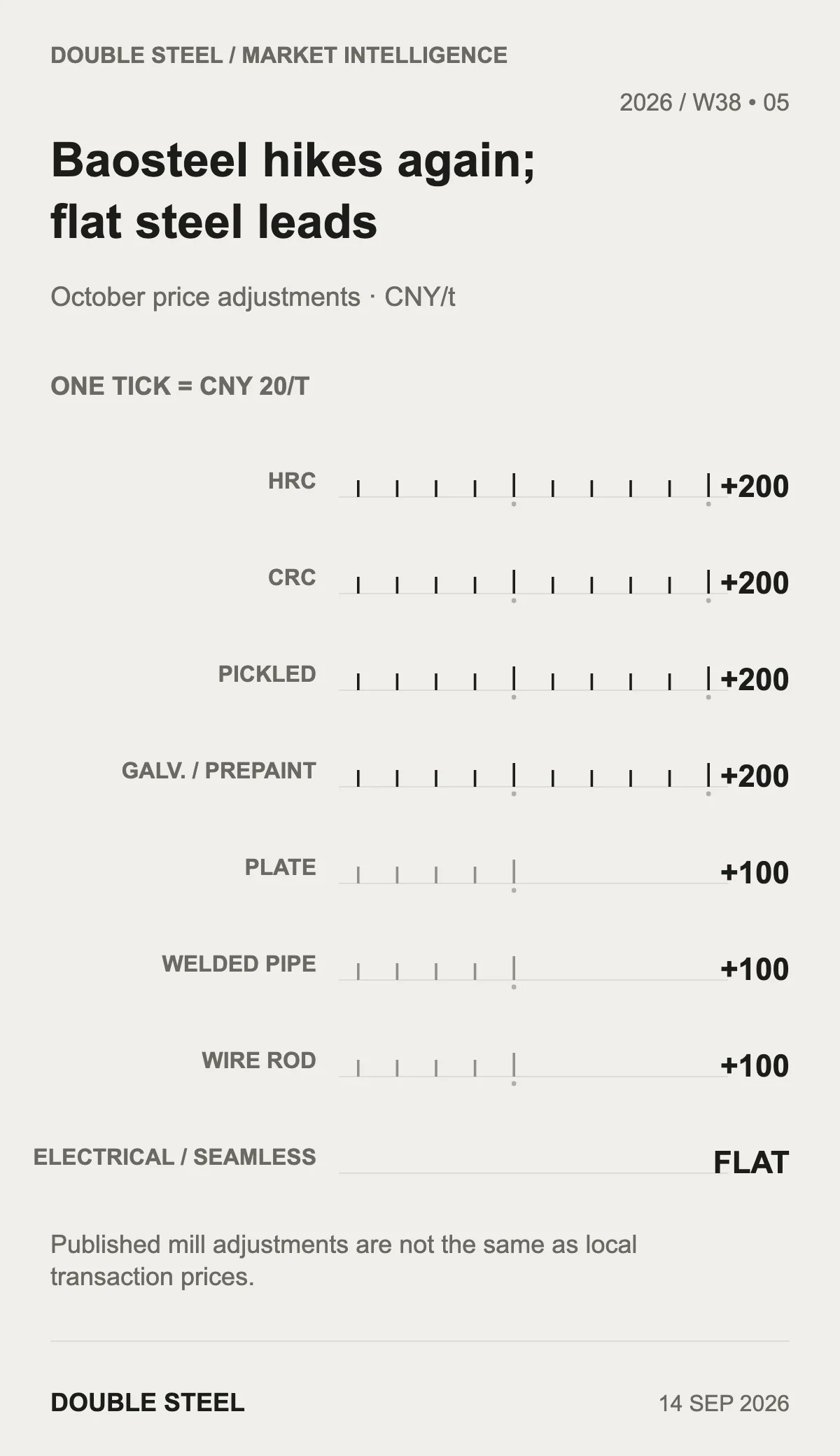
In Baosteel's October pricing, HRC, CRC, pickled, galvanized, and pre-painted products were mostly raised by CNY 200/T, while plate, welded pipe, and wire rod were increased by CNY 100/T. This was Baosteel's third consecutive monthly price increase, with a wider adjustment reflecting raw material costs, mill losses, and efforts to stabilize prices.
However, Chinese futures and spot markets weakened later in the week, and buyers remained cautious about higher prices. Domestic Chinese spot prices for 1.0 mm CRC were approximately CNY 3,750/T, up about CNY 30/T from the previous week. Export offers were around FOB USD 560–570/T, while tradable prices of approximately FOB USD 555–560/T were slightly lower than a week earlier. Chinese SS400 plate export offers were approximately FOB USD 538–565/T, with tradable prices around FOB USD 535/T, leaving a gap between offers and buyer acceptance.
The common feature across flat products is that loss-making mills are unwilling to cut prices proactively, while end-user demand is not strong enough to support broad-based price chasing. Firm offers and cautious transactions may therefore coexist. Procurement decisions should prioritize specifications, volume, delivery schedules, and actual tradable terms.
2.6 Wire Rod, Bar, and Special Steel: Costs Rise, but Export Orders Continue to Limit Price Increases
After leaving fourth-quarter wire rod and bar prices unchanged, CSC again introduced a low-carbon wire rod project-pricing program for grades 1018 and 1022 in diameters of 5.5–8 mm. The discount to list price remained NTD 2,000/T, and the allocation ratio remained 350%. The program is intended primarily to help small fastener manufacturers maintain competitiveness in export order intake.
Asian ordinary wire rod offers continued to rise. The assessed price of Chinese SAE1008 6.5 mm mesh-quality wire rod was approximately FOB USD 510/T, up USD 6/T from the previous week. Mill offers were around FOB USD 515/T, but buyer bids remained near FOB USD 490/T, and actual transaction volumes were limited. This again shows that higher costs can support mill offers without immediately translating into transactions.
The 45# special-steel round bar benchmark rose from CNY 3,530/T in W37 to CNY 3,550/T, an increase of CNY 20/T or approximately 0.57%. Special-steel prices across regions were mostly stable or slightly weak this week, and trading activity was generally average. Industrial wire rod was also soft in the near term.
2.7 Stainless Steel: Nickel Retreats, and Demand After Price Increases Still Needs Confirmation
LME nickel closed at USD 16,469/T on September 11, down approximately 2.2% on the week and returning to around a two-month low. LME monitored inventories increased to 274,300 tonnes. China's most-active stainless steel futures contract closed at CNY 13,580/T on the same day, down 1.77%, while the most-active Shanghai nickel contract fell 1.82%.
Chinese 304/2B CRC stainless spot prices were approximately CNY 15,000/T, down CNY 200/T from the previous week. Although transactions improved slightly, the overall market remained weak. Unlike carbon steel flat products, which received support from mill price increases, stainless steel faced downward pressure from nickel and futures markets this week. The restocking trend in carbon steel should therefore not be applied directly to stainless steel.
Chapter 3: Regional Market Intelligence
Taiwan | Direction of Price Increases Is Clear, but List and Transaction Prices Must Be Distinguished
Feng Hsin and Wei Chih raised their rebar offers, while new domestic flat-product prices also increased the cost of subsequent replenishment. Transaction prices for rebar and pickled coil both rose from earlier levels, but pass-through in general HRC remained limited.
Impact assessment: Taiwan's market has moved beyond the low-price competition seen in mid-August, but demand has not entered a broad-based price-chasing phase.
China | Baosteel Raises Prices, While Futures and Spot Markets Weaken Later in the Week
Baosteel broadly increased its October prices by CNY 100–200/T, and Shagang also raised construction steel prices for mid-September, indicating that large mills continued to prioritize costs and price stabilization. However, Chinese ferrous futures declined across the board on September 11. Coking coal and coke fell by more than 3%, while rebar and HRC also retreated, reflecting peak-season demand that had not reached earlier market expectations.
Impact assessment: Mill pricing can lift the market floor, but if spot transactions and flat-product destocking do not keep pace, actual trading may continue to favor negotiation, lower-priced material, or delayed procurement.
China | Exports Remain High, While Domestic Demand Has Yet to Fully Take Over
China exported approximately 10.155 million tonnes of steel products in August, remaining above 10 million tonnes for a fourth consecutive month. Cumulative exports for the first eight months were 75.149 million tonnes, approximately 3% lower year on year. August iron ore imports were approximately 108.54 million tonnes, exceeding 100 million tonnes for a third consecutive month, while cumulative imports for the first eight months increased 5.5% year on year.
Impact assessment: High export volumes continue to help Chinese mills absorb output, but overseas trade barriers and buyer price acceptance will constrain further growth. Whether domestic peak-season demand can take over remains an important variable for Asian steel prices.
Asia | Semi-Finished Prices Are Supported, but End Buyers Remain Cautious
Southeast Asian billet remained at CFR USD 485–495/T, while Asian plate and wire rod offers were also supported by raw material and mill costs. Some higher-priced Indonesian slab and HRC transactions were completed, but buyer acceptance of expensive material differed across China, Vietnam, and Taiwan.
Impact assessment: Asian mill offers are unlikely to fall sharply in the near term, but a high offer does not mean it is tradable in every market. Import procurement should focus on actual tradable prices, shipment periods, dimensions, and payment terms rather than mills' published offers alone.
Key Monitoring Indicators
-
Whether market transactions can remain at NTD 17,300–17,500/T after Feng Hsin's rebar list price rises to NTD 18,100/T, or whether prices weaken again as downstream users consume lower-cost inventories.
-
Whether domestic and imported HRC at NTD 18,500–18,800/T can further reflect CSC's new prices, or whether high-end transactions remain constrained by demand.
-
Whether domestic pickled coil at NTD 20,100–20,300/T and imported pickled coil at approximately NTD 20,000/T can secure continuous shipment support.
-
Whether Chinese rebar can continue destocking, whether wire rod maintains its improvement, and whether HRC and CRC can shift from inventory accumulation back to destocking.
-
Whether a sixth round of coke price increases begins after implementation of the fifth round, and whether mill losses and maintenance reduce hot-metal production further.
-
Whether iron ore can stabilize after falling below USD 100/T or remains weak as mills reduce procurement.
-
Whether US containerized scrap supply, Japanese 50:50 scrap offers, and freight continue to raise electric-arc-furnace costs in Taiwan.
-
Whether subsequent Russian billet offers, origin conditions, and delivery schedules can maintain the recent CFR USD 488–492/T transaction range.
-
Whether Chinese HRC, CRC, and plate spot prices follow Baosteel's increase, or whether mill offers and buyer acceptance continue to diverge.
-
Whether order intake among small fastener exporters and distribution prices improve materially after CSC introduces its low-carbon wire rod project-pricing program.
Conclusion
The key change in W38 was the steel market's shift from asking whether mills would raise prices to testing whether transactions could follow. Feng Hsin's further increases in rebar and scrap and Baosteel's wider flat-product adjustments demonstrate that mills still have a strong need to pass through costs. However, general HRC registered limited gains, Taiwan rebar buying weakened after the increase, and Chinese HRC and CRC inventories rose, indicating that demand has yet to absorb the increases broadly.
Compared with W34–W37, raw material trends began to diverge this week. Although coking coal declined slightly from the previous week, its cumulative five-week increase remained above 20%, and the fifth round of coke price increases was implemented. Iron ore, billet, and Chinese rebar moved lower together. This structure of elevated coal and coke, retreating iron ore, and diverging finished products will widen cost differences among production routes and product categories.
In the near term, buyers may prioritize low-inventory products with clear end-use demand, such as pickled coil. General HRC should not be chased solely on the basis of announced mill increases; actual transactions and delivery schedules still need to be confirmed. Rebar costs should be calculated separately for imported-billet and scrap-based electric-arc-furnace routes. Whether the uptrend can continue will depend on post-increase transaction volumes, flat-product inventories, and end-user orders rather than mill prices alone.
Sources: TradingEconomics (iron ore, coking coal, HRC, rebar, international scrap, and USD/CNY, as of September 13, 2026), E.SUN Bank (USD/TWD spot exchange rate, as of September 13, 2026), Mysteel (Tangshan billet, as of September 13, 2026), domestic and international steel news (cross-verified through September 13, 2026), and publicly available information from industry associations (as of September 13, 2026).
This report is published by the Market Research Department of Double Steel Co., Ltd. Its contents are provided solely for market research and procurement assessment and do not constitute a final basis for investment or direct purchasing decisions.