Publication date: August 31, 2026
Market and news cutoff: August 30, 2026
Exchange-rate benchmark: USD/TWD spot selling rate: 31.72
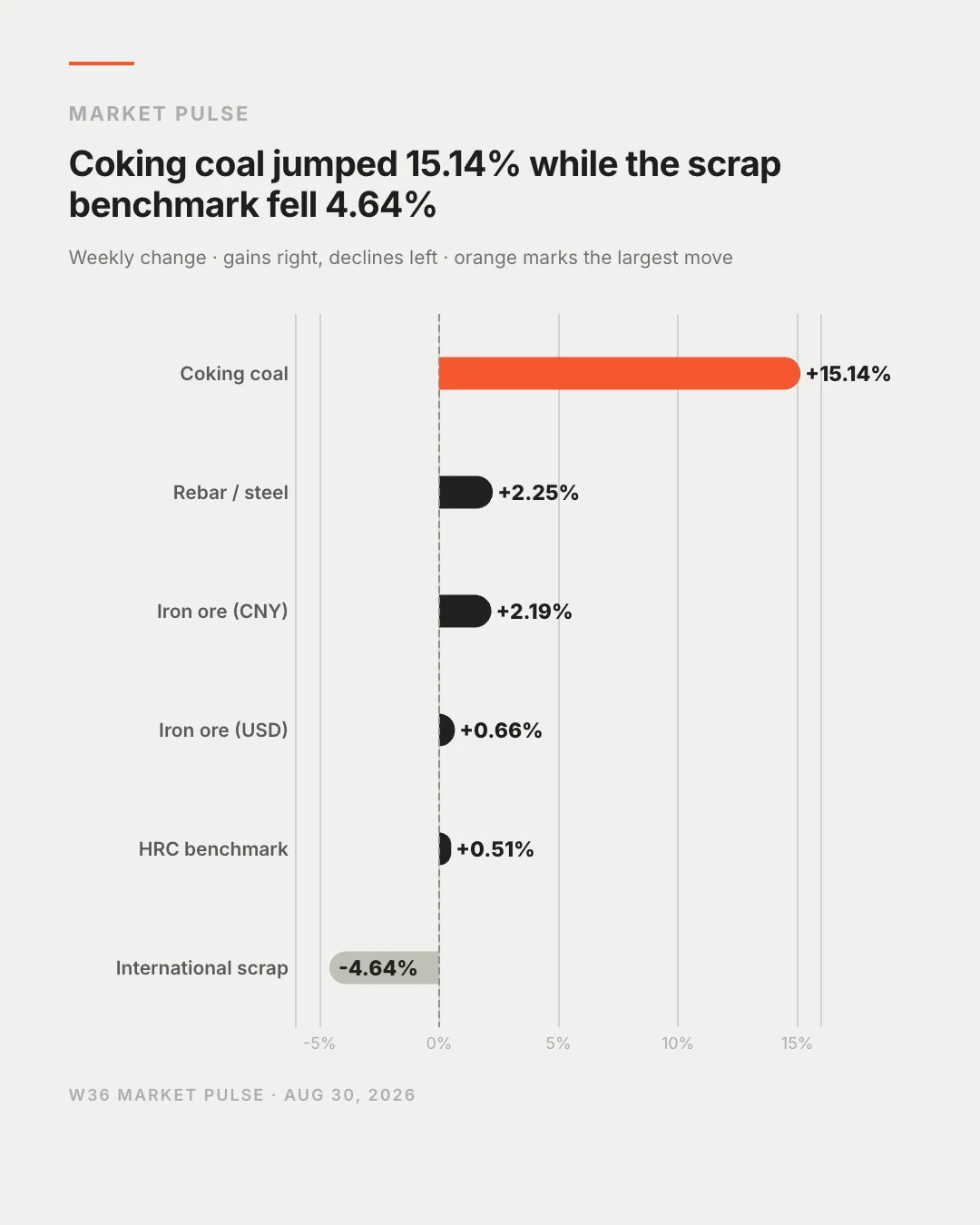
This week, the steel market was characterized by further increases in coal and coke costs, follow-through gains in steel prices, a return to inventory growth for long products, and a rebound in Taiwan's distribution prices. The coking coal benchmark rose to USD 270/T, up 15.14% week on week, while the rebar and CNY-denominated iron ore benchmarks gained 2.25% and 2.19%, respectively. Tangshan Q235 billet climbed to CNY 3,030/T. In contrast, the international scrap benchmark fell 4.64% on the week, underscoring continued divergence among raw material prices.
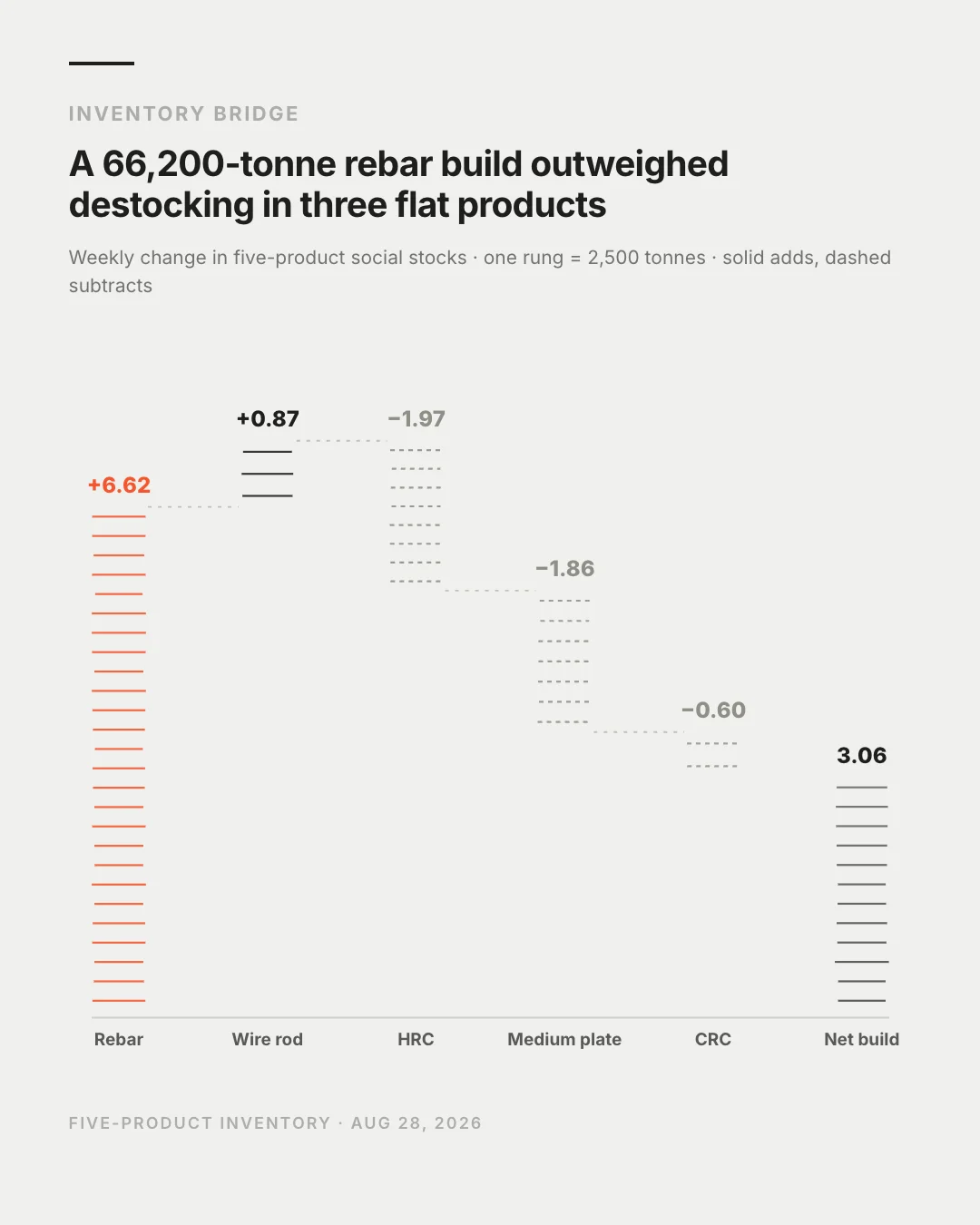
China's social inventories of five major steel products ended two consecutive weeks of decline, rising to 11.8343 million tonnes on August 28. This was a weekly increase of 30,600 tonnes, or 0.26%. Rebar and wire rod inventories grew by 1.31% and 1.34%, respectively, while hot-rolled coil, plate, and cold-rolled coil inventories continued to fall, indicating stronger destocking in flat products than in construction steel.
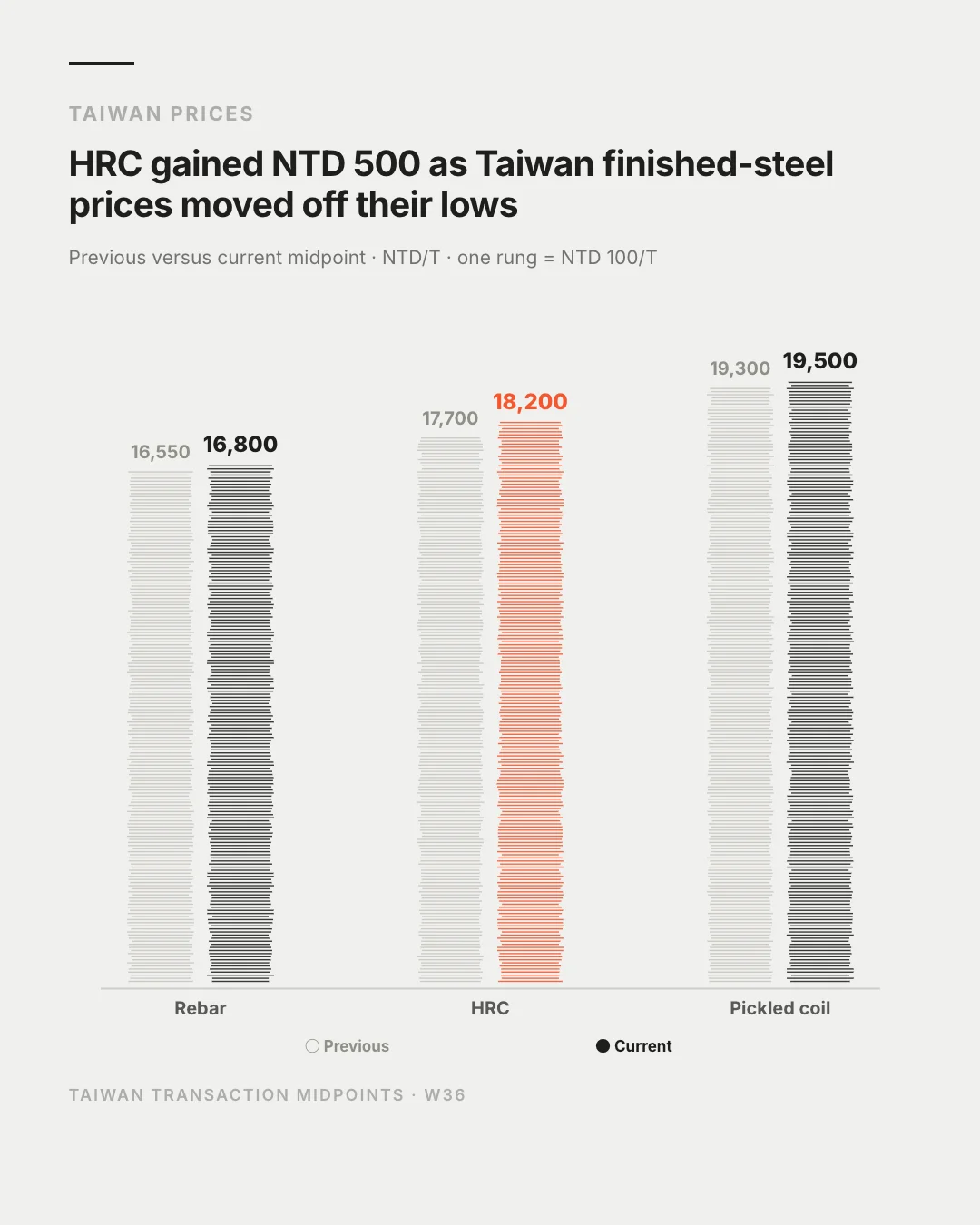
Taiwan's rebar market reversed its decline as scrap and billet prices rose. The transaction benchmark for 1,000-tonne lots recovered to approximately NTD 16,800–17,000/T, and major mills in central and southern Taiwan each booked more than 10,000 tonnes of orders. Tradable Asian billet prices also rose to CFR USD 485–490/T. Imported billet remains costly, and the market estimates a reasonable rebar rolling cost of approximately NTD 17,300/T, meaning spot margins have yet to recover fully.
Key Data This Week
| Indicator | Latest Value | Daily Change | Weekly Change |
|---|---|---|---|
| Iron ore | USD 95.84/T | +0.17% | +0.66% |
| Iron ore | CNY 723.00/T | +0.91% | +2.19% |
| Coking coal | USD 270.00/T | +1.50% | +15.14% |
| HRC benchmark | USD 1,191.07/T | +0.94% | +0.51% |
| International scrap | USD 375.25/T | -3.91% | -4.64% |
| Rebar/steel | CNY 3,130.00/T | +0.84% | +2.25% |
| Tangshan Q235 billet | CNY 3,030/T | +1.00% | — |
| USD/TWD spot rate | Selling 31.72 / Buying 31.62 | — | — |
| USD/CNY | 6.72980 | +0.17% | +0.85% |
| China's social inventories of five major steel products | 11.8343 million tonnes | — | +0.26% |
Chapter 1: Detailed Data Overview
Cost Indicators and Exchange-Rate Monitoring
Coking coal remained the strongest cost-side variable this week. The coking coal benchmark rose to USD 270/T, gaining 15.14% week on week and 19.21% month on month. Australian low-volatility hard coking coal was quoted at FOB USD 228.6/T, while the landed price in China rose to CFR USD 247/T. China's third round of coke price increases will take effect on August 31, raising wet-quenched coke by CNY 100/T and dry-quenched coke by CNY 110/T. A fourth round is already being discussed, adding further pressure to steelmaking costs.
The USD-denominated iron ore benchmark rose to USD 95.84/T, up 0.66% on the week. The August 28 spot price of 62% Australian fines shipped to China returned to CFR USD 100/T, a six-week high. Although iron ore's increase was smaller than the gains in coal and coke, higher coke prices, rising freight costs, and the rebound in steel prices provided combined support.
The rebar/steel benchmark rose to CNY 3,130/T, up 2.25% week on week, while Tangshan Q235 billet climbed to CNY 3,030/T. The estimated rebar-billet spread was only about CNY 39.4/T. Although slightly better than the previous week, it remains insufficient to cover normal rolling and operating costs. Unless finished steel prices continue to catch up, mill margins will remain under pressure.
The USD/TWD spot selling rate fell to 31.72, down another 0.20 from 31.92 in W35. The stronger New Taiwan dollar can slightly reduce the cost of USD-denominated imports. USD/CNY rose 0.85% on the week, indicating modest renminbi depreciation, which supports the export competitiveness of Chinese steel. For now, however, rising coal and coke costs remain the main driver of quotations.
Leading Indicators and Interpretation
-
Rebar-billet spread: Approximately CNY 39.4/T, still within a margin-compression range.
-
Social inventories of five major steel products: 11.8343 million tonnes, up 30,600 tonnes or 0.26% week on week, ending two consecutive weeks of destocking.
-
Rebar social inventory: 5.1132 million tonnes, up 66,200 tonnes or 1.31% week on week.
-
Wire rod social inventory: 657,600 tonnes, up 8,700 tonnes or 1.34% week on week.
-
HRC social inventory: 3.6515 million tonnes, down 19,700 tonnes or 0.54% week on week.
-
Plate social inventory: 1.1919 million tonnes, down 18,600 tonnes or 1.54% week on week.
-
CRC social inventory: 1.2201 million tonnes, down 6,000 tonnes or 0.49% week on week.
-
Tangshan billet: CNY 3,030/T, up CNY 60/T from CNY 2,970/T in W35.
-
USD/CNY: Up 0.85% week on week, indicating modest renminbi depreciation.
The increase in total inventory was limited, but the divergence among products deserves attention. Rebar and wire rod inventories rose together, indicating that construction steel demand remains affected by weather and the pace of end-user construction activity. HRC, plate, and CRC inventories continued to decline, suggesting comparatively stronger support from flat-product demand and trader restocking. Ahead of the traditional September peak season, a second consecutive weekly increase in long-product inventories would warrant lower expectations for seasonal demand.
Chapter 2: In-Depth Analysis of Key Products
2.1 Steel Billet
Tangshan Q235 billet rose to CNY 3,030/T, up CNY 60/T from W35. On August 27, Chinese 3SP 150 mm billet was quoted at FOB USD 465–470/T, while Indonesia's Dexin quoted FOB USD 475/T. Mainstream import offers in the Philippines rose to CFR USD 490–495/T, and Taiwan's tradable level was approximately CFR USD 485–490/T.
Taiwanese mills raised their bids to CFR USD 480–483/T, but sellers were still unwilling to accept less than CFR USD 485/T. Although the bid-ask gap narrowed from the previous week, the rapid price increase also pushed buyers back to the sidelines. Russian billet offers may resume, but the most recent transaction into Taiwan was already concluded at CFR USD 492/T, so Russian supply should not be expected to provide a low-priced alternative in the near term.
Taiwan's rebar transaction price for 1,000-tonne lots recovered to NTD 16,800–17,000/T, while the market estimates a reasonable rolling cost of approximately NTD 17,300/T. Even with the New Taiwan dollar appreciating this week, imported billet at CFR USD 485–490/T still does not provide an adequate processing margin.
2.2 Special Steel and Round Bar
Structural bright spots emerged in special steel demand. CITIC Pacific Special Steel reported first-half revenue of CNY 53.672 billion, down 1.91% year on year, but net profit rose 6.85% to CNY 2.99 billion. Sales of high-end bearing steel increased 16.1% year on year, automotive steel sales rose 14.7%, and export volume grew 7.07% to 1.2009 million tonnes. Higher-end products and exports continue to offset downward pressure in the broader steel market.
Stainless steel and nickel-bearing products, meanwhile, showed a combination of upstream price increases and weak downstream conditions. LME nickel closed at USD 16,861/T on August 28, down 1.15% on the week, while inventories rose to 268,362 tonnes. China's most-active stainless steel futures contract briefly fell below CNY 14,000/T, its lowest level in four years. Nevertheless, costs for nickel pig iron, stainless scrap, molybdenum, and copper remained elevated. Yieh United Steel raised September prices for 304 products by NTD 1,500/T and the 316L alloy surcharge by NTD 2,500/T. Walsin Lihwa raised 304 wire rod by NTD 3,000/T, copper-bearing 304 by NTD 4,000/T, and the 316 wire rod surcharge by NTD 5,000/T.
2.3 Updates on Other Related Steel Products
Hot-Rolled Coil and Pickled Coil
Chinese SS400/Q235 HRC was quoted at FOB USD 498–510/T, with the tradable level around FOB USD 500/T. Indonesian HRC was offered to Vietnam at CFR USD 526–530/T, with a tradable level near CFR USD 525/T. Vietnamese buyers were still waiting for Hoa Phat's new offers, and actual trading remained limited, indicating that higher quotations were driven primarily by raw materials and supply-side factors.
Taiwan's distribution market began replenishing inventory. Domestic HRC ex-yard prices rose from NTD 17,600–17,800/T to NTD 18,100–18,300/T, while imported pickled coil increased to NTD 19,400–19,600/T. The landed cost of Indonesian HRC scheduled to arrive soon was approximately CFR USD 550–565/T, while Japanese and Korean material stood at approximately CFR USD 575–615/T, creating pressure for distribution prices to catch up.
Wire Rod and Wire Products
The tradable price of Chinese SAE1008 6.5 mm wire rod was approximately FOB USD 501–505/T. Shanghai spot prices for Q195 6.5 mm wire rod were CNY 3,250/T, up CNY 10/T on the week. Indonesian mills raised prices twice during the week, for a cumulative increase of USD 10/T, but Southeast Asian demand remained weak.
Cost support for carbon steel wire rod is strengthening, but mills are shifting production toward wire rod because its margins are better than those of construction steel, and the additional supply may limit further gains. Stainless wire rod prices, meanwhile, have already been raised sharply by Walsin Lihwa. Procurement timing for carbon and stainless wire rod should therefore be assessed separately.
Scrap
The international scrap benchmark fell to USD 375.25/T, down 4.64% on the week, but physical prices in Asia remained supported by freight costs and regional demand. US 80:20 containerized scrap was offered to Taiwan at CFR USD 332–335/T, with a tradable floor near CFR USD 330/T. Taiwanese mills mostly bid CFR USD 325–328/T, resulting in limited transactions.
Japanese H2 scrap was still quoted to Vietnam at CFR USD 355–358/T, US 80:20 scrap at approximately CFR USD 330–335/T, and bulk scrap at around CFR USD 370/T. Vietnam's advantages in volume, port efficiency, and cost conditions continue to make it difficult for Taiwan to secure lower-priced imported material. With imported scrap costing more than comparable domestic scrap, Taiwan's domestic scrap prices face upward pressure.
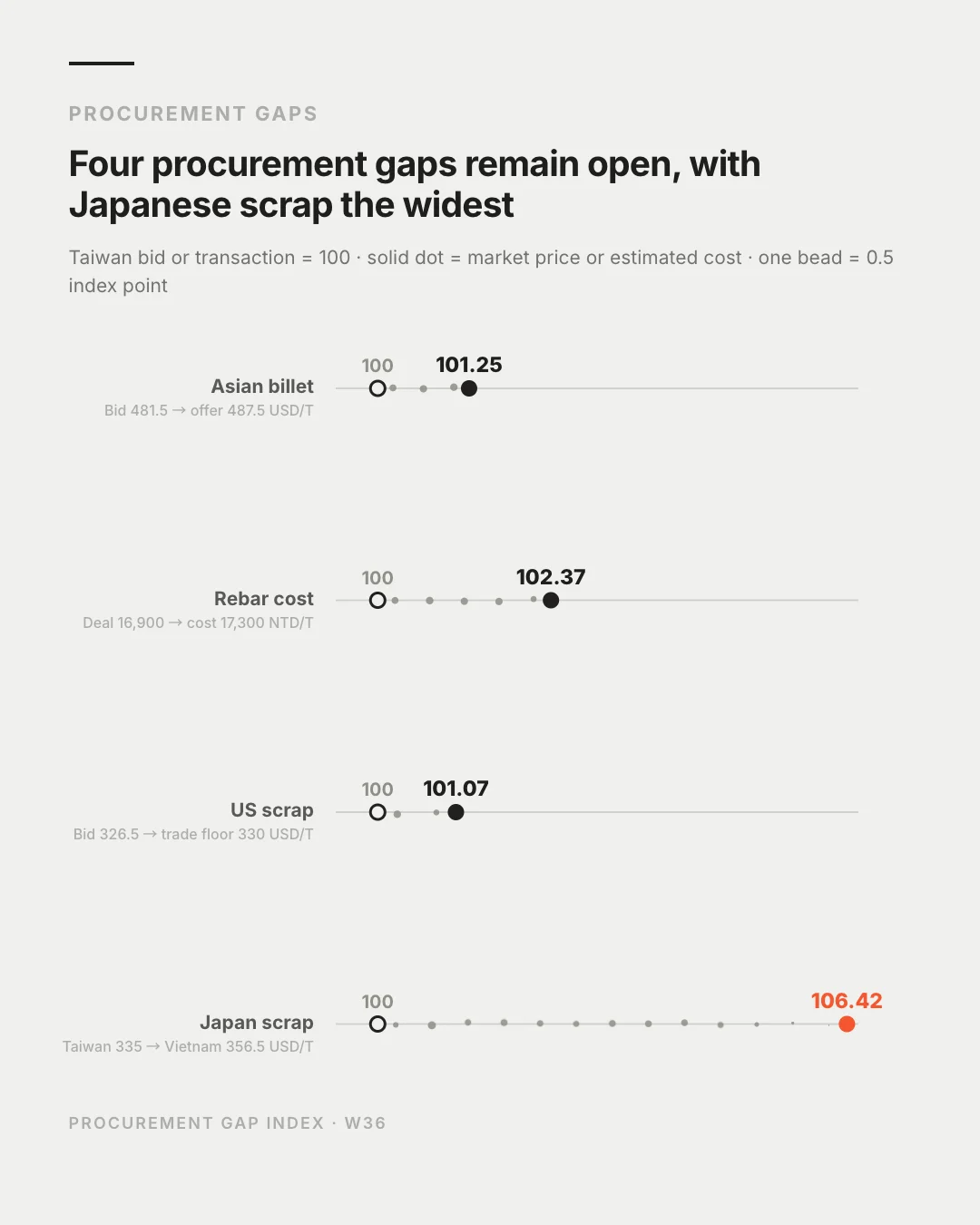
Plate and Cold-Rolled Coil
Chinese SS400 plate was quoted at FOB USD 535–560/T, up USD 8–10/T on the week, with a tradable level around FOB USD 530/T. Vietnamese buyers indicated interest at approximately CFR USD 540–545/T, still below mills' minimum levels. Buying interest in the Middle East, Turkey, and South America was stronger than in Southeast Asia.
The average spot price of Chinese 1.0 mm CRC rose to CNY 3,690/T, up CNY 40/T on the week. Export offers stood at FOB USD 550–555/T, with a tradable level around FOB USD 545/T. Lower supply and declining inventories supported prices, but peak-season trading volumes still need to be confirmed before procurement is accelerated.
Chapter 3: Regional Market Intelligence
China | Social Inventories of Five Major Steel Products Edge Higher
As of August 28, China's social inventories of five major steel products rose to 11.8343 million tonnes, up 30,600 tonnes or 0.26% week on week. Rebar and wire rod inventories increased, while HRC, plate, and CRC inventories declined.
Impact assessment: Flat-product destocking remains supportive, but peak-season demand for construction steel has yet to be confirmed. If rebar inventories continue to increase, further price gains will become more dependent on cost pressures.
China | Third Round of Coke Price Increases Takes Effect
Beginning August 31, wet-quenched coke prices in Tangshan and other regions will rise by CNY 100/T, while dry-quenched coke will increase by CNY 110/T. A fourth round of increases is already being discussed, and the coking coal benchmark rose 15.14% this week.
Impact assessment: The cost floor for blast-furnace steel continues to move higher, limiting near-term downside in steel prices. However, it may also further compress mill margins and reduce mills' capacity to purchase iron ore.
Asian Billet | Tradable Prices Rise to CFR USD 485–490/T
Chinese billet was quoted at FOB USD 465–470/T, while Indonesian billet was quoted at FOB USD 475/T. Taiwan's tradable range rose to CFR USD 485–490/T, and buyers raising bids to CFR USD 480–483/T were still unable to secure significant volumes.
Impact assessment: Taiwan's rebar prices have rebounded but still do not fully cover the rolling cost of imported billet.
Taiwan | Rebar Stabilizes and Major Mills' Order Intake Recovers
Taiwan's transaction benchmark for 1,000-tonne rebar lots recovered to NTD 16,800/T in southern Taiwan and NTD 17,000/T in central and northern Taiwan, approximately NTD 200/T above the low point of the previous offer cycle. Major mills in central and southern Taiwan each received more than 10,000 tonnes of orders.
Impact assessment: Higher raw material costs successfully triggered near-term restocking, but the reasonable cost is still estimated at approximately NTD 17,300/T. Mills need to establish a stronger pricing consensus to prevent another spread of low-price competition.
Taiwan | HRC and Pickled Coil Distribution Prices Rebound More Rapidly
Domestic HRC ex-yard prices rose to NTD 18,100–18,300/T, while imported pickled coil increased to NTD 19,400–19,600/T. Some distributors with low inventories began replenishing more actively.
Impact assessment: Landed costs and peak-season expectations support distribution prices, but HRC trading in Vietnam remains limited.
Taiwan | September Stainless Steel Prices Fully Reflect Higher Costs
Yieh United Steel raised 304 prices by NTD 1,500/T and the 316L surcharge by NTD 2,500/T. Walsin Lihwa raised 304 wire rod by NTD 3,000/T, with larger increases for copper-bearing 304 and the 316 surcharge.
Impact assessment: Taiwanese upstream producers have passed alloy and raw material costs downstream, but weak Chinese 304 spot and futures prices leave uncertainty over whether downstream orders can absorb the increases.
Taiwan | China Steel Holds October AP Plate Flat and Raises SN Plate
China Steel Corporation kept its October base price for AP plate unchanged at NTD 26,200–26,300/T and raised the project price for SN490B by NTD 300/T.
Impact assessment: Holding general plate prices flat helps maintain downstream competitiveness, while special grades reflect differences in costs and supply-demand conditions.
Asian Scrap | Taiwan's Bids Continue to Trail Vietnam
US 80:20 scrap was offered to Taiwan at CFR USD 332–335/T, while Taiwanese bids were approximately CFR USD 325–328/T. Japanese H2 scrap was quoted to Vietnam at CFR USD 355–358/T, while Taiwan's bid for Japanese 50:50 scrap was approximately CFR USD 335/T.
Impact assessment: Taiwan continues to struggle to compete with Vietnam for supply. Insufficient imported scrap transactions will increase the likelihood of catch-up gains in domestic scrap prices, keeping electric-arc furnace costs firm in the near term.
Taiwan Manufacturing | Output of Basic Metals and Fabricated Metal Products Improves
Taiwan's basic metal manufacturing output rose 1.30% month on month and 13.24% year on year in July. Fabricated metal product output increased 4.67% month on month and 28.12% year on year, while automobile output fell 5.03% year on year.
Impact assessment: Overall metal-processing demand improved, but the automotive supply chain remained weak. Restocking in bars and wire, flat products, and automotive special steel should be assessed separately.
Chinese Special Steel | High-End Products and Exports Support Earnings
CITIC Pacific Special Steel's first-half net profit rose 6.85% year on year. Sales of high-end bearing steel and automotive steel increased 16.1% and 14.7%, respectively, while export volume grew 7.07%.
Impact assessment: When the broader steel market is under pressure, high-end grades and exports remain resilient. Special steel procurement should emphasize grade certification, lead times, and supply stability rather than comparing prices per tonne alone.
Europe | Lower Imports Support Fourth-Quarter Flat Products
European CRC was priced at approximately EUR 820–830/T and hot-dip galvanized steel at approximately EUR 815–825/T. Steel import volumes have fallen 47% since July, and the market expects prices to find support after the summer holiday period.
Impact assessment: European import restrictions and CBAM verification will increase compliance costs. They may also encourage suppliers in Turkey, India, and other regions to redirect material toward higher-priced markets, indirectly tightening Asian supply.
North America | US-Canada Tariff Conflict Raises Regional Costs
Canada plans to impose additional tariffs on certain US metal imports beginning September 8, increasing tariffs on some steel products from 25% to 50% to match the United States' 50% import tariffs on steel and aluminum.
Impact assessment: The highly integrated US-Canada supply chain faces higher costs and a reorganization of trade flows, potentially widening regional price spreads and redirecting global steel trade.
Key Monitoring Indicators
-
Whether China's social inventories of five major steel products rise for a second consecutive week, and whether inventory growth in rebar and wire rod accelerates.
-
Whether finished steel prices can fully absorb coking coal at USD 270/T and the third round of coke price increases.
-
Whether Tangshan billet at CNY 3,030/T can hold above CNY 3,000/T or quickly retreat.
-
Whether Taiwan billet bids at CFR USD 480–483/T converge with sellers' CFR USD 485–490/T offers.
-
Whether Taiwan rebar can reach NTD 17,000–17,300/T and whether major mills can sustain their order intake.
-
Whether domestic HRC at NTD 18,100–18,300/T and pickled coil at NTD 19,400–19,600/T are accompanied by actual shipments.
-
Whether Chinese HRC, CRC, and plate social inventories continue to decline.
-
Whether LME nickel at USD 16,861/T and inventories of 268,362 tonnes remain weak, and whether Taiwan's stainless steel price increases gain market acceptance.
-
Whether US-Canada tariffs, European import restrictions, and CBAM verification alter Asian steel trade flows in the fourth quarter.
Conclusion
The key change in W36 was that rising coal and coke costs began to pass through more visibly to billet, steel products, and Taiwan's distribution market. Coking coal rose 15.14% week on week, Tangshan billet climbed to CNY 3,030/T, and Taiwan's rebar and HRC prices rebounded from their lows. However, China's social inventories of five major steel products returned to growth, led by inventory increases in rebar and wire rod. This indicates that the current uptrend remains primarily cost-driven and that peak-season end-user demand has yet to be fully confirmed.
Sources: TradingEconomics (iron ore, coking coal, HRC, rebar, international scrap, and USD/CNY, as of August 30, 2026); E.SUN Bank (USD/TWD spot exchange rate, as of August 30, 2026); Mysteel (Tangshan billet, as of August 30, 2026); domestic and international steel industry news (cross-verified through August 30, 2026); and publicly available information from industry associations (as of August 30, 2026).
This report is published by the Market Research Department of Double Steel Co., Ltd. Its contents are provided solely for market research and procurement assessment and do not constitute a final basis for investment or direct purchasing decisions.