
Publication date: October 5, 2026
Market and news cutoff: October 4, 2026
Exchange-rate benchmark: USD/TWD spot selling rate: 31.91
The central theme of W41 is that transactions are now supporting Taiwan's flat-steel price increases, while rebar dealers continue to undercut mills' new prices. More than 10,000 tonnes of Indonesian HRC were reportedly sold to Taiwan, pickled coil distribution prices moved higher, and Yieh Phui raised its October galvanized and prepainted steel prices. In rebar, project-related orders and restocking under long-term contracts have improved, but ordinary distribution channels are still supplying cheaper, older inventories, making it difficult for mills to sell at their new prices. Flat and long products have not entered a broad-based cycle of buying at higher prices together.
China has shifted from W40's concentrated pre-holiday deliveries to slower destocking. Social inventories of five major steel products fell for a fifth consecutive week, but the decline narrowed from 4.11% to 1.90%. HRC, plate and CRC inventories all either returned to accumulation or continued building. Rising output and falling apparent consumption indicate that supply-demand conditions improved less than in the previous week as pre-holiday restocking wound down.
Raw materials are also diverging. Iron ore's decline accelerated, seaborne hard coking coal weakened, and some Chinese mills began implementing coke purchase-price cuts. Japanese scrap purchase prices nevertheless increased, leaving Taiwanese electric-arc-furnace mills without a matching easing in input costs. In round bar, China's general carbon steel prices were broadly steady while special-steel inventories increased; Taiwan's high-end special steels for aerospace and energy applications, meanwhile, continued to receive support from orders.
Key Data This Week and Comparison with the Previous Four Weeks
| Indicator | W37 | W38 | W39 | W40 | Latest W41 Value | Change from W40 Cutoff |
|---|---|---|---|---|---|---|
| Iron ore (USD/T) | 99.57 | 98.02 | 97.57 | 97.06 | 91.35 | -5.88% |
| Iron ore (CNY/T) | 727.00 | 718.00 | 715.50 | 713.50 | 702.50 | -1.54% |
| Coking coal benchmark (USD/T) | 275.00 | 271.00 | 262.00 | 265.00 | 262.50 | -0.94% |
| International HRC benchmark (USD/T) | 1,238.00 | 1,274.00 | 1,300.00 | 1,322.00 | 1,310.00 | -0.91% |
| International scrap benchmark (USD/T) | 394.00 | 396.00 | 404.00 | 402.00 | 400.00 | -0.50% |
| Rebar/steel benchmark (CNY/T) | 3,131.00 | 3,071.00 | 3,099.00 | 3,107.00 | 3,109.00 | +0.06% |
| Tangshan Q235 billet (CNY/T) | 3,040 | 3,000 | 3,000 | 3,010 | 2,980 | -1.00% |
| USD/TWD spot selling rate | 31.71 | 31.70 | 31.87 | 31.85 | 31.91 | +0.06 |
| USD/CNY | 6.70783 | 6.70793 | 6.69531 | 6.72040 | 6.70627 | -0.21% |
| China's social inventories of five major steel products (10,000 tonnes) | 1,176.85 | 1,160.55 | 1,144.66 | 1,097.57 | 1,076.69 | -1.90% |
Each indicator uses its latest available trading cutoff: September 30 for China's renminbi-denominated iron ore and rebar benchmarks, October 1 for international scrap, October 2 for the other main US-dollar commodity benchmarks, and October 4 for E.SUN Bank exchange rates. Chinese social inventories reflect pre-holiday data, while Tangshan billet is a price fixed for the holiday rather than a new price established through continuous holiday trading. The commodity benchmarks are market references, not landed or spot transaction prices for specific grades in Taiwan.
Chapter 1: Taiwan's Flat-Steel Increases Gain Firmer Support, but Rebar Price Pass-Through Remains Blocked
New HRC Import Transactions Emerge as Pickled Coil Prices Continue to Rise
More than 10,000 tonnes of Indonesian HRC were reportedly sold to Taiwan this week at approximately CFR USD 554–556/T. Compared with W40's offers near CFR USD 554/T and assessed tradable level around CFR USD 550/T, new transactions now support higher replacement costs. Specifications, volumes and shipment schedules must still be checked for each lot.
POSCO HRC was offered to Taiwan at approximately CFR USD 593/T, with reported transactions near CFR USD 590/T. Market information suggests, however, that the material may be thick SN-grade coil intended to substitute for SN steel plate. This transaction can signal tighter supply in particular specifications, but should not be treated as a market-wide transaction price for ordinary SS400 or SAE1006 HRC. Nor should a price gap against China Steel Corporation's project material be calculated without accounting for grade differences.
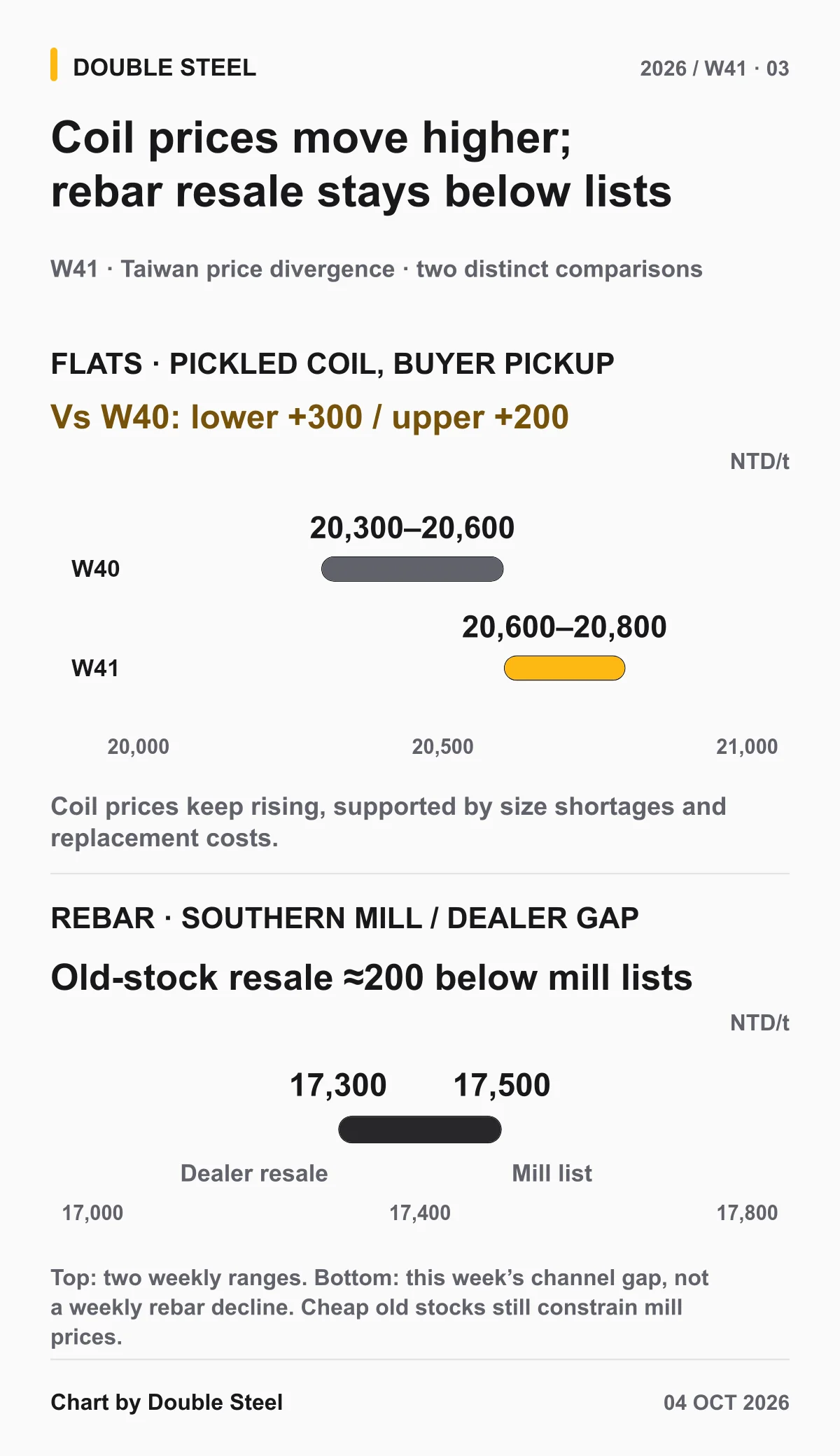
Pickled coil has shown a more consistent pattern. Domestic and imported pickled coil distribution prices on a self-collection basis moved from NTD 20,300–20,600/T in W40 to approximately NTD 20,600–20,800/T. Some suppliers raised offers to NTD 21,000/T. Shortages in certain sizes, concerns over future import replacement costs, and sellers' reluctance to release more than limited quantities continue to support prices.
Meanwhile, approximately 15,000 tonnes of previously purchased POSCO pickled coil are scheduled to arrive in batches during October and November. Current shortages can coexist with future import arrivals. Short-term withholding does not mean supply will remain insufficient indefinitely; procurement still needs to be matched to customers' actual specifications, shipment schedules and inventories.
Yieh Phui Announces Higher Prices; CSC's November Adjustment Awaits an Official Announcement
Yieh Phui announced new prices on September 30, raising its October domestic prices for galvanized steel, prepainted steel and prepainted 304 stainless steel by NTD 1,000/T. November export prices for galvanized and prepainted steel rose by USD 20/T. These are announced supply-side adjustments this week; the extent of distributor pass-through and subsequent shipments remains to be seen.
Market expectations for CSC's November HRC increase have strengthened from W40. Some participants have raised their estimates from NTD 500–600/T to approximately NTD 1,000/T.
CSC and Dragon Steel Shipments Recover, but the Increase Is Not Entirely New Demand
CSC and Dragon Steel's combined September shipments, including billets, were approximately 1.041 million tonnes, up about 25.27% from 831,000 tonnes in August. Domestic shipments rose from 440,000 to 472,000 tonnes, while exports increased from 391,000 to 569,000 tonnes. Exports accounted for most of the increase.
These figures show a recovery in shipments, but the company's explanation includes cargo deferred from the previous month and the resumption of loading after weather conditions improved. Domestic shipments also remained below the original target of 493,000 tonnes. The overall monthly increase therefore cannot all be interpreted as new end-user orders. For Taiwan's flat-steel market, the more reasonable assessment is that replacement costs, transactions in specific grades and recovering shipments are jointly providing support, while general downstream demand has not expanded broadly at the same time.
Rebar Restocking for Projects Improves, but Older Inventories Continue to Suppress New Prices in Ordinary Channels
Feng Hsin's September 29 price announcement kept its rebar base price at NTD 18,300/T, scrap purchase price at NTD 9,800/T and section steel price at NTD 25,000/T, with all three unchanged. Market reports indicate that southern public works and technology-factory projects rushing to meet year-end schedules have supported some long-term orders and restocking. Feng Hsin, however, said the response to its previous increase was moderate and ordinary customers were still purchasing only part of their requirements.
Improving project orders and cautious buying in ordinary channels are not contradictory. W40's project demand and some large transactions did improve mills' order intake, but have not led all distributors to restock consistently at higher prices.
An October 2 report on southern Taiwan indicated a mill list price around NTD 17,500/T, while major dealers were still reselling lower-cost inventories at approximately NTD 17,300/T. Even when mills discounted to NTD 17,300–17,400/T, shipments did not become noticeably easier. Compared with W40's assessed NTD 17,400–17,450/T range for large southern orders, ordinary distribution transactions did not continue moving higher this week.
Two different pressures are at work: a distribution price inversion, in which dealers sell below mills' new prices; and a cost-price inversion, in which production costs, including imported scrap, exceed finished-product selling prices. Until cheaper older stock is absorbed, mills have difficulty passing through the full increase even when costs give them a reason to defend prices. The current situation is best described as support from projects and long-term orders, but stalled price pass-through in ordinary channels—not an absence of any improvement in orders, or a market-wide expansion in trading volumes.
A One-Month Review: Product Divergence Widens After Mill Price Increases Take Effect
In W37, CSC's adjustments took effect and raised subsequent replacement costs for flat steel. W38 brought distribution price increases, but low-priced rebar inventories continued to hold back new prices. In W39, Chinese destocking extended to some flat products while Taiwanese mills restricted sales volumes to defend prices. W40 saw pre-holiday deliveries of Chinese long products and improvement in selected Taiwanese project demand. By W41, Taiwan had new flat-steel import transactions, but older stock continued to suppress ordinary rebar channels and Chinese destocking slowed again.
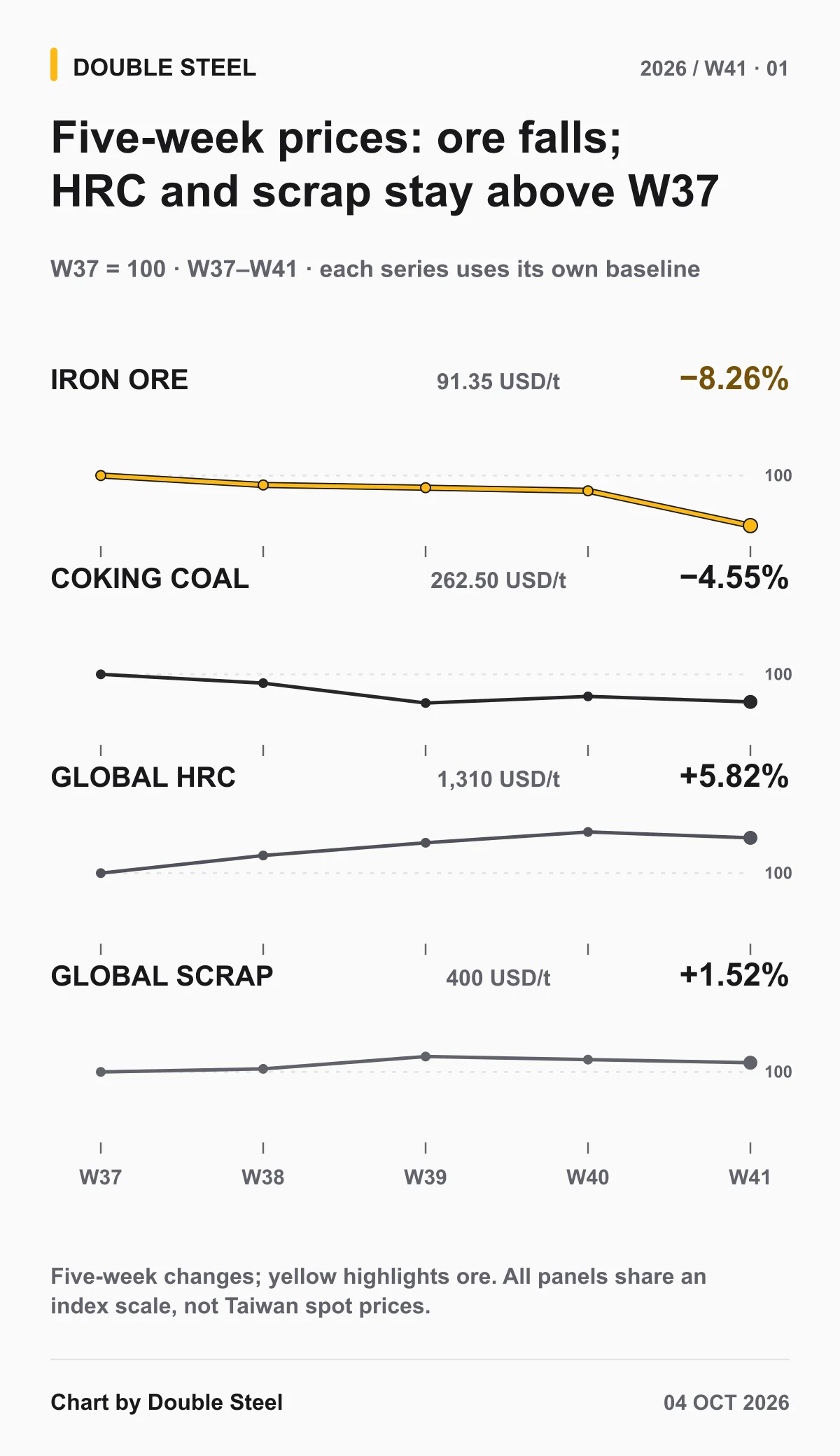
From W37 to W41, the US-dollar iron ore benchmark fell approximately 8.26% and coking coal declined about 4.55%, while HRC and the international scrap benchmark remained approximately 5.82% and 1.52% higher, respectively. Although HRC and scrap eased slightly this week, cooling raw-material prices should not be interpreted directly as broad-based price reductions for finished steel in Taiwan.
Exchange rates provided no additional cushion. The USD/TWD spot selling rate increased by 0.06 from W40. For imported material valued at USD 550/T, this change alone adds approximately NTD 33/T to the cost of the goods. Taiwanese import procurement needs to consider US-dollar quotations, exchange rates and available supply together.
Chapter 2: Chinese Destocking Slows as Raw Materials and Round-Bar Demand Diverge
2.1 Social Inventories: Long Products Continue Destocking, While All Three Flat Products Accumulate
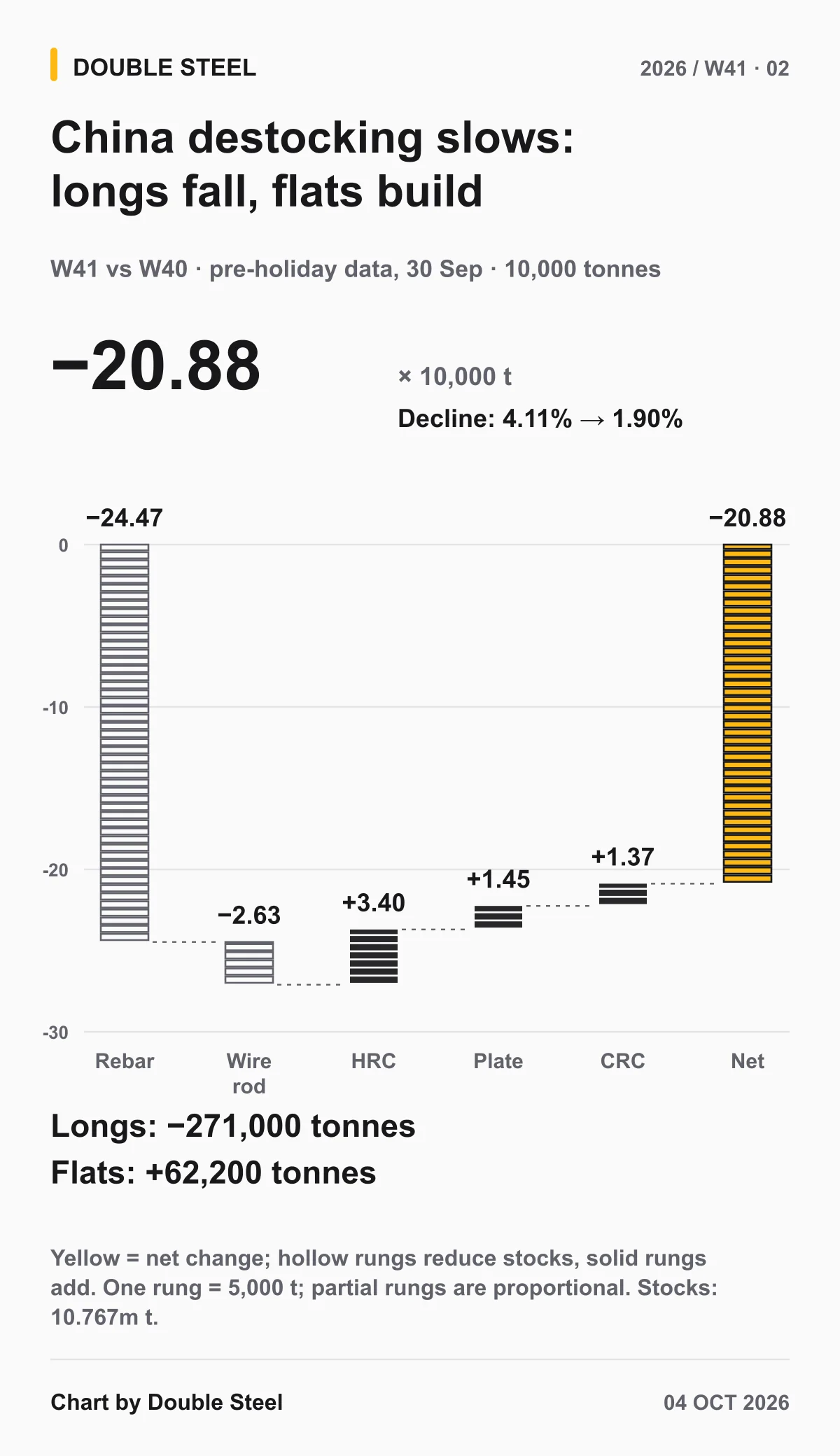
China's social inventories of five major steel products were 10.7669 million tonnes this period, down 208,800 tonnes from W40 and declining for a fifth consecutive week. Stocks were approximately 8.51% lower than W37 over four weeks, but the latest reduction was smaller than W40's 470,900 tonnes. Destocking was once again concentrated in rebar and wire rod.
| Product | W40 Social Inventory (10,000 tonnes) | W41 Social Inventory (10,000 tonnes) | Change (10,000 tonnes) | Weekly Change |
|---|---|---|---|---|
| Rebar | 439.59 | 415.12 | -24.47 | -5.57% |
| Wire rod | 58.05 | 55.42 | -2.63 | -4.53% |
| HRC | 354.70 | 358.10 | +3.40 | +0.96% |
| Plate | 120.03 | 121.48 | +1.45 | +1.21% |
| CRC | 125.20 | 126.57 | +1.37 | +1.09% |
HRC and plate shifted from destocking to accumulation, while CRC continued building inventories. The broader destocking seen in W39–W40 therefore did not fully persist. Flat-product social inventories increased by a combined 62,200 tonnes, offsetting part of the reduction in long products.
Supply-demand data also changed. Mysteel's September 30 figures put combined weekly output of the five products at 7.9318 million tonnes, up 135,000 tonnes, or approximately 1.7%. Apparent consumption was 8.1221 million tonnes, down 2.8%, with construction steel falling 4.4% and flat products declining 1.9%. As pre-holiday restocking ended and end users began taking time off, W40's assessment of improving volumes no longer carried through to this period.
Combined mill and social inventories of the five products still fell to 14.6294 million tonnes, but this is a different measure from the social inventories in the table above. Falling inventories do not necessarily mean consumption is continuing to rise. The more important changes this week are recovering output, declining consumption and accumulating flat-product inventories.
These figures mainly reflect the pre-holiday situation on September 30. China's National Day holiday runs through October 7. Actual post-holiday inventory accumulation, construction-site restarts and manufacturing restocking still require confirmation from subsequent data.
2.2 Iron Ore: The Price Decline Accelerates as Blast-Furnace Input Costs Begin to Ease
The US-dollar iron ore reference benchmark fell much more sharply this week than in preceding weeks. A separate assessment for 62% Australian fines shipped to China fell to approximately USD 92.60/T on October 2, down about 4.2% from the previous week within the same price series. It is not the same series as the USD 91.35/T financial reference benchmark in the table and should be tracked separately.
Increasing port inventories, mill losses that constrain higher bids, and falling hot-metal output continue to weaken purchasing appetite. Lower iron ore prices help reduce blast-furnace costs, but may also encourage some production lines to resume output. If finished-steel consumption does not increase at the same time, cheaper raw materials may not immediately translate into a broad improvement in mill margins.
2.3 Coking Coal and Coke: Seaborne Buyers Wait as the First Round of Coke Cuts Takes Effect
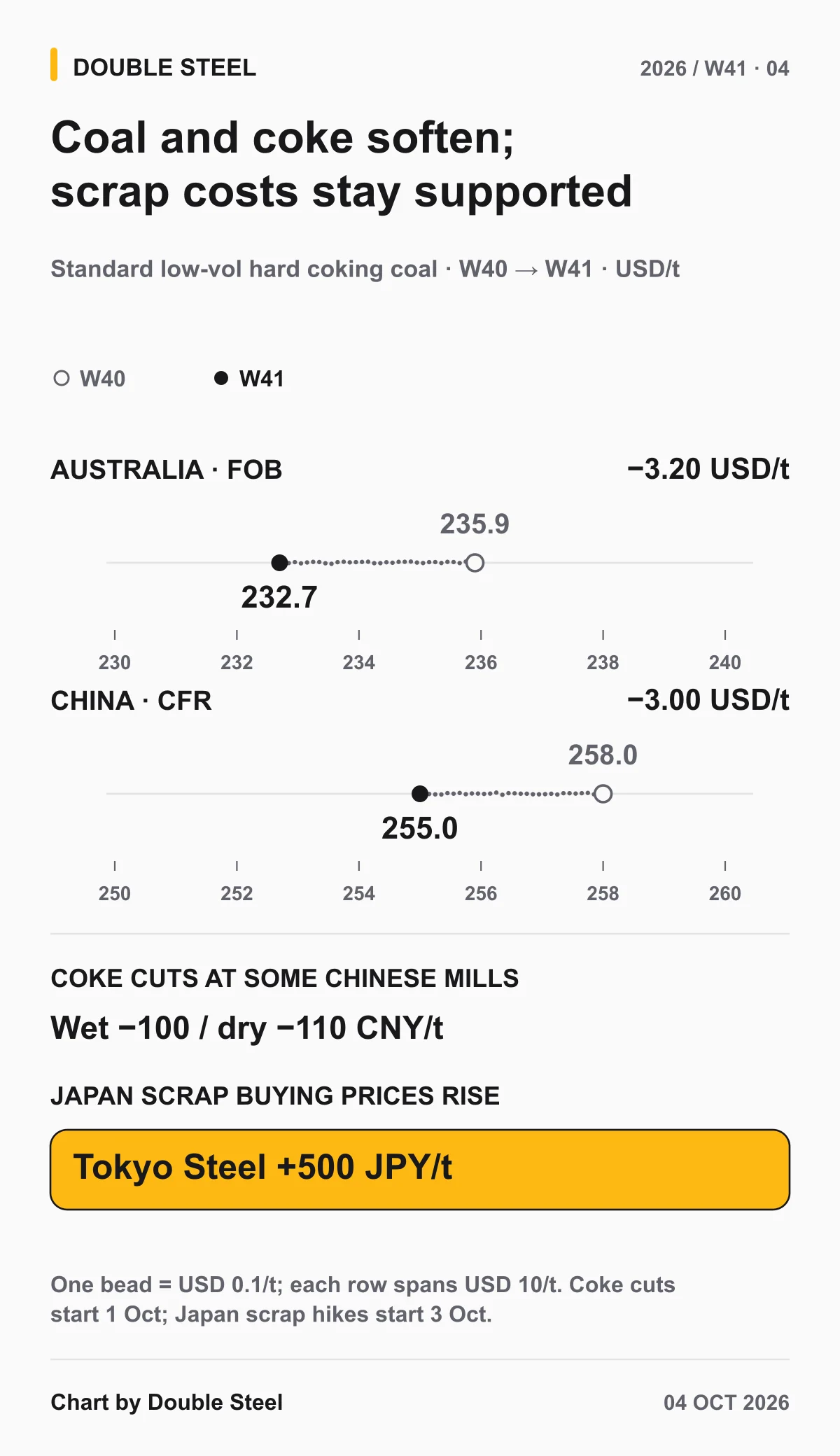
On October 1, Australian standard low-volatile hard coking coal was approximately FOB USD 232.7/T and CFR USD 255/T into China. Premium low-volatile hard coking coal was around FOB USD 272.1/T and CFR USD 294/T. Compared with W40's standard low-volatile hard coking coal assessment of approximately FOB USD 235.9/T, the current price was about USD 3.2/T lower. Significant price differences between qualities remain.
Chinese buyers were absent during the extended holiday, leaving seaborne trading thin. Indian metallurgical coal buyers, with relatively adequate inventories, also preferred to wait for lower prices. This is a change in purchasing patterns for steelmaking coal and should not be conflated with supply-demand issues in thermal coal used for power generation.
China's coke market showed a more concrete cost change than in the previous week. Some mills in Hebei and Shandong announced purchase-price reductions on September 30 of CNY 100/T for wet-quenched coke and CNY 110/T for dry-quenched coke, effective October 1. Compared with W40's standoff after the earlier increases, the first round of cuts has now begun taking effect, directly easing some blast-furnace costs. The extent of implementation and the recovery of coal-mine supply remain points to watch.
2.4 Scrap and Billet: Electric-Furnace Inputs Do Not Ease Alongside Iron Ore, Coal and Coke
Tokyo Steel raised scrap purchase prices at all its plants by JPY 500/T from October 3, bringing H2 prices to approximately JPY 48,000–50,500/T. Japanese purchasing prices retained support, moving in the opposite direction to the international scrap reference benchmark's small decline this week.
For Taiwan's imported scrap, a September 30 market report described offers for US 80:20 containerized scrap in the preceding week at approximately CFR USD 347–348/T, with transactions around CFR USD 343–344/T. Its forecast for the current week was for offers starting at CFR USD 350/T and a tradable range near CFR USD 346–348/T. The latter two remain market assessments and cannot be confirmed as transaction records, but indicate that mills still face difficulty securing cheaper material.
Japanese 50:50 scrap also attracted high offers of CFR USD 380/T. An estimated rebar production cost of approximately NTD 19,500/T using this raw-material mix applies only to that production scenario, not to the average cost across Taiwanese mills. The 50:50, H2 and US 80:20 grades are not interchangeable.
The billet market was affected by China's extended holiday. Tangshan Q235 billet was fixed near CNY 2,980/T for the holiday, while Indonesian export offers were approximately FOB USD 475/T. Taiwanese billet purchases remain constrained by rebar buying conditions and dealers' lower selling prices. Even where mills are considering billet as an alternative to expensive scrap, they need to confirm finished-product sales and actual processing costs first.
2.5 Round Bar and Special Steels: General Prices Hold Steady, While High-End Applications Receive Order Support
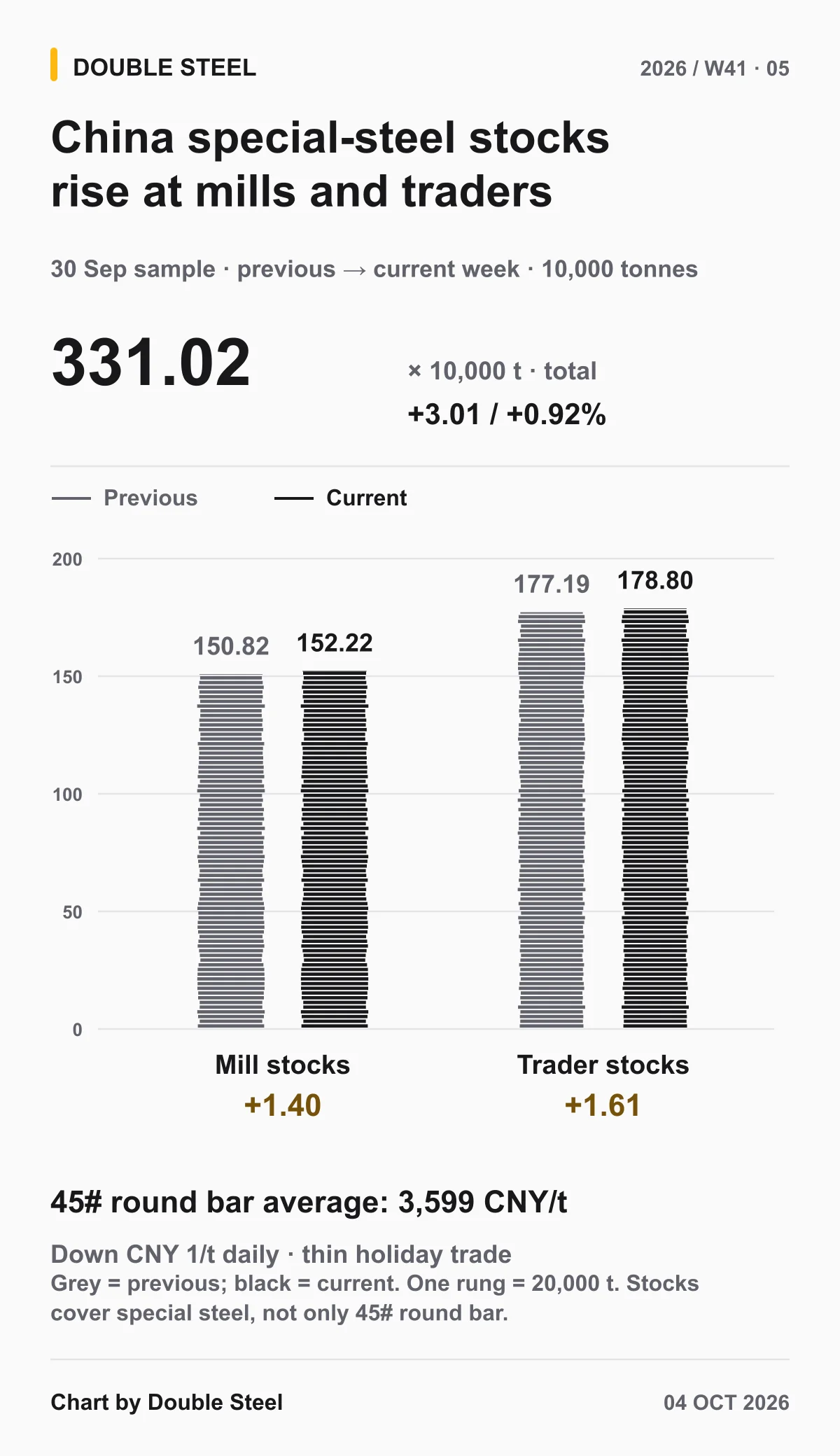
China's general round-bar market did not show the pronounced price increases seen in Taiwan's flat-steel market this week. On September 30, the national average for 45# carbon steel round bar, 29–85 mm in diameter, was approximately CNY 3,599/T, down CNY 1/T from the previous trading day. Warehouse pickup prices were around CNY 3,540/T in Hangzhou and CNY 3,510/T in Wuxi. As downstream users and distributors began their holidays, trading was thin and short-term prices were mainly steady.
The national special-steel inventory sample totaled 3.3102 million tonnes on the same date, up 30,100 tonnes, or approximately 0.92%, for the week. Inventories at 46 sampled mills were 1.5222 million tonnes, up 14,000 tonnes, while social inventories were 1.7880 million tonnes, up 16,100 tonnes. Stocks increased at both mills and distributors, indicating that inventory clearance had not strengthened.
Taiwan's high-end special steels showed a different signal. At its September 29 investor briefing, Gloria Material Technology said its order backlog for existing capacity was approximately NTD 8.5 billion, up from about NTD 8.0 billion previously. Demand for high-end aerospace and energy materials provided support, and the backlog did not yet include future orders that new facilities, including large-scale forging equipment, could accommodate. This indicates an improvement in the company's order position, not NTD 500 million of new orders booked in this week alone, and does not establish a broad strengthening in general machinery-grade round bar.
2.6 H-Beams and Stainless Steel: List Prices, Raw Materials and Demand Remain Out of Step
Tung Ho Steel raised its H-beam list prices by NTD 500/T this period. Expensive imports also reduced low-price competition against domestic spot material. Market reports nevertheless indicate limited distribution demand. Imported H-beam distribution base prices moving above NTD 24,000/T and domestic H-beams reaching above NTD 25,000/T remain expectations for subsequent prices, not new levels at which transactions are already widespread.
Stainless steel inputs faced pressure from nickel. LME nickel futures closed near USD 15,626/T on October 2, down approximately 4.31% from the previous week. Elevated inventories and cautious downstream demand continued to weigh on the market. Lower nickel prices do not mean all stainless steel products decline together; mill list prices, specifications and actual orders still need to be distinguished.
Taiwan's average stainless steel wire rod export price in August was approximately NTD 97,662/T, rising for a fourth consecutive month, but export volume fell about 0.83% from July. These monthly trade figures show that prices and quantities did not move together. They are not evidence of stronger transaction volumes for stainless round bar or wire rod in the current week.
Chapter 3: Asian Flats Continue Repricing as Regional Supply Drives International Markets
Vietnam | HRC Rises and Wire Rod Holds Steady, Extending Product Divergence
Formosa Ha Tinh Steel raised HRC prices for December–January delivery by approximately USD 10/T, to around CFR USD 555–570/T. Low-carbon wire rod remained unchanged at approximately CFR USD 570–585/T. Hoa Phat also increased its HRC list prices for November delivery to around VND 14,410–14,440/kg, while retaining discounts for large buyers.
Rising HRC and unchanged wire rod prices again show that not all Asian steel products are strengthening together. More active transactions for some imports into Taiwan do not mean Vietnamese buyers are likewise accepting higher prices.
United States | Tight Spot HRC Supply Should Be Assessed Separately from Financial Benchmarks
US spot HRC was approximately USD 1,250 per short ton, with average mill lead times around 9.3 weeks. Some mills had suspended spot order intake or pushed back deliveries. Compared with W40, physical spot prices retained supply-side support and lead times had not shortened materially.
International Policy | Joint Action on Excess Capacity Advances, but This Is Not a New Tariff Taking Effect
The Global Forum on Steel Excess Capacity (GFSEC) adopted the Milwaukee Framework for Collective Action at its September 30 ministerial meeting, reflecting the continued importance of excess capacity and trade competition in national steel policies. The OECD estimates that excess capacity could reach 745 million tonnes by 2028, but that forecast was published previously. This week's new development is the international coordination framework, not a new tariff taking immediate effect.
Taiwanese businesses should monitor the actual trade measures, covered products and effective dates that follow, as well as whether restricted supply is redirected to other Asian markets. Policy announcements should not be translated directly into a prediction that short-term steel prices must rise or fall.
Key Developments to Watch Next Week
- CSC's official November price announcement and adjustments for individual products.
- Whether pickled coil shipments continue at NTD 20,600–20,800/T, and how earlier import purchases affect supply as they arrive.
- Whether Taiwanese rebar restocking for projects and long-term contracts spreads to ordinary channels, and whether lower-priced old inventories clear more quickly.
- Whether new US containerized scrap offers result in transactions, and the actual cost advantage for electric-furnace mills considering billet instead.
- China's production restarts and restocking after October 8, distinguishing holiday stock accumulation, output changes and actual consumption.
- Whether Chinese HRC, plate and CRC stop accumulating, and whether long-product destocking regains its previous pace.
- The extent of implementation of the first coke price cuts, the return of seaborne hard coking coal buyers, and changes in iron ore purchasing and hot-metal output.
- Whether special-steel mill and social inventories turn lower, and whether Taiwan's high-end special-steel orders translate smoothly into shipments.
Conclusion
W41's biggest difference from the previous four weeks is that selective improvements are no longer extending in the same direction. Taiwan's flat-steel market has support from import transactions and higher pickled coil prices, but lower-priced stocks continue to suppress ordinary rebar channels. Chinese long products are still destocking while flats accumulate; recovering output and lower pre-holiday consumption have also slowed the pace of inventory reduction.
Raw-material divergence has widened: blast-furnace inputs are cooling, while regional scrap prices retain support. Round bar and special steels also differ by application. General prices are steady with rising inventories, while high-end aerospace and energy materials have support from orders.
Subsequent assessments should focus on actual transactions, the clearance of low-priced inventories, lead times and shipments against orders—not just mill announcements or offers. CSC's official price announcement and China's post-holiday supply-demand data will determine whether the current cycle remains driven by specific products or broadens into a more widespread market recovery.
Sources: TradingEconomics (iron ore, coking coal, HRC, rebar, international scrap and USD/CNY; market data through September 30–October 2, 2026), E.SUN Bank (USD/TWD spot exchange rates; through October 4, 2026), Mysteel (through October 2, 2026), CNA, Cnyes, Caixun Kuaibao (財訊快報) and other domestic and international steel news outlets (through October 3, 2026), OECD/GFSEC (through September 30, 2026).
Published by the Market Research Department of Double Steel Co., Ltd. This report is intended solely as a reference for market research and procurement assessment and does not constitute investment advice or a basis for direct procurement decisions.