
Publication date: October 26, 2026
Market and news cutoff: October 25, 2026
Exchange-rate reference: USD/TWD spot selling rate 32.62
W44 centers on “low-priced rebar bookings expand, while flat steel and round bars remain under spread pressure.” Distributor restocking in Taiwan's rebar market has broadened this week. An incomplete market tally puts low-priced bookings above 100,000 tonnes, but transaction prices have fallen to around NTD 17,200/t in the south and NTD 17,400/t in central and northern Taiwan, followed by higher domestic scrap procurement prices. The first improvement is in order coverage, while the spread between selling prices and replacement raw-material costs faces greater pressure.
Flat steel and round bars have not shown the same expansion in volumes. The upper end of domestic HRC distribution prices has reached NTD 20,000/t, but trading remains quiet and the spread between pickled and cold-rolled coil is also being squeezed. Ordinary medium-carbon straight bars continue to face competition from imported spot material and low-priced project offers. China's combined inventories of the five major steel products are now below their pre-National Day holiday level, yet weekly destocking has roughly halved, with flat products clearing particularly slowly. Compared with the previous four weeks, the distinction is increasingly between products winning orders through price concessions and markets absorbing higher costs without being able to raise selling prices.
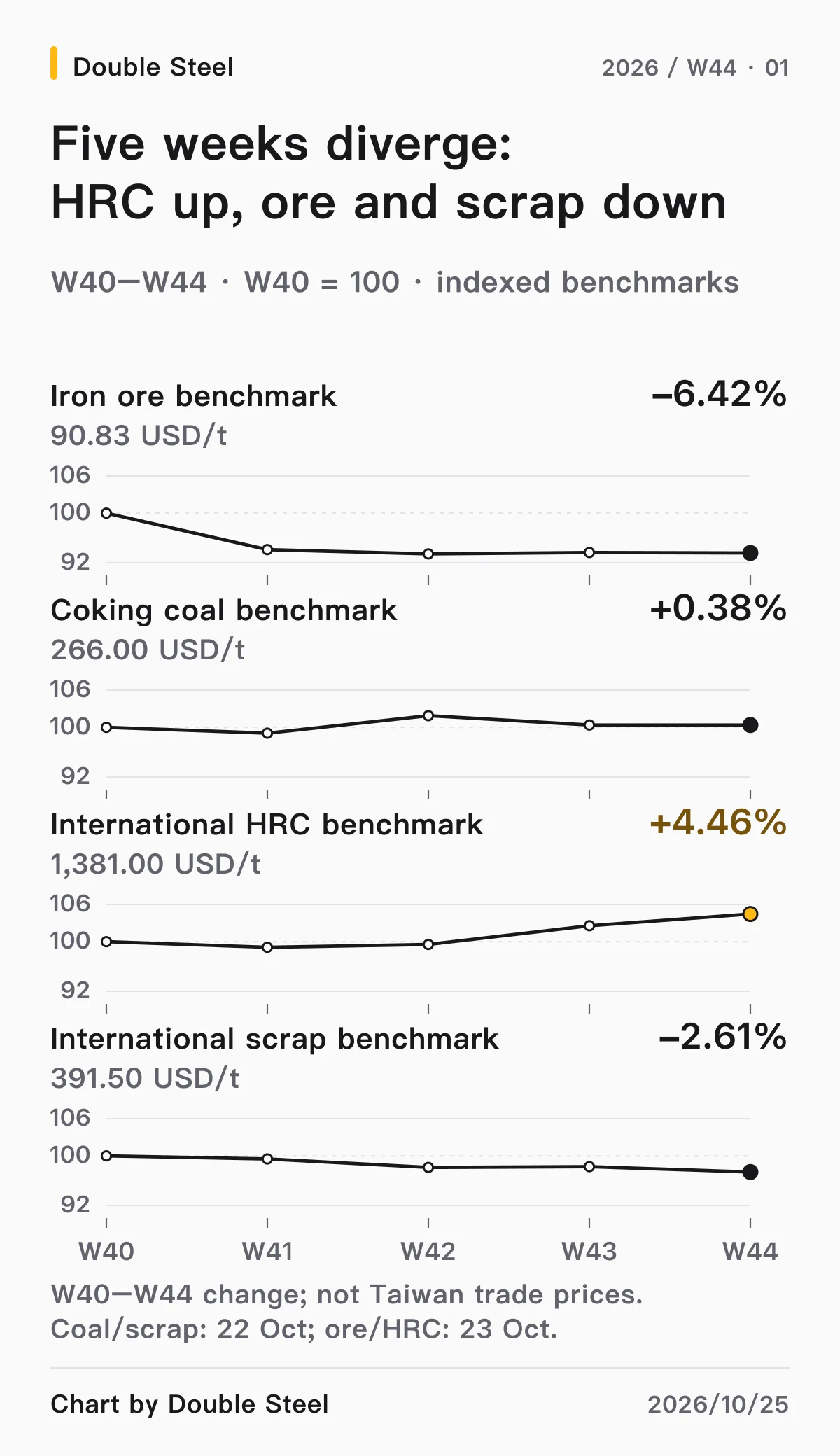
Key figures and comparison with the previous four weeks
| Indicator | W40 | W41 | W42 | W43 | W44 latest | Change vs W43 cutoff |
|---|---|---|---|---|---|---|
| Iron ore (USD/t) | 97.06 | 91.35 | 90.68 | 90.90 | 90.83 | -0.08% |
| Iron ore (CNY/t) | 713.50 | 702.50 | 682.50 | 672.50 | 675.00 | +0.37% |
| Coking coal benchmark (USD/t) | 265.00 | 262.50 | 270.00 | 266.00 | 266.00 | Unchanged |
| International HRC benchmark (USD/t) | 1,322.00 | 1,310.00 | 1,316.08 | 1,356.00 | 1,381.00 | +1.84% |
| International scrap benchmark (USD/t) | 402.00 | 400.00 | 394.50 | 395.00 | 391.50 | -0.89% |
| Rebar/steel benchmark (CNY/t) | 3,107.00 | 3,109.00 | 3,099.00 | 3,089.00 | 3,051.00 | -1.23% |
| Tangshan common billet, ex-works (CNY/t) | 3,010 | 2,980 | 2,950 | 2,950 | 2,920 | -1.02% |
| USD/TWD spot selling rate | 31.85 | 31.91 | 31.94 | 32.42 | 32.62 | +0.20 |
| USD/CNY | 6.72040 | 6.70627 | 6.69259 | 6.68630 | 6.66948 | -0.25% |
The coking coal and international scrap benchmarks use October 22 data; the other listed commodity benchmarks and USD/CNY use October 23 data. Tangshan common billet is the October 24 mainstream Qian'an ex-works price. The E.SUN exchange rate was queried on October 25 and does not represent a new Sunday transaction. Changes are calculated between each weekly report's cutoff observations; the USD/TWD change is an absolute difference. The international benchmarks are separate from the grade- and region-specific physical prices discussed below.
Chapter 1: Low-priced rebar bookings expand, but replenishment pressure rises
From isolated large orders to bulk distributor restocking
On October 20, three southern mills reportedly booked approximately 40,000 tonnes from distributors at NTD 17,200/t, with the low-price terms requiring batches of 2,000–3,000 tonnes. The following day, cumulative bookings at the same price by one major southern mill had exceeded 30,000 tonnes. By October 22, SteelWorld's incomplete market tally showed combined mill bookings above 100,000 tonnes, mainly in the south, at approximately NTD 17,200/t in southern Taiwan and NTD 17,400/t in central and northern Taiwan.
These are successive updates on the expansion of the same wave of bookings. Compared with individual large orders in W42 and low-priced resales undercutting new mill prices in W43, this week brought larger batches of distributor restocking across several mills, making the improvement in bookings more concrete. Buyers entered because mills accepted lower prices, rather than because downstream customers began chasing higher offers.
Feng Hsin kept rebar, scrap and section prices unchanged on October 19 for the fourth consecutive week, retaining a rebar base price of NTD 18,300/t. Stable list prices alongside low-priced bulk transactions show mills seeking orders through quantity, regional and negotiated terms outside the formal base price. New buying this week came mainly from distributor restocking, with bulk discounts providing more support for production schedules.
Scrap increases have taken effect; rebar catch-up pricing is the next step
Raw materials strengthened first in the middle of the week. From October 22, Feng Hsin increased procurement prices by NTD 400/t for TPI pig iron and THF special heavy scrap, and by NTD 300/t for other grades. New prices for heavy scrap and special heavy scrap reached approximately NTD 10,700/t and NTD 11,500/t, respectively.
Other mills also followed. Tung Ho's Taoyuan works raised special heavy scrap by NTD 400/t and other grades by NTD 300/t from October 21; Chien Shun implemented the same increases from October 22. Wei Chih and Hsieh Sheng Fa raised procurement prices by NTD 300/t. Yih Sheng increased prices by NTD 200/t on October 22 and a further NTD 100/t the following day, totaling NTD 300/t over two days.
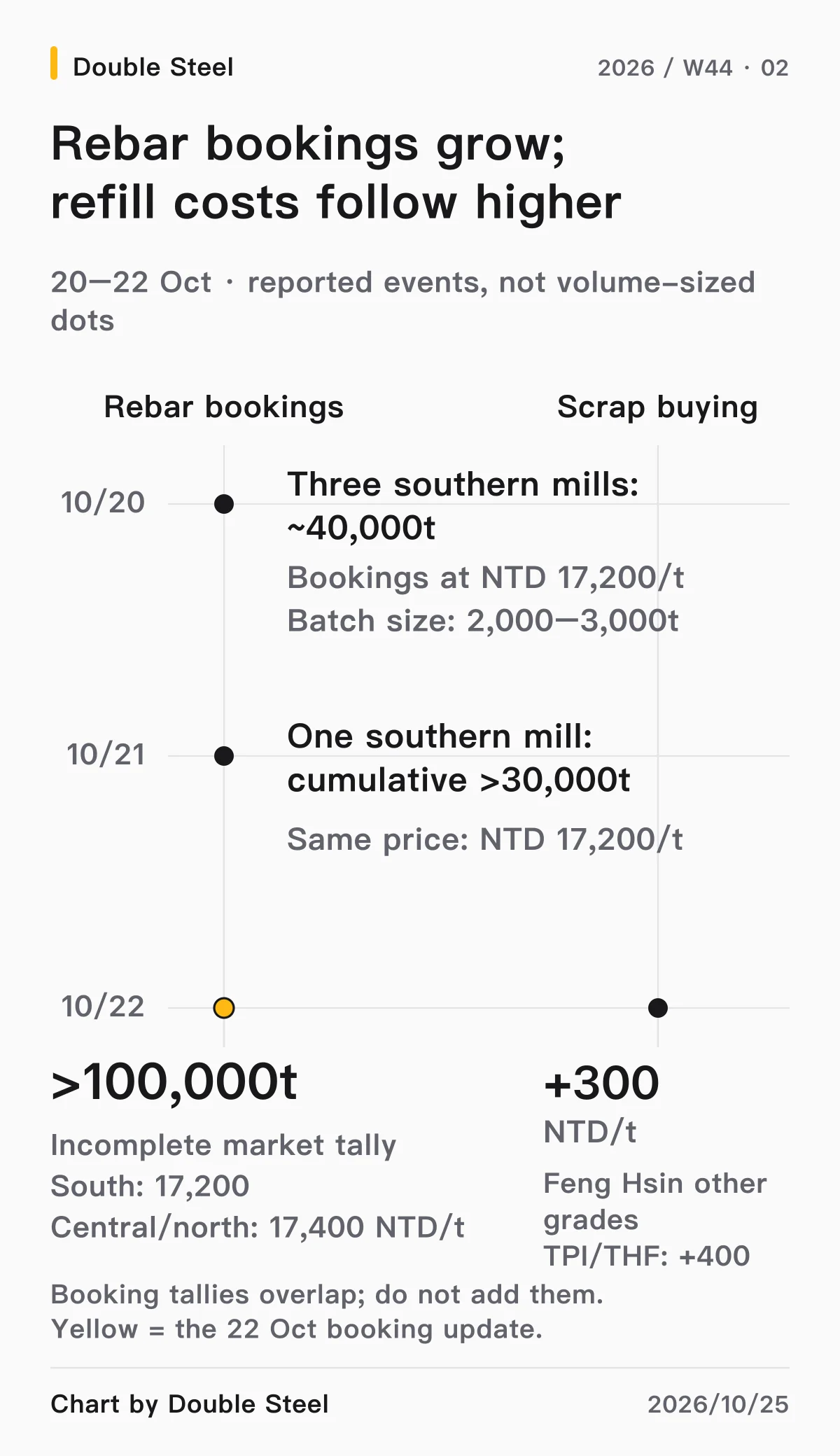
Our assessment is that low-priced bookings improved order visibility without a corresponding improvement in the replacement-cost spread on those new orders. Mills first discounted finished steel, then raised raw-material procurement prices, while further Taiwan-dollar depreciation made cheaper imports harder to secure. This increases pressure to defend prices and narrow discounts in the next pricing round. Expectations have consequently emerged for a rebar catch-up increase on October 26; at this report's cutoff, that remained an assessment of the next pricing round, not an announced new price.
Chapter 2: Higher flat-steel costs struggle to pass through, while processing spreads narrow
Domestic HRC approaches NTD 20,000/t, but trades lag offers
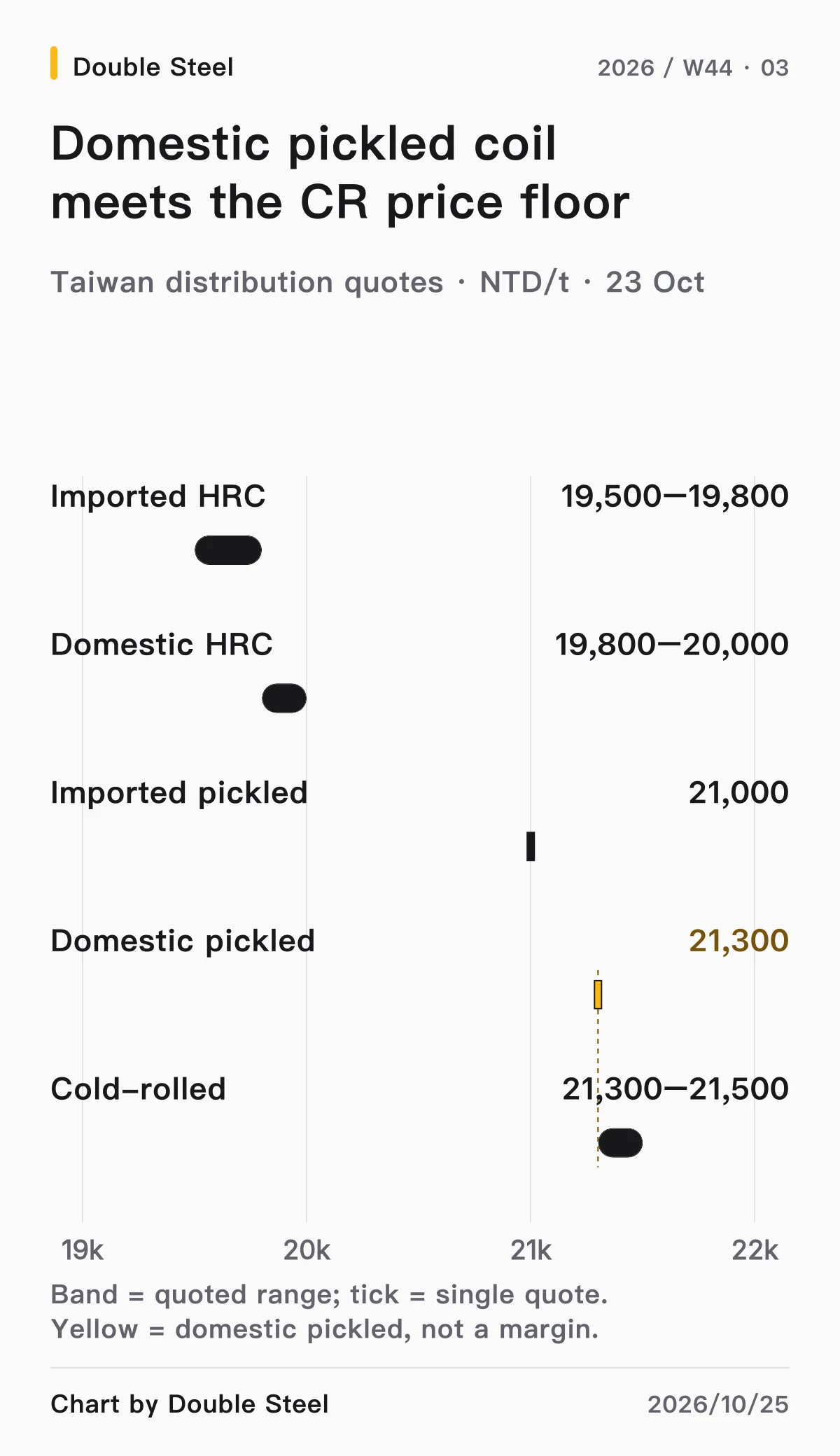
Market reports on October 23 put HRC distribution prices for buyer pickup at around NTD 19,500–19,800/t for imported spot material and NTD 19,800–20,000/t for domestic material. Compared with W43's overall distribution range of around NTD 19,500–19,800/t, the upper end of domestic offers has advanced. Trading remains quiet, however, with little active buying to support prices near NTD 20,000/t.
Buyers also have alternatives beyond new domestic mill prices. Asian import offers have not continued rising sharply: Indonesian HRC offers to Vietnam are around USD 534–535/t CFR, with buyers and sellers still negotiating. This encourages Taiwan's downstream buyers to replenish as needed rather than build expensive inventory. Offers to Vietnam provide a regional competitive reference; Taiwan import transactions still depend on destination port, specifications and shipment timing.
Following the earlier increases in CSC's and Chung Hung's November prices, subsequent replenishment costs have moved higher. Market reports indicate that CSC also raised November LW HRC by NTD 900/t, narrowing the scope for downstream users to offset the new prices with lower-cost material. This week's issue is no longer whether mills have raised prices, but whether distributors can incorporate those costs into new orders. Sellers holding cheaper inventory retain greater flexibility to make deliveries.
Pickled and cold-rolled prices converge; commercial plate also lacks pricing power
Pickled coil distribution prices are around NTD 21,000/t for imported material and NTD 21,300/t for domestic material, against NTD 21,300–21,500/t for cold-rolled coil. Domestic pickled coil is now close to the lower end of cold-rolled prices, indicating limited downstream acceptance of the premium for additional cold-rolling processing. Pressure on flat steel extends beyond higher substrate costs to the spreads retained between processed products.
Commercial plate faces a different supply-demand squeeze. Imported A36 plate distribution prices in Taiwan are approximately NTD 26,000–26,500/t, with SN490B at NTD 28,000–28,500/t. Even with reduced allocations for some domestic projects, distribution prices lack upward momentum. Lower supply has yet to outweigh weak buying and import competition.
End-use differences remain within flat steel. Asian shipbuilding plate offers have risen, supported by relatively firmer demand, while ordinary commercial structural plate is weaker. Taiwan's general HRC, cold-rolled coil and commercial plate remain more constrained by processing orders and distribution prices; supply-side increases have not translated into equivalent gains in distribution returns.
Chapter 3: China's holiday inventory build is cleared, but destocking momentum halves
Total stocks fall below pre-holiday levels as apparent consumption declines
Mysteel's five-major-product data released on October 22 put weekly production at 7.9205 million tonnes, down 24,700 tonnes from the previous period. Combined mill and social inventories fell to 14.4775 million tonnes, a decline of 320,800 tonnes, or approximately 2.17%. Apparent consumption fell from 8.6313 million tonnes to 8.2413 million tonnes, down around 4.52%.
The positive development is that total inventories are now 151,900 tonnes below the September 30 pre-holiday level of 14.6294 million tonnes. Much of W42's holiday build was cleared when deliveries resumed in W43; stocks have now moved below their pre-holiday level, so the holiday buildup is no longer the main new source of pressure.
The pace of destocking has nevertheless cooled sharply. The previous period's 686,100-tonne drawdown fell to just 320,800 tonnes this period, a reduction of approximately 53%. Production declined only slightly, while apparent consumption fell much more, indicating a shift from concentrated post-holiday replenishment back to a slower pace of everyday consumption.
Construction steel still leads destocking; flat-product clearance nearly stalls
By product group, combined construction-steel inventories fell by 302,800 tonnes, while flat-product inventories declined by only 18,000 tonnes. The previous period's reductions were 523,200 tonnes and 162,900 tonnes, respectively. Flat-product destocking shrank by nearly 90%, making it this week's clearest point of weakening.
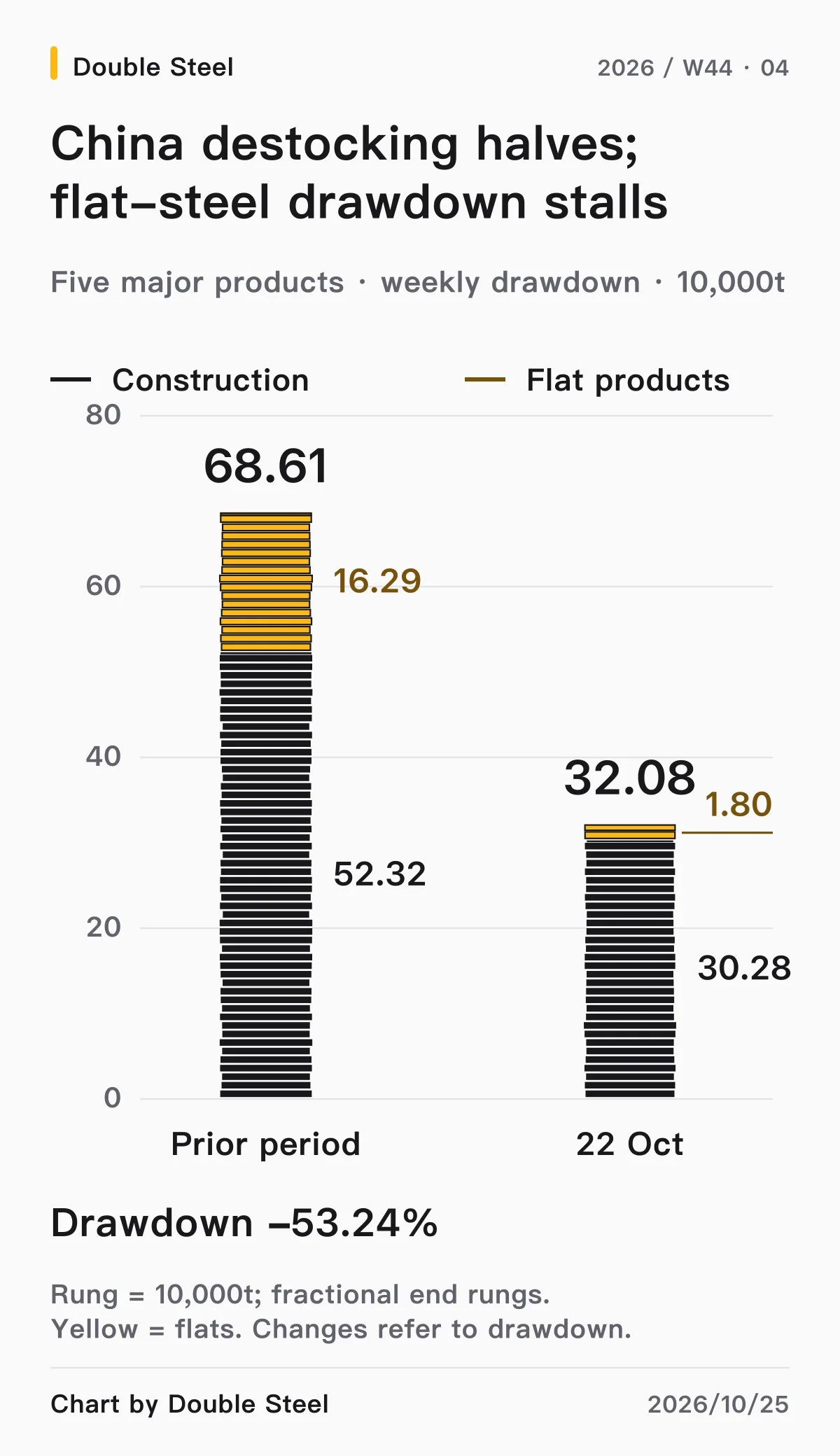
HRC production edged higher and mill inventories increased slightly, while downstream purchasing remained subdued. Rebar continued to destock, but apparent demand also fell to 2.0103 million tonnes. Falling inventories still support long products, whereas the gap between flat-steel supply and demand is becoming harder to clear through faster deliveries.
This week's change in China is the coexistence of inventory normalization and slower demand flows. For Taiwan's flat-steel market, China's destocking has not provided strong regional support for higher prices. If HRC supply rises while downstream consumption remains slow, import competition will continue to constrain catch-up increases in domestic distribution prices.
Chapter 4: Scrap diverges from coal and ore; a weaker Taiwan dollar intensifies replenishment pressure
Firmer Vietnamese buying limits Taiwan's bargaining room for US scrap
US containerized 80:20 scrap offers to Taiwan are around USD 350–355/t CFR. Faced with low-priced rebar bookings and exchange-rate pressure, Taiwanese mills hope to keep buying prices near USD 345/t CFR. Market-tradable levels for comparable material in Vietnam are around USD 350–355/t CFR, giving suppliers little incentive to accept Taiwan's lower bids.
This is also the backdrop to this week's domestic scrap increases: inexpensive import alternatives are difficult to secure, pushing mills to compete for local supply. Although the international scrap benchmark has fallen, Taiwan faces regional competition for material, currency pressure and domestic collection constraints, leaving actual procurement costs little easier.
Metallurgical coal falls before stabilizing; coke increases remain unaccepted
Available Asian physical quotations show Australian low-volatile hard coking coal, LVHCC, falling from around USD 233.3/t FOB on October 16 to USD 230.8/t FOB on October 20–21. Premium low-volatile hard coking coal, PLV, fell from around USD 267.7/t FOB to USD 265.4/t FOB over the same period. Both were unchanged on October 21.
Expectations of Chinese mine restarts and improving supply reduced buyers' willingness to chase prices, while low inventories continued to support the short-term market. After two rounds of coke price cuts, coke producers proposed increases of CNY 50/t for wet-quenched coke and CNY 55/t for dry-quenched coke on October 19. Mysteel's October 23 analysis still indicated weak mill acceptance and a stable market. Compared with W43's discussion of a third round of cuts, this week shifted toward a contest between coke producers seeking a rebound and steelmakers resisting higher costs.
India is the next demand variable for international metallurgical coal. The market is watching whether fourth-quarter festivals and the traditional consumption season lift steel production and metallurgical-coal restocking. For now, Indian spot purchases of premium hard coking coal remain limited, with buyers relying more on long-term contracts. Increased Indian restocking could cushion the effect of recovering Chinese supply on seaborne coal prices; current support still rests mainly on low inventories and expectations of later replenishment.
Iron ore rebounds late in the week; billet replacement costs remain currency-sensitive
The physical price of 62% Australian fines delivered to China rose by USD 0.90/t on October 23 to USD 92.35/t CFR. A rebound in coking-coal futures and freight support helped the late-week recovery. However, Mysteel's corresponding survey of 247 mills showed daily hot-metal output falling by 13,600 tonnes to 2.3230 million tonnes, signaling weaker raw-material consumption.
The mainstream ex-works price of common billet in Qian'an, Tangshan, was CNY 2,920/t on October 24, down CNY 30/t from W43. Asian export billet remained sensitive to freight, the renminbi and chemical-composition requirements. Offers for chemistry-adjusted billet to Taiwan were around USD 495–498/t CFR, still difficult to accommodate against Taiwan's low-priced rebar bookings.
E.SUN's USD/TWD spot selling rate reached 32.62, up another 0.20 from W43 and 0.77 from W40. A weaker Taiwan dollar keeps raising the local-currency outlay for dollar-denominated cargoes, so Taiwanese buyers cannot capture the full benefit of some lower international offers. Cooling blast-furnace raw materials and firmer electric-arc-furnace scrap remain different cost environments.
Chapter 5: Import competition persists in round bars as special-steel inventories turn upward
Taiwan's S45C straight-bar rebound is constrained by project-price competition
Pressure on Taiwan's ordinary medium-carbon straight bars is more tangible than a sequence of unchanged list prices. Market reports put imported Chinese S45C straight-bar distribution prices back at around NTD 21,500–22,000/t, with NTD 21,500/t applying to diameters of 200 mm and above. Japanese medium-carbon straight-bar spot material is around NTD 22,500/t, alongside forward-order offers near NTD 21,500/t.
Imported spot supply and low forward offers coexist, limiting a rebound in domestic material. Some rerollers are competing for orders through volume-based project prices, extending competition from upstream base prices to actual supply terms.
China's same-sample mill and social stocks rise as prices weaken
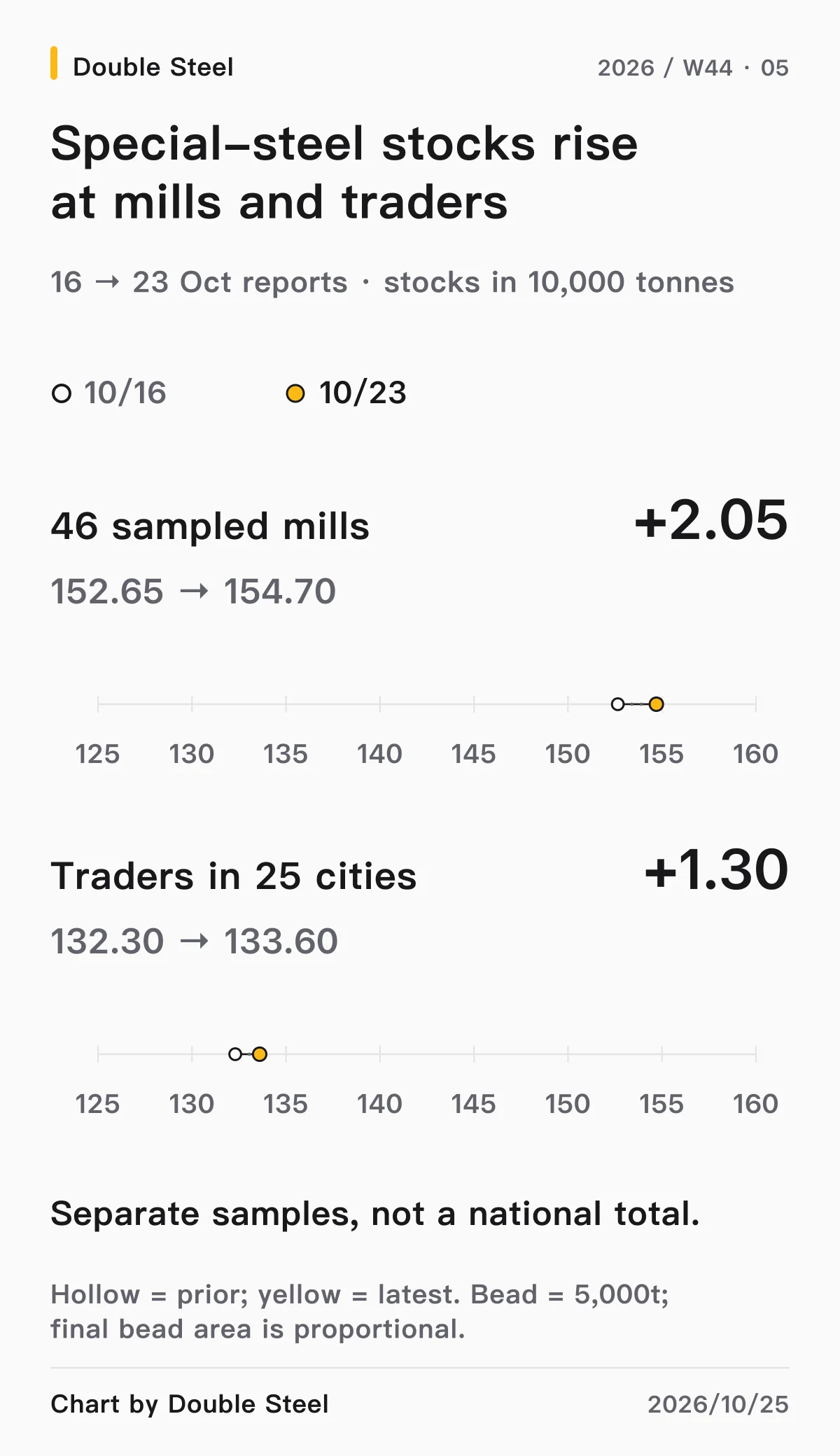
A Chinese steel-information weekly report on special steel released on October 23 showed inventories at its 46 sampled mills rising from 1.5265 million tonnes to 1.5470 million tonnes, up 20,500 tonnes. Trader inventories across 25 cities increased from 1.3230 million tonnes to 1.3360 million tonnes, up 13,000 tonnes. Both have turned to accumulation after mill destocking and a slight decline in distribution stocks in the previous period.
The same information provider's average price for 85 mm, 45# carbon structural steel was CNY 3,643/t, down CNY 13/t from CNY 3,656/t. Its survey indicated continued supply releases from mills, while downstream machinery, automotive-parts and general-equipment buyers continued placing small turnover orders; concentrated restocking was insufficient to absorb supply.
The main pressure on round bars is growing distribution supply, limited expansion in orders for ordinary applications and competition from cheaper material. Taiwan's import competition and China's special-steel inventory build point separately to pressure on ordinary grades in the two markets. Mills may hold list prices, but actual project discounts and distribution prices remain difficult to lift.
Chapter 6: Four-week trends and next week's watchpoints
The location of improving bookings shifts, but margin recovery remains uneven
W40's improvement was concentrated in Taiwanese construction projects and individual large orders, alongside China's pre-holiday deliveries. W41 brought flat-steel import transactions and pickled-coil catch-up increases, while ordinary rebar distribution remained constrained by low-priced inventory. In W42, CSC's new prices were confirmed as China built holiday inventories. In W43, Chung Hung followed with higher prices and China resumed destocking, but Taiwan's spot-price pass-through stalled.
By W44, distributor restocking in Taiwanese rebar had become broader, but at lower transaction prices. Flat steel continued absorbing new mill costs, while ordinary round bars faced import and project-price competition. China completed its holiday inventory normalization and entered a new phase of slower destocking and weak flat-steel demand. This week's turning point is not a synchronized recovery: lower prices can attract orders, while higher selling prices still lack sufficient buying support.
International markets remain regionally divided. From W40 to this report, the table's HRC benchmark rose approximately 4.46%, China's rebar/steel benchmark fell around 1.80%, and the US-dollar iron-ore benchmark declined approximately 6.42%. US physical HRC was reported at around USD 1,320/short ton this week, with average mill lead times of approximately 9.2 weeks, contrasting with subdued trading in ordinary Asian flat steel. The World Steel Association's latest release showed total crude-steel output for the first nine months down 0.7% year on year, with North America growing and Asia and Oceania declining, underscoring regional differences in production as well.
Key watchpoints for next week
- Whether the October 26 rebar pricing round brings an adjustment, and whether new bookings move above this week's low-price range with less reliance on bulk discounts.
- Whether mills reduce low-priced booking allocations after scrap increases, and whether domestic collections ease import procurement pressure.
- Whether domestic HRC attracts more actual trades near NTD 20,000/t, and whether the pickled/cold-rolled spread narrows further.
- Whether Chinese flat-product destocking regains speed, and whether HRC mill stocks keep rising as production resumes.
- Whether mills accept the first proposed coke increase, and whether Chinese mine restarts and Indian metallurgical-coal restocking translate into new actual purchasing.
- Whether special-steel mill and social stocks continue accumulating, and whether Taiwan's S45C project offers further depress ordinary distribution prices.
Conclusion
W44 provides evidence of expanding Taiwanese rebar bookings, with improvement no longer confined to individual projects or single transactions. Yet the volume gain comes with finished-steel price concessions, while higher scrap prices and a weaker Taiwan dollar raise replenishment pressure. More mill bookings alongside tighter replacement-cost spreads form this week's clearest contradiction.
Flat steel and round bars remain constrained by import competition, processing spreads and downstream purchasing patterns, while China's destocking momentum has slowed. Our assessment is that the market is moving from winning orders to determining whether selling prices and replenishment terms can improve once those orders are secured. Whether the next pricing round converts into actual transactions will reveal buying support more clearly than price announcements alone.
Sources: TradingEconomics (data dated October 22–23, 2026), E.SUN Bank (USD/TWD spot exchange rate, queried October 25, 2026), Mysteel (data through October 22–23, 2026; Tangshan billet through October 24, 2026), Lange Steel (October 16 and October 23, 2026), SteelWorld (through October 24, 2026), World Steel Association (September and January–September 2026 crude-steel output, released October 23, 2026).
Published by the Market Research Department of Double Steel Co., Ltd. This report is for market research and procurement assessment only and does not constitute the final basis for investment or direct procurement decisions.