Publication date: September 21, 2026
Market and news cutoff: September 20, 2026
Exchange-rate benchmark: USD/TWD spot selling rate: 31.87
The central theme of the W39 steel market is that destocking has broadened, but the recovery in transactions remains uneven. China's social inventories of five major steel products fell to 11.4466 million tonnes, declining for a third consecutive week. Unlike W38, when rebar accounted for almost the entire reduction, rebar, wire rod, and HRC all destocked this week, providing slightly stronger confirmation of demand. Plate and CRC inventories nevertheless continued to rise, while Chinese steel output has yet to contract materially. The current pattern is therefore closer to structural destocking than a broad peak-season recovery.
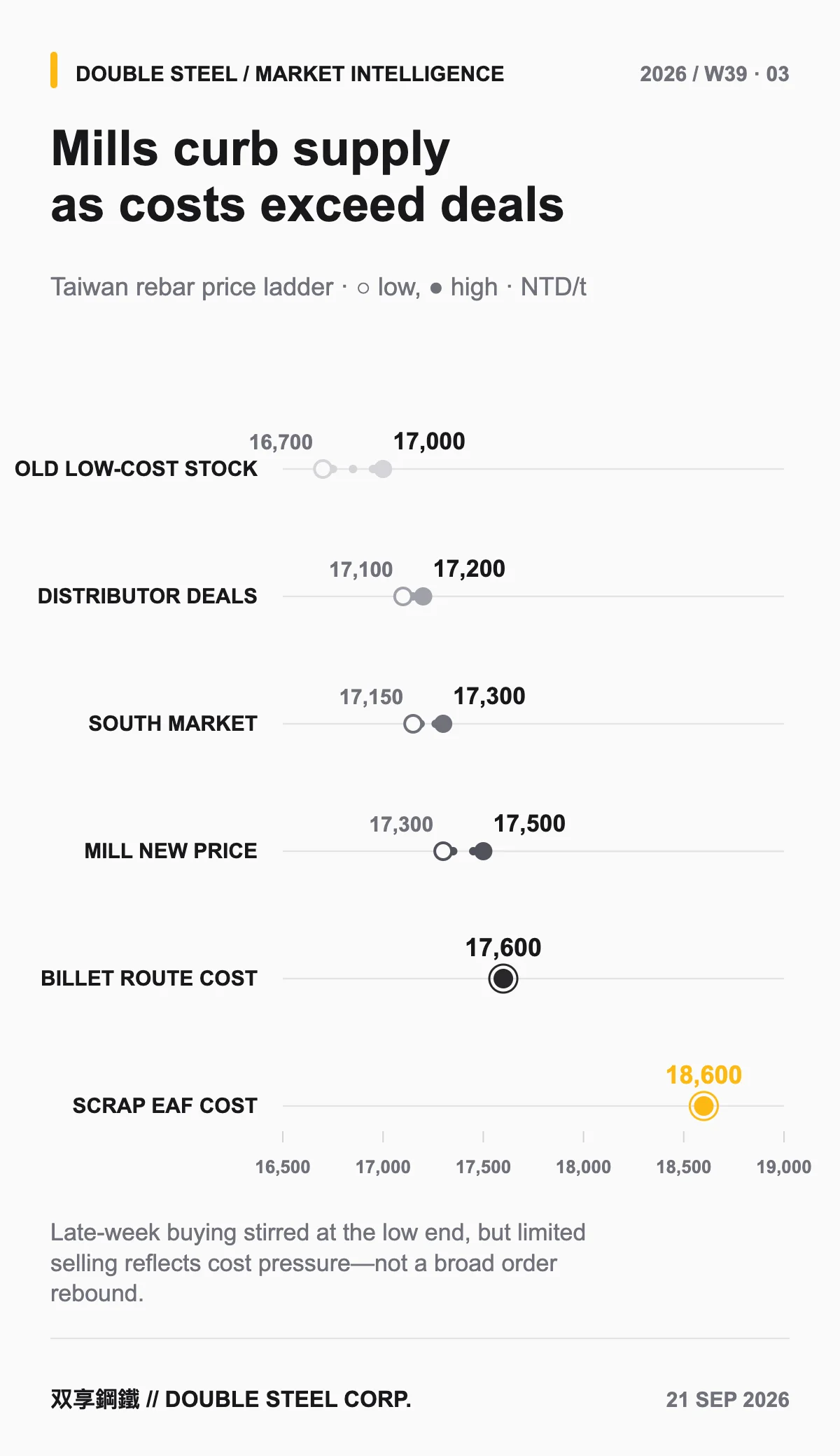
The divergence in Taiwan became even more pronounced. Mainstream rebar transactions remained at approximately NTD 17,300–17,500/T, but downstream users continued to consume earlier low-priced inventories purchased at NTD 16,700–17,000/T, limiting transactions at mills' new prices. In contrast, HRC distribution prices rose to approximately NTD 18,800–19,000/T. Chung Hung Steel raised its October domestic prices by NTD 600/T for HRC and CRC and by NTD 800/T for galvanized steel, indicating that cost pass-through in flat products is still progressing.
The raw material structure also shifted from the coal-led gains of previous weeks toward stronger scrap and finished flat products. The composite coking coal benchmark fell 3.32% this week and iron ore edged down 0.46%, while the international scrap benchmark rose 2.02% and the HRC benchmark gained another 2.04%. With the USD/TWD spot selling rate rising from 31.70 to 31.87 as the Taiwan dollar weakened, cost pressure on Taiwan's electric-arc-furnace producers and imported raw materials has not eased simply because coal prices declined.
Key Data This Week and Five-Week Comparison
| Indicator | W35 | W36 | W37 | W38 | Latest W39 Value | Change from W38 Cutoff |
|---|---|---|---|---|---|---|
| Iron ore (USD/T) | 95.21 | 95.84 | 99.57 | 98.02 | 97.57 | -0.46% |
| Iron ore (CNY/T) | 707.50 | 723.00 | 727.00 | 718.00 | 715.50 | -0.35% |
| Coking coal benchmark (USD/T) | 249.00 | 270.00 | 275.00 | 271.00 | 262.00 | -3.32% |
| International HRC benchmark (USD/T) | 1,185.00 | 1,191.07 | 1,238.00 | 1,274.00 | 1,300.00 | +2.04% |
| International scrap benchmark (USD/T) | 393.50 | 375.25 | 394.00 | 396.00 | 404.00 | +2.02% |
| Rebar/steel benchmark (CNY/T) | 3,061.00 | 3,130.00 | 3,131.00 | 3,071.00 | 3,099.00 | +0.91% |
| Tangshan Q235 billet (CNY/T) | 2,970 | 3,030 | 3,040 | 3,000 | 3,000 | Unchanged |
| USD/TWD spot selling rate | 31.92 | 31.72 | 31.71 | 31.70 | 31.87 | +0.17 |
| USD/CNY | 6.72019 | 6.72980 | 6.70783 | 6.70793 | 6.69531 | -0.19% |
| China's social inventories of five major steel products (10,000 tonnes) | 1,180.37 | 1,183.43 | 1,176.85 | 1,160.55 | 1,144.66 | -1.37% |
Chapter 1: Destocking Improves, but Flat Products Remain Stronger Than Long Products
Taiwan Rebar Prices Hold, but Order Intake Does Not Rise in Tandem
Feng Hsin Steel kept rebar prices unchanged this week, with its mill offer at approximately NTD 17,500/T and official list price at approximately NTD 18,100/T. It raised scrap purchase prices by NTD 200/T, bringing industrial scrap to approximately NTD 10,400/T and special industrial scrap to approximately NTD 11,100/T. Section steel remained at approximately NTD 23,600–24,100/T.
In the distribution market, rebar was approximately NTD 17,300/T in southern Taiwan and NTD 17,500/T in central and northern Taiwan, but actual buying interest remained weak. Some downstream users with urgent requirements turned to large distributors for lower-priced inventories at approximately NTD 17,100–17,200/T, suppressing transactions at mills' new prices.
Marginal changes nevertheless emerged in southern Taiwan later in the week. Rebar buying began to stir in the lower NTD 17,150–17,300/T range, while one mill accepted only a limited volume of approximately 2,000 tonnes at NTD 17,300/T. This indicates sporadic restocking demand. At the same time, mills became reluctant to sell large volumes at current prices as international scrap and billet rose together, shifting their supply strategy from competing for orders toward limiting sales and defending prices.
Limited selling should not be interpreted as a broad increase in order intake. There is no evidence that the limited allocation sold out rapidly, nor did other mills broadly expand sales. A more reasonable interpretation is that demand remains weak while supply is being restricted first, thereby reducing the room for further price declines.
The market is not rejecting higher raw material costs; rather, purchasing has been deferred. As long as distributors still hold earlier low-priced material purchased at NTD 16,700–17,000/T, mills will find it difficult to pass higher costs fully through to transaction prices, even when they have valid reasons to increase offers.
Looking to next week, market views on rebar pricing are divided between another unchanged offer and an increase of NTD 200/T. Those expecting no change argue that NTD 17,300–17,500/T has not yet become a stable transaction range and that the market should first wait for distributors' lower-priced inventories to be absorbed. Those expecting an increase believe that imported scrap, billet, and a weaker Taiwan dollar have raised rebar costs under different production routes to approximately NTD 17,600–18,600/T, leaving mills little room to wait. Taken together, the current signals point to a firm direction for next week's offer, most likely ranging from unchanged to a modest increase. Whether actual transactions can follow will still depend on how quickly distributors clear older inventories.
Taiwan Flat Products Continue to Rise, Clearly Diverging from Rebar
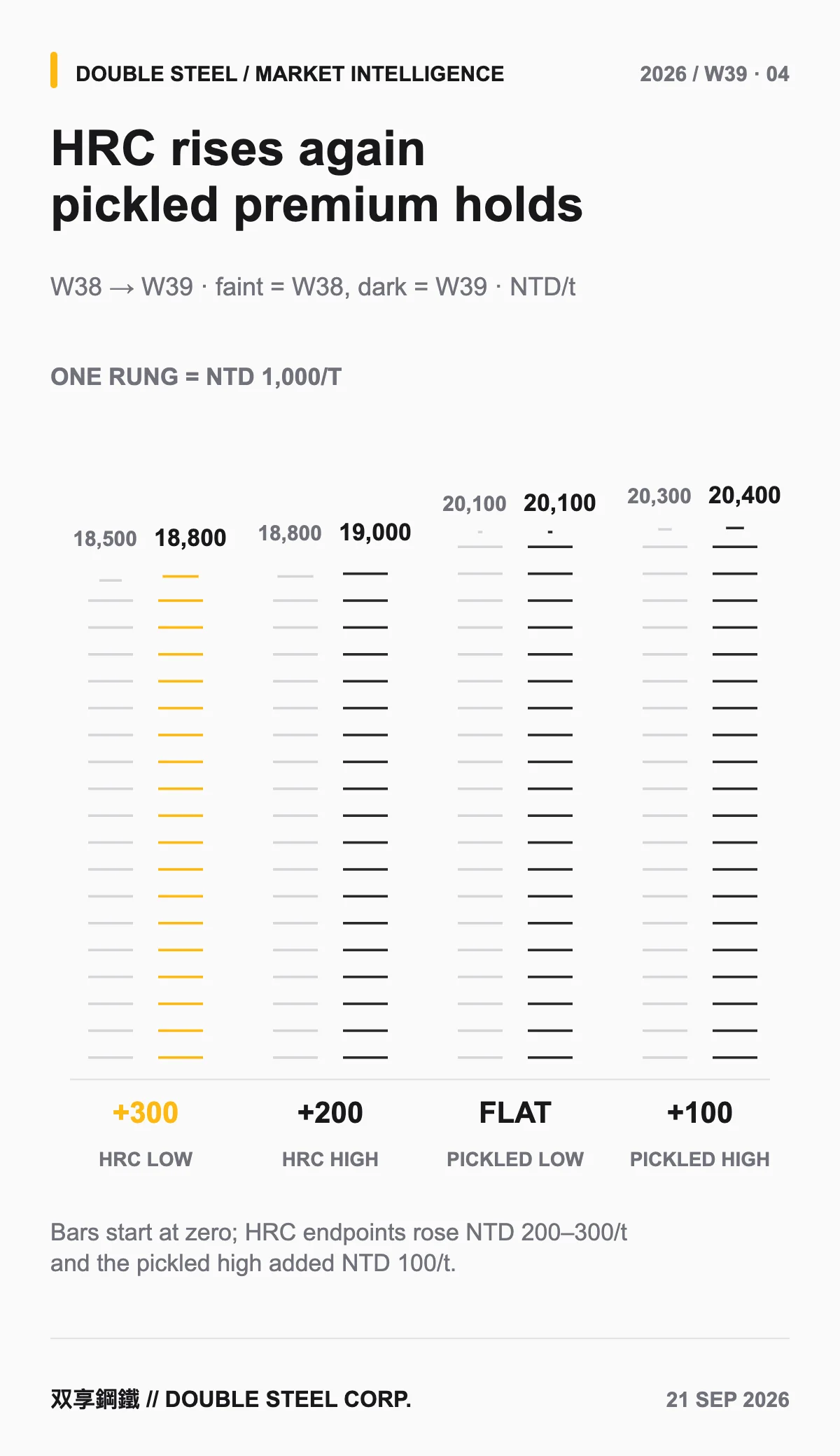
Domestic HRC distribution prices were approximately NTD 18,800–19,000/T this week, with some higher-priced transactions reaching NTD 19,100/T. Compared with W38's NTD 18,500–18,800/T range, the low and high ends rose by approximately NTD 300/T and NTD 200/T, respectively. Pickled coil was approximately NTD 20,100–20,400/T, with the high end increasing by another NTD 100/T. Imported CRC was approximately NTD 19,900–20,200/T, domestic CRC NTD 20,200–20,500/T, and galvanized steel NTD 21,000–21,300/T.
In Chung Hung Steel's October domestic pricing, HRC and CRC were raised by NTD 600/T and galvanized steel by NTD 800/T, bringing the adjusted HRC base price to approximately NTD 27,000/T. This base price belongs to the mill's official pricing system and differs from distribution spot material in specifications, discounts, and delivery terms, so the two cannot be compared directly. The direction of the adjustment nevertheless indicates that flat-product suppliers are still actively reflecting raw material and earlier production costs.
Market participants also discussed a possible NTD 300–500/T increase in CSC's November HRC price. As of this week's cutoff, however, this remained a market expectation and should not be treated as an official price announcement. Procurement assessments should be based on the actual announcement, specification surcharges, and transaction discounts.
Five-Week Trend: Coal Cools, While HRC, Scrap, and the Exchange Rate Take Over as Cost Supports
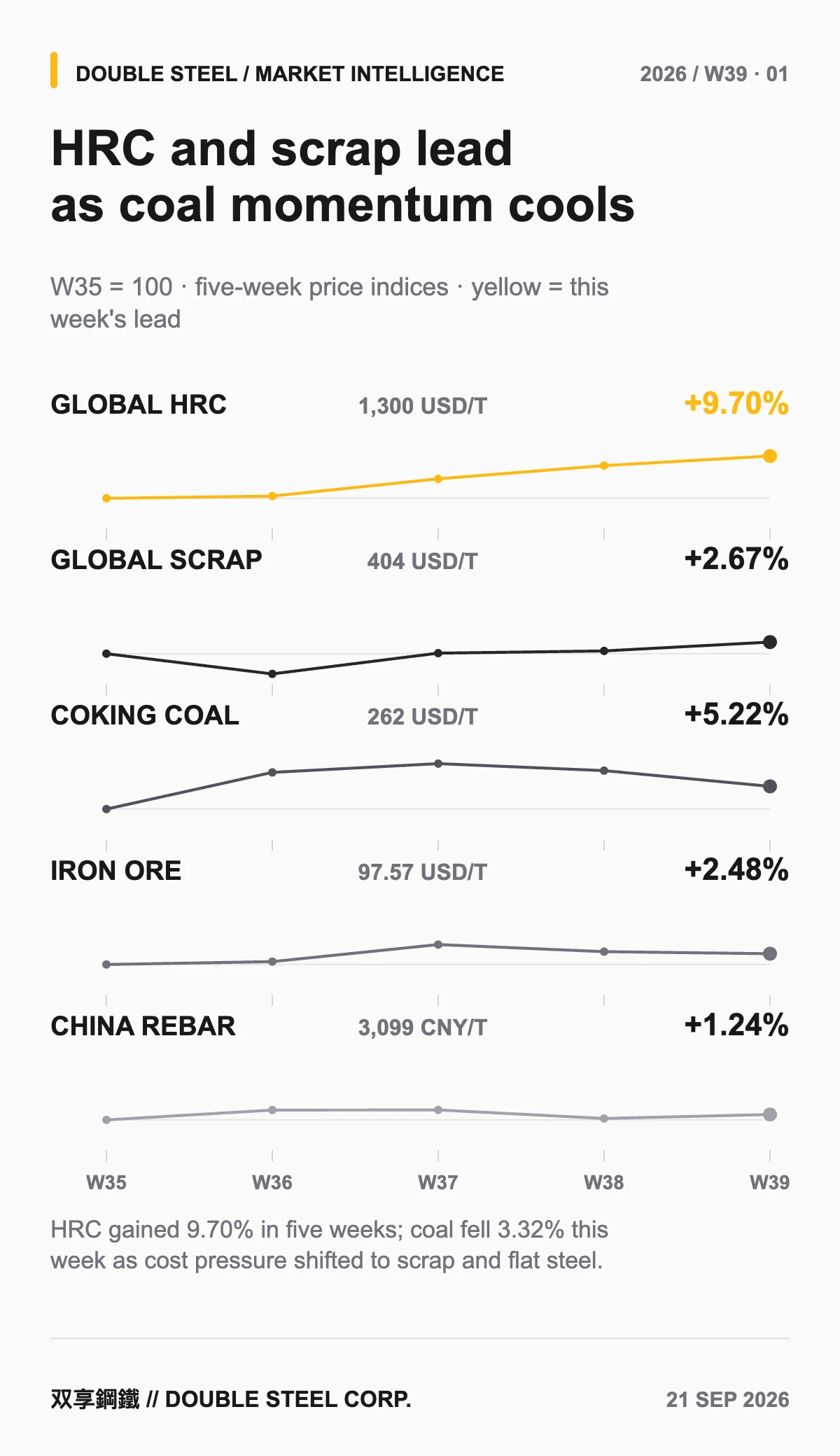
From W35 to W39, the HRC benchmark rose from USD 1,185/T to USD 1,300/T, a cumulative increase of approximately 9.70% and the strongest performance among the main indicators. Coking coal rose from USD 249/T to USD 262/T, remaining approximately 5.22% higher over the period, although it fell from USD 271/T to USD 262/T this week. International scrap increased from USD 393.5/T to USD 404/T, a cumulative gain of approximately 2.67%, and rose for a second consecutive week.
Over the same five-week period, the US-dollar iron ore benchmark rose approximately 2.48%, Tangshan billet approximately 1.01%, and the Chinese rebar benchmark approximately 1.24%, all less than HRC. This confirms that the market is not strengthening across every steel product; support is more pronounced in flat-product prices and scrap costs.
The exchange rate has also re-emerged as a variable in Taiwan's import costs. The USD/TWD spot selling rate rose from 31.70 in W38 to 31.87, an increase of 0.17 in one week. For imported material valued at USD 500/T, the exchange-rate movement alone adds approximately NTD 85/T. Although it is not the primary cost driver, it amplifies the effect of higher US-dollar scrap and billet offers.
Chapter 2: Analysis of Costs, Inventories, and Key Products
2.1 Five-Product Social Inventories: Destocking Broadens from Rebar to Wire Rod and HRC
As of September 18, China's social inventories of five major steel products were 11.4466 million tonnes, down 158,900 tonnes or approximately 1.37% from W38. Compared with W35, inventories declined by a cumulative 357,100 tonnes, or approximately 3.03%, over four weeks.
| Product | W38 Social Inventory (10,000 tonnes) | W39 Social Inventory (10,000 tonnes) | Change (10,000 tonnes) | Weekly Change |
|---|---|---|---|---|
| Rebar | 489.30 | 476.27 | -13.03 | -2.66% |
| Wire rod | 65.49 | 62.49 | -3.00 | -4.58% |
| HRC | 365.80 | 362.15 | -3.65 | -1.00% |
| Plate | 117.93 | 120.30 | +2.37 | +2.01% |
| CRC | 122.03 | 123.45 | +1.42 | +1.16% |
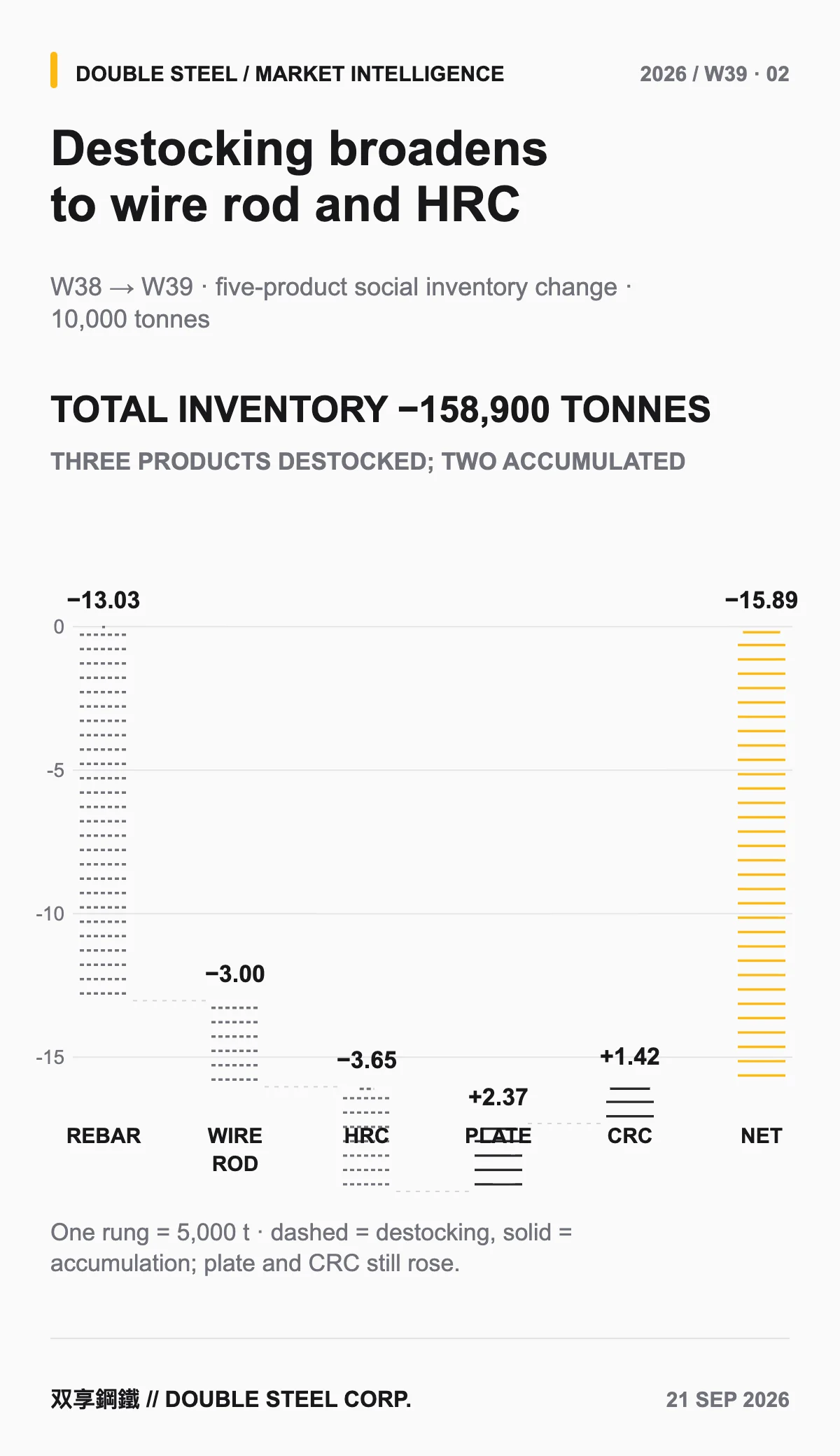
The improvement this week was that both wire rod and HRC shifted from their weaker W38 performance into destocking, meaning rebar was no longer the sole driver of the total inventory decline. Plate and CRC inventories nevertheless continued to rise, showing that demand also diverged within flat products. In addition, the average daily crude steel output of key Chinese steel association members rose to 1.924 million tonnes in early September, while mill inventories increased 1.7% from the previous ten-day period. Supply has therefore not contracted materially.
This week's improvement in social inventories represents another step forward in demand confirmation, but it is not yet sufficient to establish a broad peak season. Total inventories would need to continue falling while plate and CRC also shift to destocking before restocking and end-user demand could be considered more broadly established.
2.2 Iron Ore and Coal: Near-Term Cooling, with Pre-Holiday Restocking Still Providing Support
The US-dollar iron ore benchmark used in this report fell from USD 98.02/T to USD 97.57/T, down 0.46% on the week. A separate spot assessment for 62% Australian fines fell to USD 96.4/T on September 15 before rebounding for three consecutive days to USD 98.2/T, reflecting pre-holiday restocking and elevated hot-metal output. Because the two figures represent different price series and cutoff times, their directions are not identical. A more reasonable interpretation is that iron ore fell and then rebounded during the week while remaining below USD 100/T overall.
The composite coking coal benchmark declined from USD 271/T to USD 262/T, down 3.32% on the week but still approximately 5.22% above W35. China's fifth round of coke price increases has been implemented, bringing the cumulative increase since mid-August to approximately CNY 450–495/T. As coke-plant margins and operating rates improve, coking coal supply recovers at the margin, and loss-making mills resist additional increases, the conditions for implementing a sixth round have weakened.
Coal and coke cost pressure is shifting from continuous upward momentum to a high-level standoff. A more pronounced correction in coking coal and coke would require post-holiday restocking to cool and mills to carry out actual production cuts. If hot-metal output remains high, rigid demand will continue to support the downside.
2.3 Billet and Rebar: Costs under Both Production Routes Are at or Above Spot Prices
Mainstream offers for Chinese billet in Asia were approximately CFR USD 495–500/T, with tradable levels around CFR USD 490–495/T. Buyer bids at CFR USD 485–490/T were not accepted. Because of weak rebar sales, billet procurement in Taiwan temporarily slowed. Mills bid approximately CFR USD 485–490/T, while tradable levels were around CFR USD 493–495/T.
Based on market estimates, the cost of directly rolling imported billet into rebar was approximately NTD 17,600/T, up another NTD 200/T from approximately NTD 17,400/T in W38. This remains approximately NTD 100–300/T above the current mainstream transaction range of NTD 17,300–17,500/T.
Under the alternative electric-arc-furnace route using imported scrap, the tradable price of US containerized scrap rose to approximately CFR USD 340/T, bringing the market-estimated rebar cost to approximately NTD 18,600/T, or around NTD 1,100–1,300/T above spot transactions. The two estimates represent different production processes and raw material combinations and should not be used interchangeably. Both, however, indicate continued pressure on mills to raise rebar selling prices.
Tangshan Q235 billet remained at CNY 3,000/T at this report's cutoff, although spot prices briefly reached approximately CNY 3,020/T during the week. Chinese 3SP 150 mm export offers were approximately FOB USD 465–470/T. Renminbi appreciation also limited mills' ability to reduce US-dollar offers further.
2.4 Scrap: International Benchmark Rises, Strengthening Cost Support for Taiwan EAF Producers
The international scrap benchmark rose to USD 404/T this week, up 2.02%. US containerized scrap was tradable into Taiwan at approximately CFR USD 340/T, with most offers at CFR USD 342–345/T. Japanese 50:50 scrap was approximately CFR USD 380/T into Vietnam, H2 approximately CFR USD 375/T, and US 80:20 bulk scrap was transacted into Vietnam at approximately CFR USD 390/T.
Tokyo Steel raised scrap purchase prices at all plants by another JPY 500/T effective September 19, bringing H2 purchase prices to approximately JPY 47,500–50,000/T. With Japanese domestic prices moving higher, export material is unlikely to decline significantly. Taiwanese mills therefore continue to face limited substitution flexibility between US scrap supply and Japanese scrap prices.
2.5 HRC, CRC, and Plate: Mill Prices Are Firm, but Spot Demand Still Requires Confirmation
Export offers from major Chinese mills for HRC were approximately FOB USD 506–510/T, while private mills indicated tradable levels around FOB USD 495–500/T, slightly lower than previously. Chinese domestic HRC spot prices were approximately CNY 3,400–3,470/T, with some regions falling by about CNY 20/T during the week.
CRC export offers were approximately FOB USD 560–570/T, with tradable levels around FOB USD 555–560/T. Plate export offers were approximately FOB USD 550–555/T, with tradable levels around FOB USD 545–550/T. Shougang raised its October prices for HRC, pickled, CRC, galvanized, pre-painted, and non-grain-oriented electrical steel by CNY 200/T and plate by CNY 100/T, continuing the price-supporting direction established by Baosteel, Ansteel, and Benxi Steel.
Higher mill prices do not necessarily mean that spot demand has increased in tandem. Tradable Chinese HRC export prices softened slightly, while plate and CRC social inventories rose, showing that a gap remains between supplier pricing and buyer acceptance. High-priced Korean HRC offers to Taiwan primarily reflect suppliers prioritizing US orders and reducing allocations to Taiwan; they should not be treated as generally tradable Asian prices.
2.6 Wire Rod, Bar, and Special Steel: Offers Are Supported, but Transactions Remain Driven by Immediate Needs
The assessed price of Chinese SAE1008 wire rod was approximately FOB USD 512/T, up USD 2/T from the previous week. Major mills offered around FOB USD 515/T, but domestic Chinese Q195 wire rod spot prices fell by about CNY 20/T during the week to approximately CNY 3,270/T. Export offers were supported by costs, while domestic transactions remained weak.
The 45# special-steel round bar benchmark edged down from CNY 3,550/T in W38 to CNY 3,540/T, a decline of CNY 10/T or approximately 0.28%. The market remained focused on small purchases for immediate requirements, with no new order momentum capable of supporting a sustained price increase.
2.7 Stainless Steel: Nickel Rebounds, but Demand and Inventories Still Limit the Upside
After falling by approximately 5.4% over four consecutive sessions, LME nickel futures rebounded to USD 16,290/T on September 17, while the spot price was approximately USD 16,127/T. The rebound was driven mainly by a weaker US dollar and concerns over Indonesian supply disruptions rather than a material improvement in downstream demand. LME monitored inventories remained elevated at approximately 278,800 tonnes.
The mainstream Chinese 304/2B stainless steel benchmark was approximately CNY 15,000/T and broadly unchanged, but actual transactions remained weak. Nickel may support stainless steel offers in the near term, while weak demand and high inventories will continue to limit the scope for a sustained increase.
Chapter 3: Regional Market Intelligence
Taiwan | Flat-Product Cost Pass-Through Is Smoother, While Rebar Awaits the Clearance of Low-Priced Inventories
Chung Hung Steel raised all October domestic prices, and HRC distribution prices advanced further from W38. Rebar has support from scrap and imported billet costs, but transactions remain stalled by older, lower-priced material in distribution channels.
Impact assessment: Taiwan's market is likely to maintain a pattern of stronger flat products and weaker long products in the near term. The true signal of a rebar recovery is not another increase in the list price, but sustained transactions at NTD 17,300–17,500/T together with the successful clearance of lower-priced market inventories.
China | Industry Calls for Production Controls, but Actual Output Has Yet to Decline Materially
The China Iron and Steel Association and 45 steelmakers called for production controls, lower inventories, and an end to below-cost selling. However, the average daily crude steel output of key association members in early September increased approximately 2% from late August, while average daily hot-metal output recently rose to approximately 2.3763 million tonnes. The initiative has improved expectations for supply discipline, but it has not yet translated into a clear decline in output.
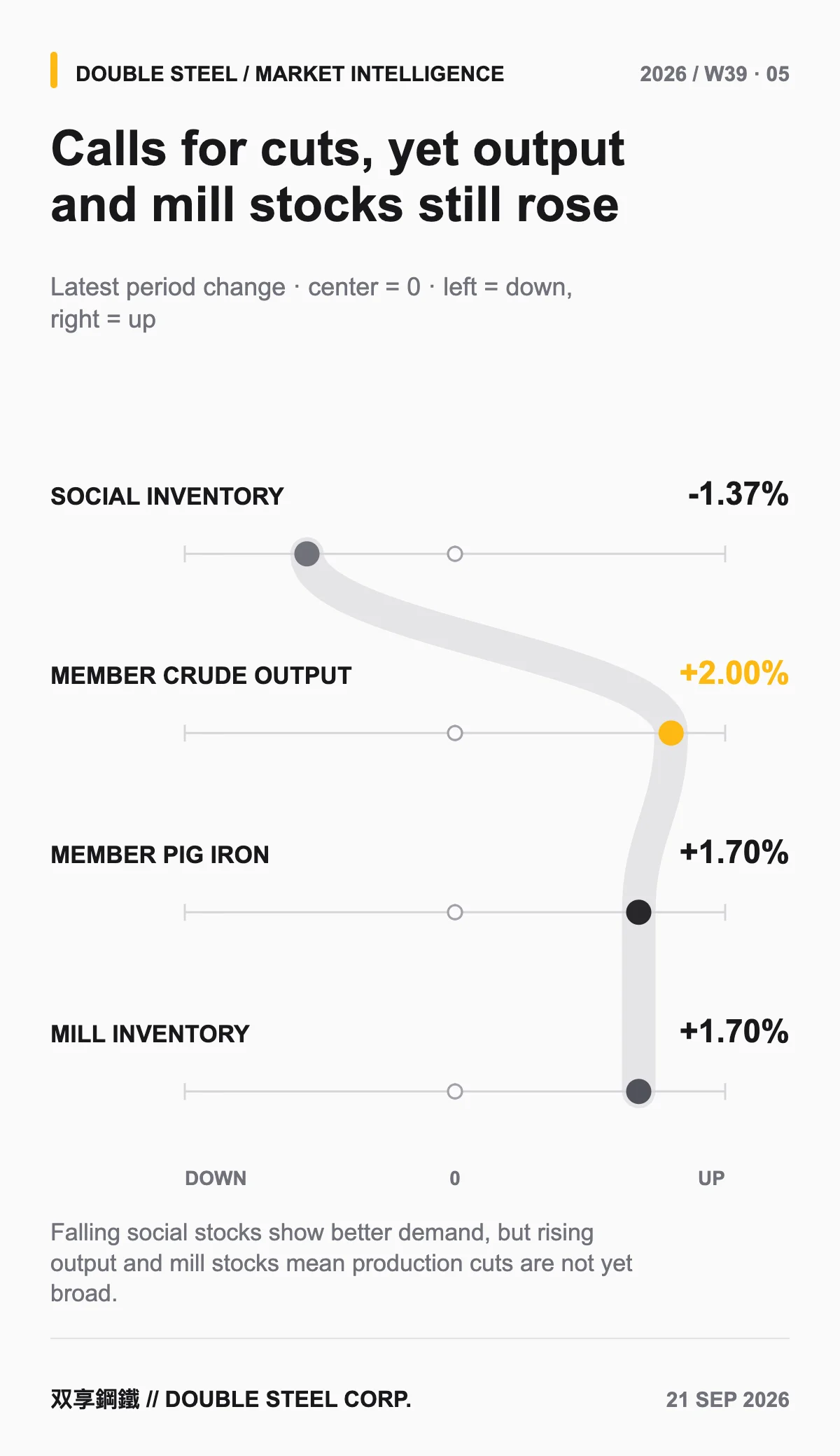
Impact assessment: If end-user demand does not improve further, a sustained increase in steel prices will require actual production cuts. Otherwise, higher mill prices and negotiated spot transactions may continue to coexist.
Asia | Billet and Scrap Remain Elevated, While Buyers Resist Higher Prices
Tradable Asian billet prices were approximately CFR USD 490–495/T, while Japanese and US scrap prices rose together. At the same time, HRC from Chinese private mills remained negotiable near FOB USD 495–500/T, indicating different degrees of support between long-product raw materials and flat-product export prices.
Impact assessment: Import procurement should track tradable prices for billet, scrap, and finished flat products separately. The direction of a single raw material should not be used to estimate all steel product prices.
Global | US Flat-Product Supply Is Tight, While European Demand Remains Weak
US HRC was approximately USD 1,230 per short ton, with limited spot availability and average lead times extending to about 9.1 weeks. Plate lead times increased from 11 to 12 weeks. European HRC buying remained weak, with distribution prices edging lower in northern Europe and holding broadly unchanged in southern Europe.
Impact assessment: Tight US supply can support high-priced export options for Asian mills, but Europe has not experienced a broad demand recovery. The international flat-products market therefore remains regionally divided rather than moving higher in unison.
Key Monitoring Indicators
-
When large Taiwan distributors will clear low-priced rebar inventories at NTD 16,700–17,200/T, and whether NTD 17,300–17,500/T can regain stable transaction support.
-
Whether Feng Hsin and southern mills keep the next rebar offer unchanged or raise it again to reflect scrap and billet costs; actual order volume should be monitored together with the pricing direction.
-
Whether Taiwan HRC at NTD 18,800–19,000/T and pickled coil at NTD 20,100–20,400/T can secure continuous shipment support after Chung Hung Steel's price increase.
-
CSC's official November price adjustment and whether differentiated changes are adopted across HRC, CRC, galvanized steel, wire rod, and bar products.
-
Whether China's social inventories of five major steel products decline for a fourth consecutive week, particularly whether plate and CRC shift from accumulation to destocking.
-
Whether the China Iron and Steel Association's production-control initiative leads to actual declines in daily crude steel and hot-metal output, or remains limited to corporate statements and localized maintenance.
-
Whether coke enters high-level consolidation after the fifth-round increase, and whether weaker post-holiday mill restocking triggers a correction in coal and coke.
-
Iron ore movements within the USD 96–100/T range and whether support fades after pre-holiday restocking ends.
-
The sustainability of US containerized scrap transactions above CFR USD 340/T and whether higher Japanese domestic scrap purchase prices continue to lift Asian export prices.
-
Whether the Taiwan dollar continues to weaken and further amplifies the landed costs of US-dollar-denominated scrap, billet, and flat products.
Conclusion
The key change in W39 is that demand confirmation advanced another step from W38, but the improvement remained uneven. China's social inventories of five major steel products declined again, while destocking broadened from rebar to wire rod and HRC. Taiwan prices for HRC, pickled coil, CRC, and galvanized steel also continued to move higher. However, plate and CRC inventories still increased, Chinese output has yet to decline materially, and transactions at Taiwan mills' new rebar prices remain constrained by lower-priced inventories. This week therefore cannot yet be interpreted as the start of a broad peak season.
Compared with W35–W38, the source of cost pressure shifted from a one-way increase in coal and coke to joint support from HRC, scrap, and the exchange rate. This week's cooling in coking coal and iron ore did not translate directly into lower finished-steel costs in Taiwan. Instead, higher international scrap prices, a weaker Taiwan dollar, and firm billet offers kept electric-arc-furnace and import-based production routes under significant pressure.
The next question is not whether mills still have reasons to raise prices, but whether transactions and inventories can improve together. The market will have the conditions to shift from cost-driven support toward demand-led momentum only if Chinese flat-product inventories begin to decline, actual production contracts, and Taiwan's lower-priced rebar inventories are cleared. Until then, procurement strategies should continue to assess each product, production route, and actual tradable price separately.
Sources: TradingEconomics (iron ore, coking coal, HRC, rebar, international scrap, and USD/CNY, as of September 20, 2026), E.SUN Bank (USD/TWD spot exchange rate, as of September 20, 2026), Mysteel (Tangshan billet, as of September 20, 2026), domestic and international steel news (cross-verified through September 19, 2026), and publicly available information from industry associations (as of September 18, 2026).
This report is published by the Market Research Department of Double Steel Co., Ltd. Its contents are provided solely for market research and procurement assessment and do not constitute a final basis for investment or direct purchasing decisions.